

Contract 2024 Pay Rates
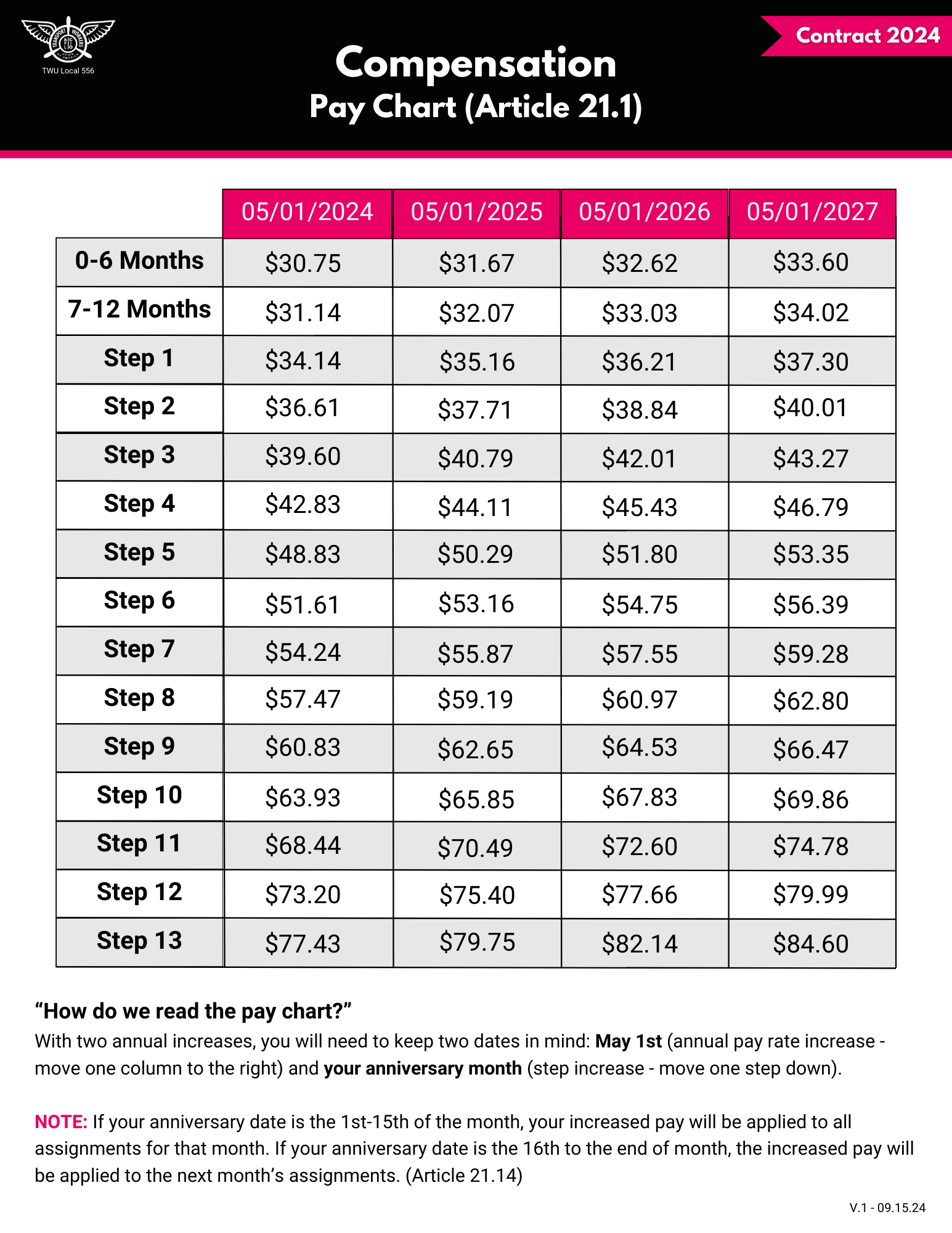
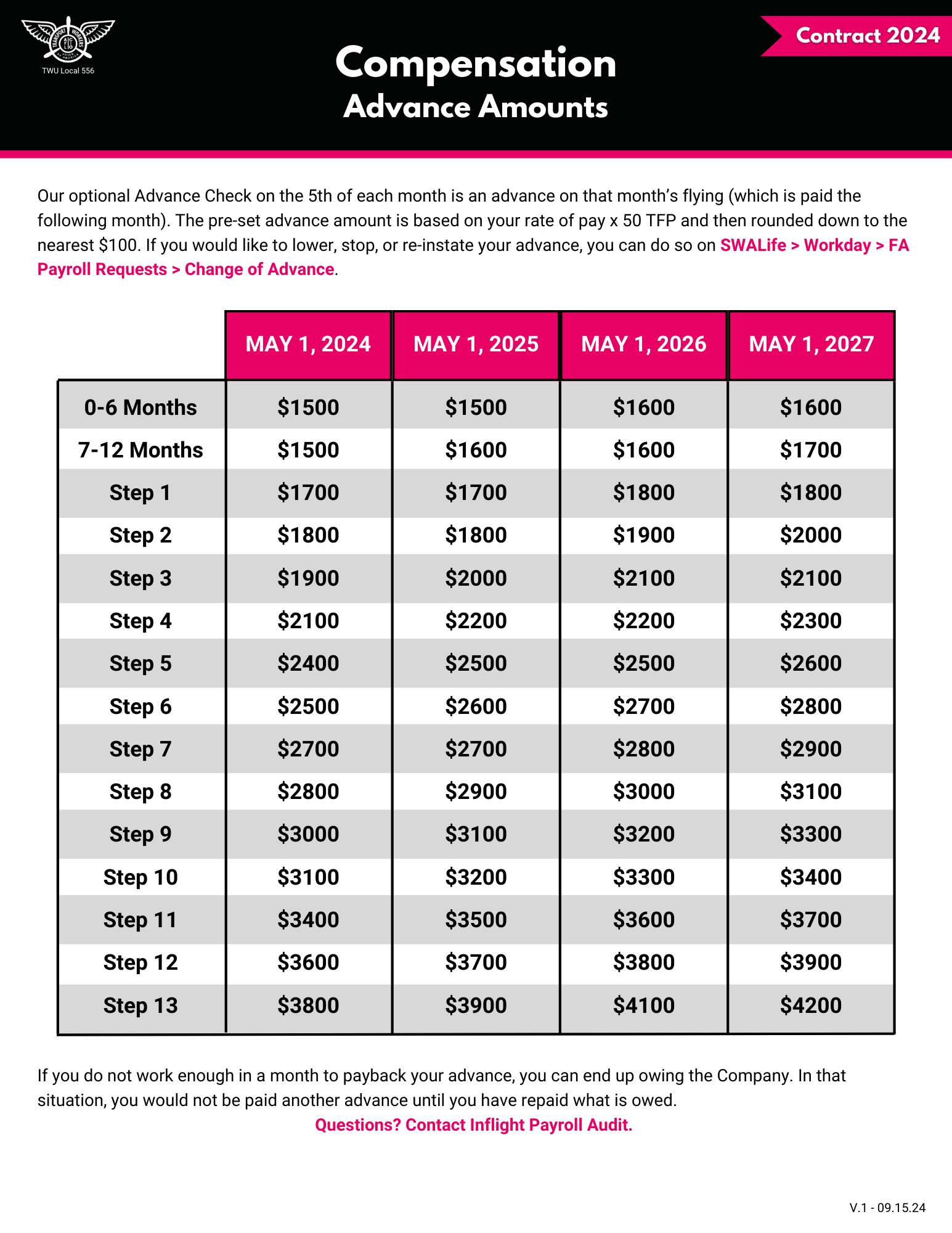
Downloads


Letters of Agreement
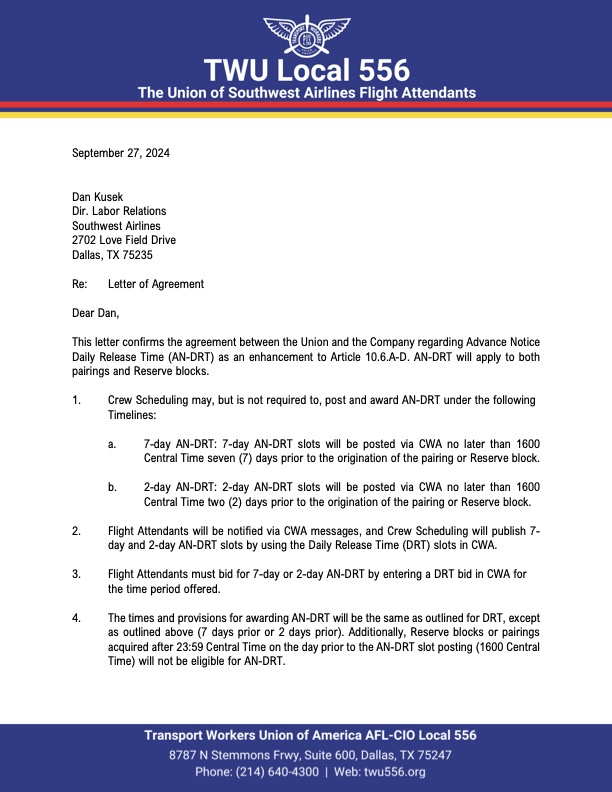
Advance Notice Daily Release Time (AN-DRT)
Contract 2024
PREAMBLE
Preamble
This Agreement is made and entered into by and between SOUTHWEST AIRLINES CO. (hereinafter referred to as the “Company”), and Transport Workers Union of America, AFL-CIO Local #556 (hereinafter referred to as the “Union”) covering those employees employed by the Company in the unit described and certified by the National Labor Relations Board in Case No. 16-RC-6826 on February 5, 1975, and described and certified by the National Mediation Board in Case No. R-7457 on June 28, 2016.
In accordance with the certification (16-RC-6826) made by the National Labor Relations Board on February 5, 1975, and the certification (R-7457) made by the National Mediation Board on June 28, 2016, the Company hereby recognizes the Transport Workers Union of America, AFL-CIO, as the duly designated and authorized representative of the Flight Attendants in the employ of the Company covering rates of pay, rules, and working conditions. The Company recognizes the Union as the exclusive and sole collective bargaining agent for all Flight Attendants.
Pursuant to its certification as a commercial air carrier, the Company hereby recognizes the Union under the provisions of the Railway Labor Act, as amended, for the purposes of the Act and for the bargaining unit specified above.
ARTICLE 1: NONDISCRIMINATION
Nondiscrimination
- No employee covered by this agreement will be interfered with, restrained, coerced or discriminated against by the Company or the Union because of membership in the Union. All employees shall be free to engage in lawful Union activities or to refrain from such activities.
- In accordance with the established policy of the Company and the Union, the provisions of this Agreement will apply equally to all employees, regardless of sex, sexual orientation, gender, gender expression, gender identity, genetic information, medical condition, color, race, creed, age, ancestry, national origin, religion, physical or mental disability, pregnancy, marital status, military and veteran status, or any other legally protected status.
ARTICLE 2 - PURPOSE OF AGREEMENT
Purpose of Agreement
The purpose of this Agreement is, in the mutual interest of the Company and employees to provide for the operation of the services of the Company under methods which will further, to the fullest extent possible, the comfort and well-being of Southwest passengers, the efficiency of operation, and the continuation of employment under conditions of reasonable hours, proper compensation and reasonable working conditions. It is recognized to be the duty of the Company, the employees, and the Union to cooperate fully for the attainment of these purposes.
ARTICLE 3: SCOPE OF AGREEMENT
Scope of Agreement
- The Company hereby recognizes the Union as the exclusive collective bargaining representative of all Flight Attendant employees.
- Employees covered by this Agreement shall be governed by all Company rules, regulations and orders previously or hereafter issued by proper authorities of the Company which are not in conflict with the terms and conditions of this Agreement and which have been made available to the affected employees and the Union prior to becoming effective. The Union shall be advised of any changes in Inflight Operations Department rules, regulations, or orders governing Flight Attendants at least seven (7) working days before such rules, regulations, or orders become effective, unless the parties mutually agree to a shorter advance notification period. This seven (7) working day requirement will not apply where the Company is required by law to make immediate changes or in other emergency circumstances. In addition, the Union will be given at least three (3) working days notice prior to the rules being communicated to the Employees.
- The right to manage and direct the working forces, subject to the provisions of this Agreement, is vested in and retained by the Company.
- This Agreement will be binding upon the parties hereto, their successors, administrators, executors, and assigns.
- Merger, Purchase, or Acquisition of Another Company
In the event of a merger, purchase, or acquisition by the Company of another company, involving that entire company or a substantial portion of that company, the Union and the Company will meet to discuss the impact of the merger, purchase, or acquisition, if any, upon Union represented Employees. The Company will provide the Union with information concerning the proposed merger, purchase, or acquisition at the earliest practicable time, subject to SEC and other applicable laws and regulations, to allow the Union to prepare for those discussions. No confidential business information shall be disclosed unless the Union agrees to suitable arrangements for protecting the confidentiality and use of such information.
- The rates of pay, rules, and working conditions contained in this Collective Bargaining Agreement will not be open for collective bargaining in the event of a merger, purchase, or acquisition of another company, nor will the Union or the Company have any obligation to bargain upon changes thereto, except as provided in Article 37.
- In the event the merger, purchase, or acquisition results in the integration of Flight Attendants, the parties agree to submit to final and binding arbitration by an arbitrator from a list approved by the National Mediation Board any disputes between the Union and the Company not settled in the meetings provided above within six (6) months of the effective date of the merger, purchase, or acquisition which involve integration of the Southwest Flight Attendant Seniority List with the flight attendant seniority list of the company being acquired. The costs of the arbitration will be shared equally by the parties, and there shall be only one such arbitration proceeding which will be the sole and exclusive remedy for all such disputes.
- It is understood that the provisions of this Section shall not apply to the Company’s purchase of another airline or the assets of another airline that does not result in the integration of Flight Attendants.
- Merger, Purchase, or Acquisition by Another Company
In the event of a merger, purchase, or acquisition of the Company by another company, the Union and the Company will meet to discuss the impact upon Union represented Employees of the merger, purchase, or acquisition. The Company will provide the Union with information concerning the proposed merger, purchase, or acquisition at the earliest practicable time, subject to SEC and other applicable laws and regulations, to allow the Union to prepare for those discussions. No confidential business information shall be disclosed unless the Union agrees to suitable arrangements for protecting the confidentiality and use of such information.
- Labor Protection Provisions
In the event of a merger, purchase, or acquisition of the Company by another company in which operational integration of Flight Attendants will occur, the integration of the respective Flight Attendant groups will be governed by Sections 3 and 13 of Allegheny-Mohawk, 59CAB22 (1972). Such integration shall occur in a fair and equitable manner within thirty-six (36) months of the effective date of the transaction. The Flight Attendant employee groups will remain separate until such time as the seniority lists are integrated in accordance with this paragraph.
- Successorship
The Company will not bring a single or multi-step successorship transaction to final conclusion unless the successor agrees, in writing, to:
- Recognize the Union as the representative of the Employees on the Southwest Flight Attendant Seniority List as of the effective date of the transaction consistent with the Railway Labor Act, as amended.
- Assume and be bound by this Agreement.
- Labor Protection Provisions
- Flight Attendant Exclusive Flying
- Cabin passenger service of the Company on all revenue and all miscellaneous flights operated by the Company will be performed only by Flight Attendants whose names appear on the Southwest Airlines Flight Attendant Seniority List.
- There will be no subcontracting of work covered by this Agreement (including wet leases) without prior written agreement from the Union. The Company may, however, enter into and maintain standard industry interline agreements for the accommodation of passengers and/or cargo or mail pursuant to standard industry practices (e.g., overbookings) and for transportation of excess baggage and excess cargo or mail.
- All present and future cabin passenger service of the Company on aircraft operated by the Pilots on the Pilot Seniority List of Southwest Airlines will be performed exclusively by the Flight Attendants on the Southwest Airlines Flight Attendant Seniority List under the terms of this Article and Agreement.
- Codeshare Agreements
- The Company will not enter into any Codesharing Agreement or operate any Codeshare Agreement Flight(s) that violates any of the provisions of this Article and this Agreement.
- “Codeshare Agreement” means an agreement or arrangement between the Company and one (1) or more air carriers under which another air carrier’s flights bear the designator code of the Company or the Company’s flights bear the designator code of the other air carrier, or both.
- “Codeshare Agreement Flight” means a flight of the Company bearing another air carrier’s designator code or a flight of another air carrier bearing the Company’s designator code under a Codeshare Agreement. A flight will be considered a Codeshare Agreement Flight where the flight has codesharing (i.e., a Company flight bearing the other air carrier’s designator code or a flight of the other carrier bearing the Company’s designator code) as published by the respective air carrier to the Official Airline Guide (OAG).
- The Company will negotiate with all codeshare partners Reciprocal Cabin Seat Agreements (RCSA) for the Flight Attendants on the Southwest Airlines Flight Attendant Seniority List.
- The Company will not allow its code to be used on flights of Foreign Air Carriers carrying local revenue passengers or cargo or mail traffic between airports within the United States or its Territories. The Company will not promote or support any change in the laws of the United States that would permit Foreign Air Carriers to engage in cabotage.
- Onboard Sales
Prior to the Company engaging in future product or service sales conducted or transacted by Flight Attendants onboard any aircraft operated by the Company which would affect the ability of Flight Attendants to fulfill their overall duties and responsibilities, the Company agrees to bargain with the Union concerning the terms and conditions of these additional responsibilities.
- Foreign Domiciles
Prior to the Company establishing any Flight Attendant domicile outside of the United States, it shall meet and confer with the Union upon its request and bargain with the Union regarding bidding, relocation expenses, and conditions of employment applicable to the specific situation at least ninety (90) days prior to any bid establishing such domicile. If a Flight Attendant domicile is established outside the United States, Flight Attendants assigned to such domicile shall be covered by this Agreement and shall enjoy all rights of the Railway Labor Act in the same manner as if the Flight Attendants were domiciled within the United States. Disputes concerning SWA Flight Attendants based at a foreign domicile shall be heard by the System Board of Adjustment, as set forth in this Agreement, and the decision of the System Board of Adjustment in such cases shall be enforceable in any court of competent jurisdiction in the United States to the same extent and in the same manner as other cases arising out of interpretation and application of this Agreement. In any proceeding related to the enforcement of the obligations of this paragraph, the Company will not raise non-applicability of the Railway Labor Act as a defense.
- Additional Protections
Any Scope protections not covered by this Agreement which are extended to the Company’s Pilot Union will, if applicable, be automatically offered to the Union. If accepted by the Union, such protections will be incorporated into this Agreement.
- The Company will provide the Union, upon request, with relevant information necessary for enforcement of this Article.
- Subject to the Union’s agreement to comply with reasonable restrictions and rules established by the Company for confidential or proprietary information. The Company will produce such information within two (2) weeks of the request, unless the parties agree that additional time is necessary.
- Remedies
- Except as provided in Section 5.B. of this Article for resolution of disputes involving integration of seniority lists, the Company and the Union agree to arbitrate on an expedited basis as provided for in Article 20.15, any grievance alleging a violation of Sections 5, 6, 7, 8, 9, 10, or 11 (with the exception of A and B) of this Article, unless otherwise mutually agreed by the Company and the Union. The provisions of the Railway Labor Act shall apply to resolution of any dispute regarding this Article.
- Nothing in this Article shall affect any rights and remedies in law or equity as may be available to the parties for enforcement of arbitration awards involving violations of this Article.
ARTICLE 4: STATUS OF AGREEMENT
Status of Agreement
- It is expressly understood and agreed that when this Agreement is accepted by the parties and signed by their authorized representatives, it will supersede any and all agreements existing or previously executed between the Company and any union or individual affecting the employees covered hereunder.
- It is further understood and agreed that all provisions of this Agreement shall be binding upon the successors or assigns of the Company.
ARTICLE 5: DEFINITIONS
Definitions
BID LINE: A planned monthly schedule for a Flight Attendant in her/his domicile awarded through the bid process with specified pairings and intervening scheduled days off.
BLOCK TIME: The time beginning when an aircraft leaves the blocks at the gate under its own power or under tow for the purpose of flight until it blocks in at the gate at the completion of the flight.
COMPANY SENIORITY: The seniority that begins to accrue from the date an employee is placed on the company payroll and shall continue to accrue during the term of employment. Company seniority shall determine vacation time, and all company benefits.
DAILY RELEASE TIME (DRT): The release from a Pairing or Reserve Block without pay that a Flight Attendant may bid and be awarded on a voluntary basis.
DAY OFF: Time free of duty from 0300 to 0259 local domicile time.
DEADHEAD: The transport of a Flight Attendant, at Company request to or from protecting a flight whether scheduled or unscheduled.
DEBRIEF: Thirty (30) minutes immediately after block arrival of the last flight in a duty period or release by Crew Scheduling, whichever is later.
DOMESTIC: Destinations or flying located wholly within the contiguous forty-eight (48) states.
DOMICILE: A location designated by the Company where a Flight Attendant is based. The domicile is referred to by its official airline code.
DOMICILE DAY: A period from 0300 to 0259 local domicile time in the domicile where the pairing originates.
DUTY PERIOD: The period of time commencing from check-in to end of debrief. The duty period does not relate to the 24 hour clock in that the day does not end/begin at 2400.
EXTRA SECTION: Additional flight that is not scheduled and is created to provide additional service and accommodate passengers who cannot be accommodated on a scheduled flight.
FERRY FLIGHT: A flight which does not carry passengers at Company request.
FLIGHT ATTENDANT: A Southwest Airlines employee regularly assigned to flight duty who is responsible for performing, or assisting in the performance of all safety, passenger service and cabin preparation duties and whose name appears on the current Flight Attendant seniority list. Flight Attendants will be responsible for handling passenger carry-on items, as required to secure the cabin for take-off and landing. Flight Attendants will not be responsible for the welfare of any passenger after the Flight Attendant has been released from her/his duties on the aircraft either at the home domicile or on any overnight. Flight Attendants will not be required to perform the work normally assigned to a Cleaner, Provisioner, Ramp, or Operations Agent. Flight Attendants will make a reasonable effort to tidy up the cabin. A Flight Attendant may be required to attend classes, meetings, etc. as are deemed necessary to fulfill FAA requirements and Company and operational requirements, and may be requested to participate in promotional and/or publicity assignments. Whenever the term Flight Attendant is used it will include the female and male gender.
FLOATING VACATION: A week of vacation awarded a Flight Attendant without an actual date assigned.
GROUND DUTY: All work performed on the ground which is directly related to the duties of a flight to which a Flight Attendant is assigned.
HOLIDAYS: Memorial Day, Independence Day, Labor Day, Thanksgiving Day, Christmas Day, and New Year’s Eve.
INFLIGHT DIVERSION: When an aircraft lands at a different airport than the airport to which it was dispatched. The time of the occurrence is the time that the diverted flight originally blocked out.
INTERNATIONAL: Destinations or flying outside the contiguous forty-eight (48) states of the United States, and within the regions of North, Central and South America. “Regions of North, Central and South America” shall mean countries, territories and islands (including Hawaii) within North, Central and South America.
IRREGULAR OPERATIONS: Flights that do not operate in accordance with the published schedule because of circumstances such as weather, maintenance delays, cancellations, crew shortages, misconnects, air traffic control, or similar circumstances within the system, as well as natural disasters, sabotage, hijacking, bomb threat or actual bomb, terrorist attacks, and/or acts of war.
JOB SHARING: When two (2) Flight Attendants voluntarily bid to share one monthly line of time. Each Flight Attendant will be designated a portion of the month for which they will be responsible. The designated off portion of the month will be without pay.
MONTH: The time period of the first day through the last day of each calendar month with the following exceptions:
January 1 - January 30 (January)
January 31 - March 1 (February)
March 2 - March 31 (March)
MONTHLY RELEASE TIME (MRT): A month of no scheduled flying without pay that a Flight Attendant may bid and be awarded on a voluntary basis in her/his domicile.
OCCUPATIONAL SENIORITY: The seniority that begins to accrue from the date a Flight Attendant is placed on the Company payroll as a Flight Attendant from which date seniority shall continue to accrue during the Flight Attendant's period of service.
OPEN TIME: All pairings (or pieces of pairings) that are not covered.
PAIRING: A series of flights which are published by the Company and intended to be flown by a single crew of Flight Attendants.
PREMIUM PAY: Additional compensation that is paid over and above a flight.
REGULATORY REQUIREMENTS (RR) FLIGHT: Any flight to a destination for which passengers and Flight Crews are subject to governmental entry and/or exit requirements.
RESCHEDULE: Any change in a Flight Attendant’s original pairing after check-in caused as a result of irregular operation. A reschedule may include different pairings, partial pairings and additional pairings. A reschedule is not a move up.
RESERVE LINE: A planned monthly schedule for a Flight Attendant in her/his domicile awarded through the bid process with specified days of reserve availability and intervening scheduled days off.
RIG: A Minimum Pay Rule.
SCHEDULE INTERRUPTION POINT (S.I.P.): Anytime the pairing passes through the domicile from which the pairing originated.
SENIOR FLIGHT ATTENDANT: The Flight Attendant who is holding the senior ("A") position on a pairing and is responsible for on board efficiency of all inflight services of all Flight Attendants as well as for all administrative details assigned.
TFP: Trips for pay.
TRIP: When an aircraft takes off and lands; a single takeoff and landing; a single flight (a leg).
UNSCHEDULED DAY: A day off appearing on a line of time.
VOLUNTARY JUNIOR AVAILABLE: A Flight Attendant who signs up on the VJA list for specified flying on days off.
600 SERIES: Three (3) full days of flying with a single deadhead on the fourth day.
900 SERIES: A single deadhead on the first day followed by three (3) full days of flying.
All male or female pronouns used herein shall be deemed and understood to designate any employee hereunder.
ARTICLE 6: SENIORITY
Seniority
- Occupational seniority will be used for all vacation selection, leaves of absence other than medical leaves, reduction in force, return to active status after release due to reduction in force and bidding rights for line of time, reserve, vacation relief, extra sections, charter and other flying.
- New Hire class seniority will be determined in the following order:
- Internal Transfers will be senior to external New Hires;
- Internal Transfers based on Company seniority. If more than one Flight Attendant has the same seniority date, then seniority will be determined by date of birth, with the older being more senior, then;
- External New Hire seniority is determined by date of birth, with the older being more senior.
- The Company will provide a copy of the permanent Flight Attendant Seniority List, revised no more than once each month through electronic means and on paper if requested by the Union, in a place mutually acceptable to the Company and the Union in all Flight Attendant Lounges.
- An employee may protest any omission or incorrect posting affecting the employee's seniority within thirty (30) days after posting of the Seniority List, except that an employee on a leave of absence, vacation, or on an assignment at a location where a roster is not posted shall have thirty (30) days after her or his return to duty in which to file such a request.
- A non-probationary Flight Attendant who has accrued at least one (1) year of occupational seniority as an on line Flight Attendant before transferring to supervisory or other non-flying duties directly related to the Flight Attendant duties shall continue to retain and accrue occupational seniority for a period equal to the greater of three (3) years or the Supervisor's years of accrued seniority as a Flight Attendant. Thereafter, such Supervisor shall retain but not accrue seniority. Such periods of time served as a Supervisor will be cumulative even though such periods of time may not be continuous.
- Inflight Training Supervisors whose duties continue to be directly related to Flight Attendant duties will retain and accrue Flight Attendant occupational seniority. However, in the event an Inflight Training Supervisor elects to accept a position (Training or otherwise) which is not directly related to the Flight Attendant position, or a position whose primary functions are not exclusive to the Flight Attendant position, she/he will forfeit all Flight Attendant occupational seniority.
- Inflight Training Supervisors who perform cross-over training assignments requiring Inflight expertise, such as CRM, will continue those responsibilities without impact to seniority.
- Any Flight Attendant or Supervisor promoted to a Management position above that of a Supervisor, or who transfers to a Management position above that of a Supervisor will immediately forfeit any and all occupational seniority. In addition, anyone hired directly as a Supervisor or to a Management position above that of a Supervisor will not accrue any occupational seniority as a Flight Attendant.
- Except as provided in paragraph 5 above, any Flight Attendant who leaves or voluntarily transfers from being a Flight Attendant will forfeit all occupational seniority unless otherwise mutually agreed in writing by the Union and Company.
- For the purpose of determining domicile assignment when an Inflight Supervisor or Manager returns to active Flight Attendant status, the following will apply:
- For those with occupational seniority:
- She/he will be assigned to the domicile in which she/he was based prior to transferring from the Flight Attendant position, provided she/he would not have been displaced out of that domicile and unable to exercise Right of Return had she/he remained a Flight Attendant in that domicile.
- If she/he would have been displaced out of that domicile, had she/he remained a Flight Attendant in that domicile, the domicile will be assigned based on her/his seniority and current vacancy bid. For example, if a Flight Attendant could no longer hold PHX, which is her/his first choice, and LAS is the second choice, she/he would go to LAS as long as at least one Flight Attendant in LAS is junior to her/him.
- If she/he had Right of Return prior to transferring from the Flight Attendant position, she/he will be placed in the domicile to which she/he had Right of Return if she/he would have been able to return to that base had she/he remained a Flight Attendant. If she/he had Right of Return and would have been unable to return to that domicile, she/he will retain Right of Return to that base upon returning to active Flight Attendant status. She/he will be placed on the Right of Return list based on her/his occupational seniority as of the date she/he returns to the line.
- For those with no occupational seniority:
- The domicile assignments will be made after the vacancy awards are processed for that month.
-
The changes agreed in Article 6, Sections 5 & 6 of the parties’ 2002-2008 Agreement (Blue Book) will apply to Flight Attendants transferring to supervisory or other non-flying duties directly related to Flight Attendants duties, on or after July 30, 2004, which was the date of ratification of the parties’ 2002-2008 Agreement. The seniority of Flight Attendants who have transferred to supervisory or other non-flying duties directly related to Flight Attendants duties, including a Management position above that of Supervisor, prior to the date of ratification of the parties’ 2002-2008 Agreement will continue to be governed by the contractual provisions in effect prior to the date of ratification of the parties’ 2002-2008 Agreement.
Flight Attendants and Inflight Supervisors who transfer to a Management position above that of a Supervisor on or after the date of ratification of the parties’ 2002-2008 Agreement will not retain Flight Attendant occupational seniority.
Her/his domicile assignment will be assigned as if she/he were awarded in the vacancy as a New Hire Flight Attendant for that month.
ARTICLE 7: PROBATION PERIOD
Probation Period
- During the first six (6) months of employment extended by any periods of furlough, suspension or leave(s) of absence, each Flight Attendant shall be on probation.
- The Company shall have the right to discharge, discipline, or furlough any employee during the probation period without cause and without a hearing. Notwithstanding the above, probationary Flight Attendants are entitled to Union representation and the grievance and arbitration provisions in this contract in connection with matters involving wages, hours, and conditions of service, but not in matters involving discipline or discharge. In meetings that involve discipline or discharge with respect to a Probationary Flight Attendant, a Union Representative may, at the request of the Probationary Flight Attendant, be present to act as a non-participating observer. If the Union Representative is unavailable, the Company may, but is not obligated to, delay such meetings.
- All Probationary Flight Attendants will be senior qualified upon the completion of training.
- Probationary Flight Attendants graduating prior to the closing date of Bid Lines as stipulated in Article 10.1.A.2 will participate in the line bidding process for the following bid period.
- Except as set forth in Section 7 below, a Probationary Flight Attendant will be scheduled for time off and assignments prior to the completion of Initial Training as follows:
- She/he will be scheduled for at least five (5) Days Off after Initial Training beginning with her/his Seniority Date (i.e. the Day Off after graduation).
- She/he will be assigned an initial multi-day pairing, from a group of identified pairings, as set forth below:
- The pairings may originate from multiple domiciles, and will be identified after the primary bid lines are awarded and before the secondary lines are published for bidding;
- The pairing may be assigned in the “B”, “C”, or “D” position. A “D” position pairing may only be assigned if that pairing is built with all four positions;
- The pairing may be assigned out of any domicile, excluding Satellite Bases;
- The identified pairings will be assigned in order of class seniority and each Flight Attendant’s Vacancy Bid order; and,
- Only one (1) new hire Flight Attendant may be assigned to the same initial multi-day pairing.
- She/he will be scheduled for at least seventy-two (72) hours off after the scheduled completion of her/his initial multi-day pairing.
- Following the time off in Section C above, she/he may be assigned Junior Reserve blocks in her/his awarded domicile that begin prior to her/his first awarded bid line. Junior Reserve blocks assigned will be of the same type as the published Reserve Lines for that bid period.
- A Probationary Flight Attendant who is unable to work her/his scheduled initial multi-day pairing due to a leave of absence of fourteen (14) days or more, may be assigned another initial multi-day pairing. Should this situation arise, the Probationary Flight Attendant does not have to be scheduled for at least seventy- two (72) hours off after the scheduled completion of this initial multi-day pairing.
- In situations involving extraordinary or emergency circumstance affecting the Company’s ability to cover Open Time, Probationary Flight Attendants may be assigned a pairing from Open Time prior to the completion of Initial Training in any position and without regard to the stipulations in Section 5 above. This pairing will then serve as the Probationary Flight Attendant’s initial multi-day pairing and any previously assigned initial multi-day pairing will be removed and placed in Open Time. The Probationary Flight Attendant will be scheduled for at least seventy-two (72) hours off after the scheduled completion of this new initial multi-day pairing and the beginning of Junior Reserve as stipulated in Section 5.C and 5.D above.
- Probationary Flight Attendants will be awarded straight Reserve in the Line Bidding process throughout her/his Probation Period, with the exception of any month with vacation or if a sufficient number of Flight Attendants satisfy the requirement through the Line Bidding process. A Probationary Flight Attendant who is projected to complete probation in the current bid period will not be required to sit straight Reserve in the following bid period.
- Probationary Flight Attendants may pick up pairings/Reserve blocks following completion of Initial Training, but may not alter (trade or give away) their initial multi-day pairing or any original Reserve blocks through the end of their first full bid period on the line . Probationary Flight Attendants will have full utilization of all provisions in Article 12 of this Agreement except as stated in this Section.
ARTICLE 8: HOURS OF SERVICE
1. Duty Limitations
- The limitations provided for herein will include all flight time when a Flight Attendant is assigned as a crew member on regularly scheduled pairings, deadheads, extra sections, ferry, or charter trips and scenic flights.
- A Flight Attendant shall not be scheduled on an original pairing for more than seven (7) legs in any twenty-four (24) consecutive hours unless broken by crew rest, eleven (11) hours from end of debrief to check-in at an overnight station or eleven and one-half (11:30) hours from end of debrief to check-in at the domicile. In the case of a reschedule situation, a line holder may be rescheduled up to a maximum of eight (8) legs within a twenty-four (24) hour period. Reserve Flight Attendants may be scheduled or rescheduled up to a maximum of eight (8) legs within a twenty-four (24) hour period.
- A Flight Attendant shall not be scheduled to fly more than twenty-eight (28) legs in any seven (7) consecutive days. The Flight Attendant may, at her/his option, fly more than twenty-eight (28) legs in a seven (7) day period provided she/he is not scheduled to do so.
- A Flight Attendant shall not be scheduled to fly pairings totaling more than one hundred thirty (130) trips for pay or ninety (90) legs, whichever is less, in a bid month. A Flight Attendant may, at her/his option, exceed the monthly maximum. For purposes of bidding, Flight Attendants will be paid a maximum of one hundred thirty (130) TFPs for sick leave and medical leave as outlined in Article 10.1.A.7.
- Notification of Flight Status
- The Company will make available via electronic means (text messaging and email) the status of flights for the current day.
- When a scheduled departure is delayed over two (2) hours, or canceled, the Company will notify the Flight Attendant by electronic means (text messaging or email as designated by the Flight Attendant). The Flight Attendant may also contact Crew Scheduling to determine whether to remain at home or the hotel, or proceed to the airport. If the Company fails to notify such Flight Attendant as stated above, each Flight Attendant will be compensated an additional two (2.0) TFP.
- In situations when Crew Scheduling allows a Flight Attendant to remain at the hotel or home, the Flight Attendant’s duty day will not commence until she/he actually reports to the airport as directed by Crew Scheduling. Flight Attendants must remain available (via cell phone or the phone in her/his hotel room) to Crew Scheduling for reschedule. Failure to do so may result in a no-show. If the hotel does not provide transportation, the Flight Attendant will be responsible for payment of any transportation, but should submit receipts for reimbursement.
- If a Flight Attendant(s) is required by Crew Scheduling to remain with an aircraft and/or at the airport for any reason, the Flight Attendant’s duty day will continue until Crew Scheduling releases the Flight Attendant. Should the Flight Attendant encounter an illegal duty day all provisions stated in Sections 2.C of this Article will apply. If Crew Scheduling releases a Flight Attendant for her/his domicile break as stipulated in Section 6.A of this Article, that domicile break will begin thirty (30) minutes after release by Crew Scheduling.
- Each Flight Attendant must have no less than one continuous forty-eight (48) hour period free from all duty within any seven (7) consecutive day period. The seven consecutive days will be domicile days. This forty-eight (48) hour period is calculated from end of debrief to check-in.
2. Duty Period Limitations
- Duty Period Reporting
- An on-duty period shall commence at the time a Flight Attendant is required to report for duty.
- Check-in time at a domicile shall be one (1) hour prior to scheduled departure.
- Check-in time at outstations will be thirty (30) minutes prior to scheduled departure, except check-in will be no more than forty-five (45) minutes prior to scheduled departure for working (not deadheading) Flight Attendants on Regulatory Requirements (RR) flights, 737 MAX 7 (150 seats), or scheduled -800 aircraft.
If the Flight Attendant is required to report to an outstation with the Pilots for a Regulatory Requirements flight, the Flight Attendant’s duty day will commence at the same time as the Pilots’ duty day, if earlier.
- A Flight Attendant is required to be at the aircraft thirty (30) minutes prior to departure, and no more than forty-five (45) minutes prior to departure for working (not deadheading) Flight Attendants on Regulatory Requirements (RR) flights, 737 MAX 7 (150 seats), or scheduled -800 aircraft.
The Company will notify the Union of changes to established check-in times at least ninety (90) days before implementation of the first day of a scheduled bid period. The Company will notify the Flight Attendants via a Read Before Fly (RBF). These established check-in times will be identical in all bases during that bid period. These reporting requirements will be indicated on the Flight Attendant’s pairing display. Check-in times will include appropriate time for Flight Attendants to perform their pre-flight duties prior to the commencement of boarding.
Flight Attendants are responsible for themselves. For the purpose of gate evaluations, the FIDs monitor in the Flight Attendant lounges will serve as the official clock in determining the time for Flight Attendants to be at the gate prior to departure. The Company will allow a three (3) minute grace period to be deducted from the time indicated on the Flight Attendant Lounge FID’s.
- If a Flight Attendant MBL's at the beginning of a pairing, her/his duty day will begin at scheduled check-in time or actual check-in time, whichever is later. In this situation, the Flight Attendant is required to be at the aircraft fifteen (15) minutes prior to scheduled departure for non-Regulatory Requirements (RR) flights and forty-five (45) minutes prior to scheduled departure for Regulatory Requirements (RR) flights. The Flight Attendant is required to confirm her/his arrival at the aircraft by notifying Crew Scheduling, and failure to do so may be treated as a no-show. One such MBL in a calendar quarter shall be non- chargeable as stated in Article 32.
- Check-in times will not be reduced to accommodate contractual crew rest/duty period in domicile. If a Flight Attendant's check-in time is reduced to accommodate crew rest for FAR purposes at an RON, for pay and scheduling purposes the duty period will commence at the scheduled check-in time.
- A Flight Attendant checking in for their initial pairing will be automatically checked in for all subsequent pairings on that same day, provided that the subsequent check-in time(s) is within six (6) hours of the time at which the Flight Attendant checked in for the initial pairing.
The Flight Attendant may contact Crew Scheduling after completion of the first pairing to have the check-in removed from the subsequent pairing(s), provided Crew Scheduling does not have a reschedule for the Flight Attendant at that time. The Flight Attendant will be responsible for checking in again for the subsequent pairing(s) subject to all applicable requirements of the Attendance Policy in Article 32 of the CBA. However, all pairings will still constitute one continuous duty period for FAR purposes.
In accordance with Article 12.13.B, the following applies:
When combining more than one pairing in the same domicile day, Flight Attendant(s) may schedule themselves for more than fourteen (14) hours as long as they are only scheduled to deadhead beyond 13:30 hours from the first check-in.
If Flight Attendant(s) give themselves two (2) hours between pairings and runs late on a subsequent pairing(s) the Flight Attendant will receive straight time unless a subsequent pairing(s) encounters illegalities independent of the combined duty day. Duty periods will not be combinable for determining premium pay for extended duty days. If any pairing(s) runs late into a subsequent pairing(s) and any subsequent scheduled pairing(s) needs to be pulled/rescheduled due to missing the push of a subsequent pairing(s), the Flight Attendant will not suffer a loss of pay. The Flight Attendant will be guaranteed the greater of the sum of the originally assigned pairing(s) or what the Flight Attendant actually flew.
- If a Flight Attendant runs one (1) hour or less late and because of that is not scheduled to receive the “24 in 7” break, the Flight Attendant has two (2) choices:
- Be pulled without pay from enough flights to make her/him legal, as outlined in Section 6.A of this Article; or,
- Agree to adjust her/his report time no later than report time at the aircraft per Section 2.A.1.c of this Article to avoid loss of pay.
- If a Flight Attendant runs more than one (1) hour late and because of that is not scheduled to receive the “24 in 7” break, the Flight Attendant has two (2) choices:
- Be pulled with pay from enough flights to make her/him legal, as outlined in Section 6.A of this Article; or,
- Agree to adjust her/his report time no later than report time at the aircraft per Section 2.A.1.c of this Article and receive time and one half (1.5) for the portion that otherwise would have been pulled.
- Flight Attendants will not be responsible to be in their boarding positions for the outbound flight prior to the scheduled arrival time. However, the Company may reasonably require early boarding under critical circumstances.
- A duty period shall terminate thirty (30) minutes after block arrival of a flight at the home domicile and at an outstation. This thirty (30) minute period after block arrival will be for debrief.
If a Flight Attendant is required to extend their duty period to clear Customs, they may call Crew Scheduling to have their day extended.
- An on-duty period shall commence at the time a Flight Attendant is required to report for duty.
- Duty Period
- Into an RON, a Flight Attendant shall not be scheduled to be on duty for more than eleven (11) consecutive hours (i.e. from check-in to end of debrief).
- Into an RON, a Flight Attendant will not be rescheduled to remain on duty in excess of thirteen (13) hours (i.e. from check-in to end of debrief).
- When returning to domicile, a Flight Attendant will not be scheduled to be on duty for more than ten and one-half (10:30) consecutive hours (i.e. from check-in to end of debrief).
- When returning to domicile, a Flight Attendant will not be rescheduled to remain on duty in excess of twelve and one-half (12:30) hours (i.e. from check-in to end of debrief).
- Notwithstanding the duty limitations contained in this Section B, in the event of an irregular operation a Flight Attendant will be required to remain on her/his pairing even if doing so requires the Flight Attendant to exceed her/his maximum duty hours.
- Extended duty periods will be compensated as follows:
- If a Flight Attendant's duty period exceeds twelve (12) hours the Flight Attendant will be paid for trips flown after the duty period exceeds twelve (12) hours at 2.0 (two) times the applicable trip rate until the Flight Attendant receives legal crew rest. This extended duty day pay will be paid in accordance with Article 21.22.E.2.a.
- If a Flight Attendant's duty period exceeds twelve and one-half (12:30) hours into domicile or thirteen (13) hours into an RON, following the termination of the pairing at the home domicile, the Flight Attendant must have time off equal to double the time spent on duty on the day the duty period exceeded twelve and one-half (12:30) hours into domicile or thirteen (13) hours into an RON.
If the Flight Attendant is scheduled to work, including Recurrent Training (RT), during that time, the Flight Attendant must contact Crew Scheduling within sixty (60) minutes following release of the pairing in order to be pulled from sufficient trips with pay or RT without pay to receive the necessary rest. If the Flight Attendant has RT pulled, she/he must reschedule RT, and upon completion, she/he will be compensated for the completed RT as outlined in Article 21.9. If the Flight Attendant does not call Crew Scheduling, or chooses to attend RT or work those trips which could have been pulled, she/he will be paid at one and one-half (1.5) times the applicable trip rate for all trips flown or attending RT until the necessary rest is received. The Flight Attendant will not be denied her/his choice.
A Flight Attendant entitled to time off due to an illegal duty day and scheduled for a VJA pairing the following day, will be paid VJA pay for all trips pulled. The Flight Attendant may choose to fly the pairing for double time (2.0) for all trips pulled if such trips are FAR legal. The following clarifies what will be pulled with compensation, and the calculation for multiple duty days that exceed twelve and one-half (12:30) hours into domicile or thirteen (13) hours into an RON:
If a Flight Attendant on a multi-day pairing has more than one day over twelve and one half (12:30) hours into domicile or thirteen (13) hours into an RON, she/he will be adjusted as stated herein for each day over twelve and one half (12:30) hours into domicile or thirteen (13) hours into an RON. The Flight Attendant(s) will suffer no loss of pay from the adjustment.
Example: Flight Attendant has a fourteen (14) hour duty day on day one of a three (3) day, and a fourteen (14) hour duty day on day two, the Flight Attendant will be adjusted to fifty-six (56) hours free of duty at the completion of the pairing.
- On the last day of a Flight Attendant’s scheduled pairing, if a duty period exceeds thirteen (13) hours and is projected to exceed sixteen (16) hours, a Flight Attendant may elect to be pulled under the following conditions:
- Must contact Crew Scheduling as soon as possible prior to the pull;
- Pull must occur at a domicile;
- Sufficient Reserves are available;
- Does not cause an unscheduled overnight;
- The pull will be unpaid;
- Return travel will be a must-ride; and
- Returned to their base or home, limited to the Southwest system.
If a Flight Attendant's duty period exceeds sixteen (16) hours, the Flight Attendant will be paid for all trips flown after twelve (12) hours at triple (3.0) times the applicable trip rate until the Flight Attendant receives legal crew rest. This extended duty day pay will be paid in accordance with Article 21.22.E.2.a.
- If a Flight Attendant on a VJA or JA pairing receives an illegal duty day, she/he will be compensated at double time and one-half (2.5) for her/his illegalities. (For example: the Flight Attendant goes over twelve (12:00) hours, the legs involved in the illegality will be paid at double time and one-half (2.5)). This extended duty day pay will be paid in accordance with Article 21.22.E.2.a.
- If a Flight Attendant has an illegal duty day which exceeds twelve and one-half (12:30) hours into domicile or thirteen (13) hours into an RON, Crew Scheduling will adjust the Flight Attendant’s schedule under the parameters stated in Section 2.C above if the following conditions are met:
- The Flight Attendant was already scheduled for her/his affected assignments prior to her/his duty day being posted as greater than twelve and one-half (12:30) hours late into domicile or thirteen (13) hours into an RON; and,
- The Flight Attendant contacts Crew Scheduling within sixty (60) minutes following release of the pairing with the illegal duty day to exercise her/his option as stated in Section 2.C above.
If a Flight Attendant’s duty day is extended beyond twelve and one- half (12:30) hours into domicile or thirteen (13) hours into an RON due to irregular operations, Crew Scheduling will only adjust for double the time off for the illegal duty day if she/he acquired the affected assignment before becoming illegal.
If the Flight Attendant’s scheduled flying was publicly posted to extend her/his duty day beyond twelve and one-half (12:30) hours into domicile or thirteen (13) hours into an RON prior to acquiring the affected assignment, Crew Scheduling will adjust this assignment for FAR purposes only. In this case, any legs pulled due to FARs will be unpaid. In the event that no FAR adjustment is needed and the assignment was picked up while already illegal, then the Flight Attendant will remain on this assignment and is not eligible for any of the options as stated in Section 2.C.2 of this Article.
- LATE RETURN OVERRIDE
A Flight Attendant on the last duty period of an original assignment will be paid one (1) TFP for an actual block in greater than one hundred twenty (120) minutes after the originally scheduled block in. This will be paid above all RIGs. The late return override pay will be paid in accordance with Article 21.22.E.2.b.
3. Crew Rest (Scheduled and Actual)
- A duty period shall run continuously unless broken by an overnight rest period that is scheduled for eleven (11) hours from end of debrief to check-in. Line Holders given an RON in domicile on a scheduled pairing will receive at least eleven (11) hours crew rest from end of debrief to check-in. Line Holders given an RON in domicile on a rescheduled pairing will receive at least ten (10) hours crew rest from end of debrief to check-in.
- A Flight Attendant shall not be required to keep the Company advised of her/his whereabouts during the off-duty periods.
- A Flight Attendant may be contacted only once during crew rest, and must be guaranteed seven (7) consecutive hours of uninterrupted crew rest between block in and block out. If a Flight Attendant is contacted during the crew rest and does not receive seven (7) hours of uninterrupted crew rest, the Flight Attendant will receive one and one-half (1.5) times the applicable trip rate for that assignment until such Flight Attendant receives legal crew rest.
- Only when a pairing already in progress is affected by irregular operations, may a Reserve be assigned that pairing with less than eleven (11) hours from end of debrief to check-in. If the Reserve receives less than eleven (11) hours from end of debrief to check-in crew rest, she/he may only be used a maximum of ten (10) hours the following day. Any Reserve scheduled in this manner will be compensated at two (2.0) times the applicable trip rate until she/he receives legal crew rest (straight time towards monthly guarantee and premium pay above monthly guarantee). Under no circumstances will a Reserve be assigned a pairing with less than FAR minimum rest.
4. RON Hotel Transportation Delays
A Flight Attendant(s) with less than ten and one-half (10:30) hours of consecutive rest from end of debrief to check-in, who experiences circumstances that significantly delay her/his arrival at the RON hotel accommodations, will be responsible to contact Crew Scheduling to advise of the situation. In such situations, Crew Scheduling will make every effort to reschedule another Flight Attendant(s) or assign Reserves to ensure that the Flight Attendant(s) has adequate rest to avoid fatigue.
5. Shortback
A duty period may be broken by a rest period that is scheduled for not less than ten (10) hours from end of debrief to check-in provided the last scheduled flight into the RON city is a terminating flight and the first scheduled flight out of the RON city is an originating flight. This will be considered a shortback. The following duty limitations shall apply to a shortback
- No more than two (2) legs back to the home domicile may be scheduled following the rest period.
- Maximum duty time for a Flight Attendant the following day after an RON crew rest that is scheduled for less than eleven (11) hours from end of debrief to check-in shall be no more than four (4) consecutive hours.
Shortbacks will only be allowed on pairings constructed entirely of Domestic flights.
6. Domicile Break
- A Flight Attendant holding a regular line of time will have a minimum eleven and one-half (11:30) hours scheduled break between pairings (from end of debrief to check-in) at the home domicile unless she/he elects otherwise. If eleven and one-half (11:30) hours is scheduled and the Flight Attendant does not receive at least ten and one-half (10:30) hours domicile break from end of debrief to check-in, the Flight Attendant's schedule will be adjusted to provide eleven and one-half (11:30) hours domicile break from end of debrief to check-in. The Flight Attendant will not suffer a loss of pay as a result of such schedule adjustment. Check-in times will not be reduced to accommodate domicile break.
- If a Flight Attendant adjusts her/his schedule and allows a domicile break of less than eleven and one-half (11:30) hours from end of debrief to check-in between pairings and the last flight of the first pairing is more than one (1) hour late, she/he will be adjusted back to the original amount of time the Flight Attendant gave her/himself between pairings. At no time will the Flight Attendant be allowed to adjust her/his schedule below eleven (11) hours of rest from end of debrief to check-in, except as stipulated in Article 12.1. The Flight Attendant will not suffer a loss of pay as a result of such schedule adjustment.
- The Flight Attendant may elect to fly pulled trips, if legal by FARs, for one and one half (1.5) times the applicable trip rate, unless otherwise specified in this Article.
7. FAR Pulls
- A Flight Attendant scheduled for the ten (10) hours from end of debrief to check-in minimum break or the ”24 in 7” regulation who is late more than one (1) hour due to reroute, company convenience, weather, passenger delay, etc., will be pulled and paid due to FAR regulation from enough flights to make them legal. If they are one (1) hour or less late, the Flight Attendant will be pulled for the FAR regulation, without pay, from enough flights to make them legal.
- This language currently exists for Contract legalities as well as pickup language. In cases of recovery, Crew Scheduling will ensure that the Flight Attendant is recovered at the earliest point possible to reduce the loss of pay to the Flight Attendant. In FAR pulls without pay, the dead head flights will be compensated. In FAR pulls with pay, the deadhead flights will not be compensated except when the deadhead exceeds the trips pulled ( i.e., pulled from two (2.0) TFP for legality, deadhead is for two and one-half (2.5) TFP, the Flight Attendant would be compensated for the two and one-half (2.5) TFP).
- When it is necessary for Crew Scheduling to adjust a report time for FAR purposes, Crew Scheduling will notify the Flight Attendant(s) of the legal check- in time.
8. Red Eye or Night Flight Service
For purposes of this article, a ”Red Eye” flight is any flight, excluding charters, that is originally scheduled to operate between or across 0200 and 0400 local time in either the departure or arrival city.
The maximum duty period for a Flight Attendant working a Red Eye or Night Flight will be ten (10) hours from check-in to end of debrief.
$1.00/TFP will be applied to Red Eye or Night Flights.
No Flight Attendant shall be scheduled to work additional flights in a Red Eye duty period should the additional flight be scheduled to depart after 0400 local time. A Flight Attendant may be scheduled to deadhead to an overnight or back to domicile after completing the Red Eye flight.
Within six (6) months of the DOR of this agreement, the Union and the Company will convene to discuss the following topics including, but not limited to, pairing construction, line construction, reserve line construction, reschedules and fatigue mitigation. Additional contractual provisions will be codified in a letter of agreement. At least ninety (90) days prior to any bid containing Red Eye pairings, the Company will notify the Union in writing.
9. Daylight Savings Time
On the first day each year that Daylight Savings Time goes into effect, Flight Attendant rest and/or duty schedules will be adjusted, if necessary, to ensure that Flight Attendants receive the eleven (11) hours crew rest from end of debrief to check-in or eleven and one-half (11:30) hours from end of debrief to check-in domicile break specified in this Article.
10. FAA Minimum Crew Exemption
The Company agrees to meet with the Union as soon as practicable to discuss Flight Attendant procedures and the expedited implementation of such procedures, in order to provide relief in the event:
- The exemption is not extended
- The FAA mandates amendments to the exemption that would materially affect the current exemption
- The exemption is revoked for any reason
11. Meal and In Flight Rest Break
- While on duty, Flight Attendants are permitted to take uninterrupted Crew breaks. Flight Attendant breaks may be utilized as a simple rest and/or meal break period. In order to ensure that Safety and Service are not compromised, the ability to take and/or length of coordinated Cabin Crew breaks is contingent upon the duration of flight/duty time.
- Rest breaks should not exceed fifteen (15) minutes in length while meal breaks may be up to thirty (30) minutes. In addition, the following criteria must always be met to protect the Safety and Hospitality of any flight:
- Coordination with Cabin Crew occurs prior to taking a break;
- Levels of snack and beverage Service specific to the flight are not compromised;
- All passenger requests continue to be met by those not on break; and,
- All applicable policies and procedures contained within the Flight Attendant Manual are adhered to by the Flight Attendants without interruption.
- The Company and the Union will meet to determine solutions for food availability while on duty.
ARTICLE 9: ADDITIONAL FLYING
Additional Flying
All open flying will be placed into Open Time for more than a few minutes prior to being assigned to a Reserve to fly and will be assigned/self-assigned to Reserves in the following manner:
1800 Local Time: Senior AM Reserves (SAR) may begin self-assigning pairings originating at or before 0959 Local Time.
1830 Local Time: Junior AM Reserve (JAR) may begin self-assigning pairings originating at or before 0559 Local Time.
1900 Local Time: Crew Scheduling may begin assigning pairings originating at or before 0959 Local Time.
2200 Local Time: Senior PM Reserves (SPR) may begin self-assigning pairings originating at or after 1000 Local Time.
2230 Local Time: Junior PM Reserve (JPR) may begin self-assigning pairings originating between 1000 and before 1159 Local Time.
2230 Local Time: Junior Late Reserve (JLR) may begin self-assigning pairings originating between 1500 and before 1659 Local Time.
2300 Local Time: Crew Scheduling may begin assigning pairings originating at or after 1000 Local Time.
Once the open flying has been assigned or self-assigned to a Reserve Flight Attendant, it will be immediately removed from Open Time.
For the purpose of trading with Open Time, pairings may be dropped into Open Time until 2300 Local time for all trips originating at or before 0959 Local time the following day, and until 0300 Local time for all trips originating at or after 1000 Local time of the same day. Unless assigned to a Reserve, Flight Attendants may pick up Open Time until two (2) hours prior to scheduled check-in; however, a Flight Attendant may contact Scheduling to pick up an assignment with a report time of less than two hours (2). If there is an insufficient number of Reserves, VJA will be offered. If there is insufficient time to assign a Reserve, the Company will utilize reschedules or move ups.
Flight Attendants will have the option to self-notify unconfirmed assignments via electronic means while off-duty. While on duty, once a Flight Attendant has been notified of a change in assignment, the Flight Attendant is required to utilize the system to acknowledge changes.
1. Voluntary Junior Available (VJA)
Crew Scheduling will notify Flight Attendants via the system of pairings available for VJA. Should there be multiple methods of notification, the Flight Attendant will have her/his choice of method. Flight Attendants may pick up pairings available for VJA from Open Time on a first-come, first-served basis. Crew Scheduling will determine, on an as-needed basis, the specific number of pairings to be covered through VJA. Crew Scheduling may restrict the pairings offered for VJA to pairings of a specified length and/or to pairings that originate at or before 0959 Local Time, or at or after 1000 Local Time. When Crew Scheduling offers a pairing(s) for VJA on a specific day(s), all pairings in Open Time for that domicile that meet the restrictions above will also be offered for VJA on that day(s). Crew Scheduling may discontinue offering VJA at any time based on the needs of the operation. Crew Scheduling may assign Reserve Flight Attendants and Reserve Flight Attendants may self-assign while VJA is being offered, provided such assignment takes place after the time periods stated above.
- Flight Attendants will be compensated at a minimum rate of time and one-half for the accepted assignment.
- No VJA will be compensated at less than five (5.0) TFP or one and one-half (1.5) times the applicable trip rate, whichever is greater.
2. Junior Available
- Junior Available (JA) -- A Flight Attendant who is required to work an assignment on her/his unscheduled day. Such assignment must be legally scheduled.
- The monthly seniority list must be used and the most junior qualified, available Flight Attendant who is completely legal for the trip will be assigned.
- If there is no such Flight Attendant available, Crew Scheduling will start over, and contact the most junior Flight Attendant who requires the least amount of future trips to be pulled to be made legal for the JA trip to be assigned.
- No JA’ing will be allowed between domiciles. Flight Attendants will not be required to check-in out of her/his domicile unless agreed to by the Flight Attendant.
- The Company will adhere to all contractual legalities when assigning a Flight Attendant a JA assignment including legal bid line combinations and those stipulated in Article 8.
- Flight Attendants may be assigned for JA duty by the following methods of contact only:
- Telephone contact at the Flight Attendant’s primary telephone number. Flight Attendants must provide their primary number to Crew Scheduling.
- In person only by members of Crew Scheduling or Inflight Management in the Flight Attendant’s domicile lounge or a training facility.
- After a Flight Attendant’s pairing is in progress.
- A Flight Attendant cannot be contacted for JA duty more than twenty-four (24) hours before the scheduled flight or reserve duty period for which she/he is needed.
- The Company shall have the right to assign the Junior Available Flight Attendant to all regular and extra section trips and charters operated to which positions are not filled from the Reserve Flight Attendant pool or VJA but only in compliance with the rules listed below. A Flight Attendant who is called as a JA and flies as such shall be compensated either by pay and days off as follows:
- If the Flight Attendant elects pay, such Flight Attendant shall receive 1.5 times the appropriate trip rate for all trips flown as a JA or for trips from which the Flight Attendant was pulled at one (1.0) times the trip rate, whichever is greater. In no event will the Flight Attendant be compensated for fewer trips than immediately prior to being JA’d.
- If the Flight Attendant elects to receive days off as compensation, such Flight Attendant shall receive days off of her/his choice to give such Flight Attendant days off equal in number to those on the Flight Attendant’s scheduled line immediately prior to being JA’d.
- If, as a result of being JA’d, such Flight Attendant has more days off than scheduled immediately prior to being JA’d, such Flight Attendant will be entitled only to receive pay as compensation for the JA.
- The choice of days off or pay will be made within sixty (60) minutes following release of the pairing for which the Flight Attendant was JA’d.
- A Flight Attendant having to sit JA Reserve shall be paid for one (1) trip at the appropriate pay for her/his current monthly bid she/he flies, whichever is greater, for each three (3) hours she/he sits JA Reserve. In computing the time such Flight Attendant is on JA Reserve, over one and one-half (1½) hours shall count as a full three (3) hours and one and one-half (1½) hours or less shall not count, but the Flight Attendant will be guaranteed one (1) standard trip pay. For any fractional time over three (3) hours, a Flight Attendant will be paid at a rate of 1.3 trips pay for each additional hour which will be computed to the nearest hour. If a Flight Attendant does not fly, the Flight Attendant will be paid the appropriate trip rate for her/his current bid month position.
- When a Flight Attendant is called as JA on her/his scheduled day off and she/he reports sick at that time, such Flight Attendant will not be charged with a sick day but such Flight Attendant may be required to produce verification of her/his illness. If the Flight Attendant produces a doctor’s statement dated within forty-eight (48) hours of the JA call, and submits it prior to departure of her/his next scheduled trip, no points will be charged under the Attendance Policy.
- No JA will be compensated less than six and one-half (6.5) TFP or one and one-half (1.5) times the applicable trip rate, whichever is greater.
- A Flight Attendant who drops vacation overlap trips cannot be JA’d during the days dropped.
3. Reschedule
Rescheduling can occur as the result of irregular operations (see definition of irregular operations in Article 5). Rescheduling is any change of flying assignment made after check-in for the Flight Attendant’s original pairing, including different pairings, partial pairings or additional pairings other than a move up.
- Rescheduling requiring an entire crew will be made based upon availability and legality of the crew.
- Rescheduling requiring less than an entire crew will be assigned in reverse order of seniority regardless of whether a crew shares the same pairing number(s). If a Reserve is a member of the crew, the Reserve must be used prior to the rescheduling of a bid line holding Flight Attendant. However, a more senior member of that crew may choose to accept the reschedule in order of seniority.
- If it is determined, prior to push of a first working leg of an -800 Only Pairing in all four (4) positions, that a smaller aircraft (downsized aircraft) will be used for that flight, and all duty periods in “D” position for that pairing are cancelled without reschedule, the “D” position Flight Attendant will be sent home or allowed to remain at home and paid cancellation pay.
- If the entire Crew will be working/deadheading on a smaller aircraft (downsized aircraft) (crew not split in reschedule, three (3) Flight Attendants will be working and one deadheading on the exact same flight(s)), the deadheading position will be assigned to the “D” position Flight Attendant.
- Flight Attendants will be paid her/his actual or scheduled flying, whichever is greater over the life of the pairing for the number of day(s) the Flight Attendant was originally scheduled to work.
A Flight Attendant will be paid a premium of one and a half (1.5) times the applicable trip rate when she/he is rescheduled to a later release time than was originally scheduled for her/his last day of the pairing. This Last Day Late Premium (LDLP) will be paid for all legs on that day which block-in after the originally scheduled block-in time and were not included in the original pairing. This premium (LDLP) will be paid above all RIGs, VJA, and JA, but will not be paid when the extended duty period premiums in Article 8.2.C.1 and 8.2.C.3 & 4 apply. A Flight Attendant who is rescheduled to a later release will be entitled to additional protections outlined in Article 33.3.A.
- If the reschedule results in flying more than scheduled, the flying above scheduled will be paid at time and one-half; or
- If the reschedule results in more days of flying, the Flight Attendant will be entitled to receive premium pay of time and one-half (1.5) for all trips flown above schedule plus a RIG of one trip for each three (3) hours from block in at the overnight city until thirty minutes after block arrival back in domicile and a day off with pay or one and one half (1.5) times the applicable trip rate for trips that otherwise would have been pulled must be made within sixty (60) minutes following release of the rescheduled pairing. The Flight Attendant will have the ability to exercise these options via the system. Any day off with pay chosen must be the first or last day of an assignment and the Flight Attendant will suffer no loss of pay from the adjustment. Deadhead flights for recovery purposes will not be compensated, except when the deadhead exceeds the trips pulled. If a Flight Attendant elects to fly pulled trips and is on a VJA or JA pairing, this premium will be paid in addition to other applicable premiums. The Company will return the Flight Attendant to the home domicile at the earliest possible time (as published in the flight schedule).
To avoid an unscheduled RON, a Flight Attendant may, at their option, elect to take a deadhead to their home domicile, designated residence in a Southwest city, or the closest Southwest city to the Flight Attendant's designated residence that exceeds the duty period limitations set forth in Article 8. The Flight Attendant will receive all applicable contractual provisions and premiums calculated per the deadhead to their home domicile.
In the event a Flight Attendant does not have another pairing or Reserve day(s)/block in the current month, the Flight Attendant may elect to take the compensatory day(s) in the next bid month (provided the lines have been loaded).
If a Flight Attendant becomes stranded or is sent on an unscheduled RON during a Reserve assignment and in the event the Flight Attendant does not have any Reserve day(s) remaining in the current bid month, the Flight Attendant may elect one of the following:
- Be pulled from a Reserve day(s) in the next bid month (provided the lines have been loaded), or,
- Be compensated at double time (2.0) above her/his guarantee for all flight(s) flown or credited on the unscheduled day as outlined in Article 11.12.B.
If the deadhead(s) scheduled for a Flight Attendant to return to her/his home domicile as stated in 3.E above, creates reduced crew rest below the FAR ten (10) hours from end of debrief to check-in, the Flight Attendant will have the option to take a later deadhead(s) of her/his choice, but with no increase in pay. The Flight Attendant must notify Crew Scheduling of her/his choice. Any deadhead(s) will be Must-Ride.
- For purposes of calculating the RIG referenced in 3. E above, one (1.0) TFP will be credited for each three (3) hour period or fraction thereof. The RIG will be calculated to two decimal places, rounded by standard convention.
- If a Flight Attendant is rescheduled into compensatory days that were previously chosen by the Flight Attendant, then she/he will receive another day(s) off to compensate for the original choice(s) and the option in 3.E above for the new unscheduled RON. The compensatory days must be consecutive and must be at the beginning or ending of an assignment.
- Flight Attendants are eligible for reschedule during vacation, reserve and vacation overlap when they make themselves available by picking up from Open Time or a line holder.
- Excluding delayed flights, if a Flight Attendant is originally scheduled to release in domicile by 0259 Local Time, and is rescheduled to an assignment scheduled to release in domicile at or after 0300 Local Time, the following will apply:
- Any flight(s) scheduled to depart at or after 0300 Local Time will be paid according to Article 9.3.E.
- The Flight Attendant will receive a RIG of one trip for each three (3) hours calculated from 0300 Local Time until thirty (30) minutes after block arrival back in domicile and a day off with pay in accordance with Article 9.3.E.
If a Flight Attendant is originally scheduled to release in domicile at or after 0300 Local Time, paragraph 3.E above would apply if she/he is rescheduled to return to domicile after 0259 Local Time the following day.
4. Stranded
- If a Flight Attendant(s) is stranded due to irregular operations, she/he will be compensated time and one-half (1.5) for all trips flown above schedule plus a RIG of one (1) trip for each three (3) hours from block in at the overnight city until thirty (30) minutes after block arrival back in domicile, and a day off with pay or the Flight Attendant may elect to fly pulled trips for one and one half (1.5) times the applicable trip rate for trips that otherwise would have been pulled. The choice of day(s) off with pay or one and one half (1.5) times the applicable trip rate for trips that otherwise would have been pulled must be made within sixty (60) minutes following release of the rescheduled pairing. The Flight Attendant will have the ability to exercise these options via the system. Any day off with pay chosen must be the first or last day of an assignment and the Flight Attendant will suffer no loss of pay from the adjustment. Deadhead flights for recovery purposes will not be compensated, except when the deadhead exceeds the trips pulled. If a Flight Attendant elects to fly pulled trips and is on a VJA or JA pairing, this premium will be paid in addition to other applicable premiums.
- If a stranded Flight Attendant is not needed to work a flight(s) back to her/his domicile, she/he will be returned to her/his home domicile at the earliest possible time (as stated in the published flight schedule).
If the deadhead(s) scheduled for a Flight Attendant to return to her/his home domicile creates reduced crew rest below the FAR ten (10:00) hours from end of debrief to check-in, the Flight Attendant will have the option to take a later deadhead(s) of her/his choice, but with no increase in pay. The Flight Attendant must notify Crew Scheduling of her/his choice. Any deadhead(s) will be Must-Ride.
To avoid being stranded and with the exception of Section 9.4.C below, a Flight Attendant may, at their option, elect to take a deadhead to their home domicile, designated residence in a Southwest city, or the closest Southwest city to the Flight Attendant’s designated residence that exceeds the duty period limitations set forth in Article 8. The Flight Attendant will receive all applicable contractual provisions and premiums calculated per the deadhead to their home domicile.
- If a stranded Flight Attendant(s) is needed to work a flight(s) back to her/his domicile, she/he must have the FAR minimum crew rest of ten (10) hours from end of debrief to check-in and will be compensated at two and a half (2.5) times the applicable trip rate for all flights that day.
5. Vacation and Reschedule/Stranded
In the event a Flight Attendant experiences an unscheduled RON as a result of a reschedule or being stranded on a pairing that originally did not cross over/encroach into her/his scheduled vacation the provisions in 9.3.E and 9.4 will apply. If a reschedule requires less than an entire crew which results in an unscheduled RON, a Flight Attendant with scheduled vacation, starting the following day, will not be assigned the unscheduled RON.
6. Move Up
Move up will occur at check-in when a Flight Attendant is moved up to cover a pairing that originates prior to the Flight Attendant’s original pairing. A move up will be requested of the Flight Attendants having like pairings in order of seniority and assigned in reverse seniority. In determining like pairings, Crew Scheduling will first consider pairings with an equal number of days, then pairings with more days and finally pairings with fewer days.
- Flight Attendants will be paid her/his actual or scheduled flying, whichever is greater over the life of the pairing for the number of day(s) the Flight Attendant was originally scheduled to work.
- If the move up results in flying more than scheduled, the flying above schedule will be paid at time and one-half; or
- If the move up results in more days of flying, the Flight Attendant will, at her/his option, be entitled to a day off without pay in lieu of time and one-half pay. The choice of days off or pay must be made at completion of the move up.
- If a move up results in more day(s) of flying and falls into compensatory day(s) that were previously chosen by the Flight Attendant, then she/he will receive another day(s) off to compensate for the original choice(s) and the option in Paragraph 2 above for the new move up. The compensatory days must be consecutive and must be at the beginning or ending of an assignment.
7. General
The Company will meet with the Union at least once per calendar quarter to review and discuss reschedules and stranded issues. The Company will consider recommendations from the Union regarding stranded and rescheduling processes.
ARTICLE 10: SCHEDULING/BIDDING
1. Bidding
The following are procedures for bidding:
- LINE/PRIMARY BIDS
- Bids must be posted via electronic means by no later than noon central time on the 2nd of each month.
- Bids will close on the 5th at noon central time. No bids will be accepted after the posted closing date and time.
- When the Seniority List is incomplete, resulting in a need for an adjustment, the Company will advise the Union of the situation.
- Bids will be awarded in order of seniority. A Flight Attendant who fails to submit a bid, or who does not bid enough lines, will be assigned the first available bid line or reserve slot in accordance with her/his seniority after the bid awards are completed.
- Bid results will be posted by noon central time on the 6 th via electronic means. Bid results are not final until the end of bid line protest.
- Flight Attendants must protest bid results by noon central time on the 7th. Any bid protest which changes the bid results will be corrected and the new bid results will be posted via electronic means.
- A Flight Attendant may submit a “Request for Pay on Leave” form for pay purposes when it is known to Crew Planning prior to the awarding of bid lines that she/he will be absent for the entire month as a result of medical leave, FMLA due to her/his own illness, or maternity leave, and is eligible for accrued sick leave or vacation(s). For other than vacation, Flight Attendants may indicate how many trips they wish to be paid from their accumulated sick leave bank up to one hundred thirty (130.00) TFP, provided such Flight Attendant has sufficient trips in her/his accumulated sick leave bank.
- A Flight Attendant who, due to inactive status is not able to participate in the bidding process must contact Crew Planning within two (2) business days of returning to active status or within two (2) business days after successfully completing her/his required training necessary to gain active status, whichever is later, to have a line built. Those Flight Attendants required to complete Recurrent Training in order to gain active status will be given two (2) business days beginning the following day after Recurrent Training is completed. In order for a Flight Attendant to bid, and be awarded a line for the next month, the Flight Attendant must have a return to work date processed on or prior to the fourth (4th) of the current month. If the Flight Attendant submits a return to work statement to the Company on the fifth (5th) of the current month, she/he will need to contact Crew Planning to determine whether she/he wants to bid. A Flight Attendant cannot bid if she/he has not successfully completed FAA required training.
- Crew Planning will build the Flight Attendant a comparable line (of what she/he could have held based upon her/his seniority), if Open Time is available. (For example: comparable pairings will be considered 3-day for 3-day on the same days of the week, but not an AM for AM nor PM for PM)
- If comparable pairings are not available, the Flight Attendant has the option to build her/his own schedule or she/he may request Crew Planning to build a Reserve line.
- If a Flight Attendant builds her/his own schedule, there are no minimum trips that must be picked up.
- If the Flight Attendant does not contact Crew Planning within the two (2) business day required window, Crew Planning may, but is not required to, build the Flight Attendant a line of time from any pairings available in Open Time based on line construction guidelines as stated in Article 28 of this Agreement.
- If the Flight Attendant is unable to bid due to inactive status, and calls when the Crew Planning office is open to have a line built prior to noon (1200) Central Time on the 11th of the month, the Flight Attendant will have two options:
- The Flight Attendant will give the Crew Planner her/his choice(s) of pairing length and start date for a comparable line. Crew Planning will record the choices and, after VR lines are built, build the Flight Attendant a comparable line with open time in accordance with Article 10.1.A.8.a-c. Crew Planning will build and/or release the line for the following month prior to the start of Reserve bidding at noon (1200) Central Time on the 11th. It is understood Crew Planning will need a reasonable amount of time to build and/or release the line for the following month if the Flight Attendant calls on the 11th prior to noon (1200) Central Time.
For example, if the Flight Attendant calls Crew Planning at 1150 Central Time on the 11th of the month, Crew Planning may not have enough time to build and release the line by noon (1200) Central Time. In such cases, Crew Planning will complete the process of building and/or releasing the line no later than 1800 Central Time on the 11th of the month.
- The Flight Attendant may elect to call back during Crew Planning's business hours any time between noon (1200) Central Time on the 11th and the end of the month to have her/his line built for the following month. This option will allow the Flight Attendant to select specific comparable pairings (if available). If the Flight Attendant does not call back, Crew Planning may exercise the option outlined in Article 10.1.A.8.d.
- The Flight Attendant will give the Crew Planner her/his choice(s) of pairing length and start date for a comparable line. Crew Planning will record the choices and, after VR lines are built, build the Flight Attendant a comparable line with open time in accordance with Article 10.1.A.8.a-c. Crew Planning will build and/or release the line for the following month prior to the start of Reserve bidding at noon (1200) Central Time on the 11th. It is understood Crew Planning will need a reasonable amount of time to build and/or release the line for the following month if the Flight Attendant calls on the 11th prior to noon (1200) Central Time.
- If the Flight Attendant is unable to bid due to inactive status and calls when the Crew Planning office is open to have a line built between noon (1200) Central Time on the 11th of the month and the end of the month, Crew Planning will follow the process outlined in Article 10.1.A.8.a-c.
It is understood if the Flight Attendant calls when the Crew Planning office is closed, she/he may be required to call back when the office is open to have a line built.
It is also understood that a Flight Attendant will not be able to participate in Trip Trade/Giveaway until her/his line is built and/or released.
- RESERVE/SECONDARY BIDS
- Reserve Bids will be posted for bid via electronic means no later than noon central time on the 11th of each month.
Reserve bids will consist of Vacation Relief Lines and Reserve Lines. To the maximum extent possible, Vacation Relief Lines will consist of all one position: A, B, C or D.
- Reserve bids will close no later than noon central time on the 14th.
- Reserve bids will be awarded in order of seniority. A Reserve Flight Attendant who is awarded a Vacation Relief Line will be treated as a regular bid line holder for the month, but the month will count toward such Flight Attendant's reserve requirement.
- Reserve bid results will be posted by noon central time on the 15th of each month via electronic means. Flight Attendants may call their supervisor to determine reserve bid results. Reserve bid results are not final until the end of the reserve bid protest.
- Flight Attendants must protest Reserve bid results by noon central time on the 16th. Any protest which changes the Reserve bid results will be posted via electronic means.
- Reserve Bids will be posted for bid via electronic means no later than noon central time on the 11th of each month.
- CHARTER BIDS
- Charters will be posted via electronic means as soon as the Company receives the information. The Charter posting will include: pairing number, specific flight number(s) and city pair(s), date of check-in, and trips for pay. Work orders will be made available via electronic means. If a Charter is not posted as outlined above, up to three (3) Flight Attendant(s) (or four (4) Flight Attendants as required by aircraft type) that have protested the Charter and could have held the Charter and legally flown it, will be compensated the applicable pay for that Charter.
Charter bids must contain the following information to be valid bids:
- Flight Attendant's name, employee number and domicile. The charter number, bid position, domicile of charter and date the charter departs.
- Bids for Charters on different days must be submitted on separate Charter bids. Charter bids must be submitted via electronic means.
- Charter bids will close at noon central time the day prior to the departure of the Charter.
- If a Charter is modified during the bidding timeframe (prior to closing), as outlined in Article 10.1.C.2, it will be cancelled by the Company, and a new Charter with a new pairing number will be created when the modification results in:
- an earlier check-in;
- later end-of-debrief time; or
- c. change in the number of duty periods
- If one of the above modifications occurs, the following will apply:
- Flight Attendants who submitted a bid for that respective Charter will be sent a cancellation notice in the form of a CWA message. This notification will be sent as soon as possible, once Crew Scheduling is made aware of the cancellation of the original Charter.
- The newly created Charter will be posted electronically via CWA and will be made available for bidding as outlined in Article 10.1.C.
- If a Charter is modified after it has been awarded, but prior to the end of the protest period as outlined in Article 10.1.C.11:
- Notification will only be required if the modification results in an earlier check-in.
- The Company must attempt to reach the Flight Attendant by calling her/his primary and secondary phone numbers listed in CWA. The awardees will have two (2) hours from the time Crew Scheduling placed the call to exercise her/his option to keep the Charter or have it removed without compensation. If the Flight Attendant does not return the call within the specified timeframe above, she/he will be responsible for working the Charter.
- Modifications that result in a later check-in and/or end-of-debrief, or change in the number of duty periods will be compensated pursuant to Article 9.3.E.
- The point for determining the legality of a Flight Attendant, for the purpose of awarding a Charter, will be calculated based on their legality at the time that a Charter bid is closed. At the time of closing a Charter, if the Flight Attendant is illegal, she/he will not be awarded the Charter.
- Charters will be awarded in order of domicile seniority.
- Out of Base Charter bids will only be awarded after domicile seniority bids and will be awarded in order of bid submission, not by seniority order.
- A Flight Attendant who bids a Charter with at least the FAR ten (10) hours from end of debrief to check-in between the Charter and her/his next assignment will not be denied the Charter award based on a potential FAR illegality. When a Flight Attendant who was awarded a Charter becomes FAR illegal for that Charter, the Flight Attendant will be pulled from that Charter in accordance with Article 8.7 of this Agreement.
- Charter bid results will be posted via electronic means no later than two (2) hours after the charter bids close. All Charter awards will be placed on the Flight Attendants’ computer display screens.
- Charter protests must be made no later than 1800 Central time the day prior to the departure of the Charter. At 1900 Central time, the Charter will be considered as a final award.
- Charters cannot be traded or given away.
- At 1901 Central time, any unbid Charters will immediately be placed into Open Time and made available for pickup by Flight Attendants on a first come, first served basis up to three (3) hours prior to check-in.
- A Charter will only be assigned to a Reserve three (3) hours prior to check-in.
- Charters which become available after noon central time on the closing date will be considered Late Notice charters and will be bid as follows:
- Late Notice Charters will be posted via electronic means. Flight Attendants may call Crew Scheduling and list themselves for the available Late Notice Charters.
- These charters will close no later than 1800 central time the day prior to the departure of the charter. Charter awards will be posted within one (1) hour after the bids close. All Late Notice Charter awards will be placed on the Flight Attendants’ computer display screens.
- At 1901 Central time, the Late Notice Charter will be considered as a final award.
- Late Notice Charters cannot be traded or given away.
- These charters will be awarded in order of domicile seniority. Out of Base Charter bids will only be awarded after domicile seniority bids and will be awarded in order of bid submission, not by seniority order.
- Results will be posted via electronic means. It is the Flight Attendant’s responsibility to check the Late Notice Charter Bid results.
- Beginning at 1901 Central time, the Late Notice Charter positions not bid will immediately be placed in Open Time for pick up by a Flight Attendant on a first-come, first-served basis. A Late Notice Charter will only be assigned to a Reserve three (3) hours prior to check-in.
- Operational orders for Charters must be posted with duties expected and flight schedules.
- Any Charter flown will be compensated as a Charter.
- Charters will not be rebuilt to accommodate individual Flight Attendants unless the Company is in a VJA or JA situation, or the Charter is assigned to a Reserve.
- Charter extended duty day premium pay will be paid as follows:
- If a Flight Attendant is awarded a Charter that was built up to twelve (12:00) hours, and she/he runs more than one (1:00) hour late over twelve (12:00) hours, the Flight Attendant will be compensated for trips flown after the duty period exceeds twelve (12:00) hours at triple time (3.0) for all Charter flights and double time (2.0) for all deadhead(s) or ferry flights. If the Flight Attendant exceeds sixteen (16:00) hours, the Flight Attendant will be compensated for trips flown after the duty period exceeds twelve (12:00) hours at triple time and one-half (3.5) for all Charter flights and triple time (3.0) for all deadhead(s) or ferry flights. All other provisions of Article 8.2.C will apply.
- If a Flight Attendant is awarded a Charter that was built greater than twelve (12:00) hours but no more than twelve and one-half (12:30) hours, and she/he runs more than one (1:00) hour late, the Flight Attendant will be compensated at triple time (3.0) for all Charter flights and double time (2.0) for all deadhead(s) or ferry flights that exceed the scheduled duty period by at least one (1:00) hour. If the Flight Attendant exceeds sixteen (16:00) hours, the Flight Attendant will be compensated for trips flown after the duty period exceeds twelve and one-half (12:30) hours at triple time and one-half (3.5) for all Charter flights and triple time (3.0) for all deadhead(s) or ferry flights. All other provisions of Article 8.2.C will apply.
- If a Flight Attendant is awarded a Charter that was built over twelve and one-half (12:30) hours, and she/he runs more than one (1:00) hour late over sixteen (16:00) hours, the Flight Attendant will be compensated for trips flown after the duty period exceeds sixteen (16:00) hours at triple time (3.0) for all Charter flights and double time (2.0) for all deadhead(s) or ferry flights.
- All VJA and JA provisions apply to Charters. A Flight Attendant who receives a Charter through VJA/JA will be paid double time (2.0) for the Charter legs and time and one half (1.5) for the ferry and deadhead flights, except as stated above.
- Charters will be posted via electronic means as soon as the Company receives the information. The Charter posting will include: pairing number, specific flight number(s) and city pair(s), date of check-in, and trips for pay. Work orders will be made available via electronic means. If a Charter is not posted as outlined above, up to three (3) Flight Attendant(s) (or four (4) Flight Attendants as required by aircraft type) that have protested the Charter and could have held the Charter and legally flown it, will be compensated the applicable pay for that Charter.
2. Submitting Bids
- During the bid period specified on the cover sheet, each Flight Attendant shall submit her/his bid to the Inflight Crew Planning Department via electronic means.
- All Flight Attendants will bid for positions flown on the aircraft. The "A" Flight Attendant will be primarily responsible for the forward 1/3 of the aircraft, the "B" Flight Attendant will be primarily responsible for the aft 1/3 of the aircraft, and the "C" Flight Attendant will be primarily responsible for the center 1/3 of the aircraft. If the aircraft is a -800, the “A” Flight Attendant will be primarily responsible for the forward ¼ of the aircraft, the “B” Flight Attendant will be primarily responsible for the rear ¼ of the aircraft, the “C” Flight Attendant will be primarily responsible for the second ¼ of the aircraft, and the “D” Flight Attendant will be primarily responsible for the third ¼ of the aircraft.
-
Buddy Bidding. Flight Attendants may buddy bid (double and triple), which must be indicated on the bid submitted. When submitting a buddy bid through the Company’s electronic bidding system, one (1) Flight Attendant involved in a buddy bid must submit a bid with the following information correctly completed:
Flight Attendant names, employee numbers, seniority numbers, and position preferences of the Flight Attendants involved in the buddy bid. Seniority number is found on the monthly seniority list for the bid period.
The Flight Attendants who wish to buddy bid will be bidding at the seniority of the most junior Flight Attendant. If the Flight Attendants do not bid enough lines to hold as a buddy bid, the line bids will be awarded separately at the lower seniority number. If each Flight Attendant did not bid enough lines, the Flight Attendants will be assigned according to their seniority, after all other bids are awarded. Probationary Flight Attendants may not buddy bid, Job Share, Time Away Program (TAP) or MRT.
- Bid Cover sheets will reflect the number of available MRTs and Job Shares, if any. Bid sheets will provide slots for Job Shares, buddy bidding, name, seniority number, and desired position.
- The cover sheet of the bid packet will reflect the following dates:
- When Line Holder Bids are posted, closed, bid results, and protest ends.
- When Reserve bids are posted, closed, bid results and protest ends.
- When Recurrent Training or any other required training bids will be posted, closed and dates awarded or assigned.
- The deadline for overlap adjustments (Line Holder and Reserve).
3. Job Sharing
Job Sharing occurs when two (2) Flight Attendants elect to share one line-of- time. Both Flight Attendants will bid at the higher seniority level and each will be paid at her/his appropriate pay level. Job Sharing bids will be awarded in order of seniority. A Flight Attendant may not Job Share during a vacation or Reserve month or until she/he is off probation except as stated in Article 18. Each month the Company will calculate and post in the bid packet the approximate number of Job Share bid lines which will be available in each base. Flight Attendants Job Sharing will continue to receive all Company benefits.
- JOB SHARE BID
Only active Flight Attendants who are assigned to the same base and who want to share a line may bid for Job Share flying. A Job Share Bid will be awarded at the more senior Flight Attendant’s seniority number. Any un-bid Job Shares will not be assigned. Flight Attendants will bid as follows:
- When submitting a Job Share bid through the Company’s electronic bidding system, one (1) of the two (2) Flight Attendants bidding for Job Share will submit a bid, noting a desire to Job Share, which must include the following information:
- The names of each Flight Attendant bidding the Job Share;
- Employee numbers;
- Seniority numbers (the seniority numbers will be found on the monthly Seniority List for the bid period); and
- Base.
- A Flight Attendant from each pair of Flight Attendants bidding for a Job Share slot will submit her/his bid at the time monthly bids are submitted via electronic means.
- Flight Attendants desiring to Job Share should submit her/his bid with bid lines and positions through the junior Flight Attendant’s seniority.
- If the Flight Attendants do not bid enough lines to hold as a Job Share or are unable to hold a Job Share, the bids will be awarded separately at the respective Flight Attendants’ seniority levels. If a Flight Attendant did not bid enough lines, she/he will be assigned according to seniority, after all other bids are awarded.
- If either Flight Attendant is required to fly Reserve for the month, then both Flight Attendants will be deemed as unable to hold a Job Share, and the Flight Attendant not required to fly Reserve will be treated as stated above in Section 4.
- The two (2) Flight Attendants awarded a bid line for Job Sharing will split such bid line. Each Flight Attendant will be responsible for a minimum of fifteen (15) days of the schedule to be broken into two (2) sections for flying. The first section will be assigned to the Flight Attendant indicated as number one (1) on the bid and she/he will be responsible for all pairings scheduled the first fifteen (15) days of the bid period. The second section will be assigned to the Flight Attendant indicated as number two (2) on the bid and she/he will be responsible for all pairings scheduled the second fifteen (15) or sixteen (16) days of the bid period depending on whether the month has thirty (30) or thirty-one (31) days.
- The Flight Attendant awarded the first section of flying will be responsible for any pairing that flies into the second section of the Job Share month.
- The Flight Attendant awarded the second section of flying will be responsible for any pairing that flies into the new bid month except as stated in Article 10.
- Job Share Flight Attendant(s) may only work, trade, pick up or giveaway pairings or pieces of pairings that check-in within her/his awarded section of the month. However, all Flight Attendants must be available for all mandatory training for the entire month. In case of an extraordinary or emergency circumstance affecting Company operations, Job Share Flight Attendants may be allowed to fly during their half-month of scheduled non-flying, on a voluntary basis.
- The Company will offer a minimum of one percent (1%) of the total number of bid lines for each base for Job Sharing, unless exigent circumstances require a temporary reduction or temporary suspension of the program. The Union will be notified no less than seven (7) days in advance of the nature of the exigency and the anticipated time frame of the temporary reduction or temporary suspension.
- Only during a month in which the Company offers at least one percent (1%) of the total number of bid lines for each base as Job Sharing bid lines, the Company may also offer Daily Release Time (DRT) without pay, and/or Monthly Release Time (MRT) without pay for Flight Attendants.
- A Flight Attendant may not Job Share more than three (3) months during any calendar year except as stated in Article 18. Flight Attendants may bid on a contingency basis to exceed this three (3) month limitation, if there are Job Share slots unawarded.
- When submitting a Job Share bid through the Company’s electronic bidding system, one (1) of the two (2) Flight Attendants bidding for Job Share will submit a bid, noting a desire to Job Share, which must include the following information:
4. Time Away Program
The Time Away Program (TAP) will allow the Company to offer and award two or three consecutive months of no scheduled flying without pay that a Flight Attendant may bid and be awarded on a voluntary basis in her/his domicile. The Company may offer TAP in any domicile or satellite base.
-
Time Away Bid and Award
- TAP awards must be completed before Primary Bid Lines are published for bid.
- TAP slots will be awarded in Flight Attendant base seniority order.
- A Flight Attendant may not bid for a TAP slot until she/he is off probation except as stated in Article 18.
- A Flight Attendant on a leave of absence will not be awarded TAP.
-
General
- A Flight Attendant awarded TAP must be available for all mandatory training during that time period.
- A Flight Attendant may not trade or give away their awarded TAP slot.
- A Flight Attendant may be allowed to fly during her/his TAP on a voluntary basis only in the event of extraordinary or emergency circumstances affecting Company operations.
- A Flight Attendant may not draw from her/his sick bank during a TAP unless she/he called in sick for a pairing that overlapped into the TAP.
- Flight Attendants awarded TAP will remain on active status and will continue to receive all Company benefits.
- A Flight Attendant awarded a TAP slot who is scheduled to work a pairing that overlaps into the TAP slot is responsible for the overlapping pairing.
- A Flight Attendant may be awarded a TAP slot during her/his vacation month.
- Time Away will only be offered in months when the Company offers a minimum of one percent (1%) of the Bid lines in each base as Job Shares.
- The provisions of Monthly Release Time (MRT) stated in Article 10.5.C of the CBA will apply to Flight Attendants during bid months for which Time Away has been awarded.
5. Monthly Release Time (MRT)
Monthly Release Time (MRT) is a month of no scheduled flying without pay that a Flight Attendant may bid and be awarded on a voluntary basis in her/his domicile. MRT slots may be offered during the Primary and Secondary Line bidding processes; however, MRT slots may only be offered in the Secondary Line bidding process if MRT has been offered in the Primary Line bidding process. Flight Attendants in a Reserve month may only be awarded an MRT slot in the Secondary Line bidding process, if available. Flight Attendants awarded MRT during a Reserve month will retain credit (*) for the Reserve line. MRT slots will be awarded in Flight Attendant base seniority order. A Flight Attendant may not bid for an MRT slot until she/he is off probation except as stated in Article 18. MRT slots will only be offered when the Company offers a minimum of one percent (1%) of the Bid lines in each Base as Job Shares. Flight Attendants awarded MRT will continue to receive all Company benefits.
-
Monthly Release Time (MRT) Slot Bid
- MRT slots, when available, will be listed on the cover letter of the monthly Primary and Secondary bid packets. Flight Attendants will submit a bid, noting a desire to MRT by placing the letter “M” as a bid choice on her/his monthly bid along with the other requirements as listed in Section 2. of this Article. Un-bid MRT slots will not be assigned.
- All Flight Attendants bidding for a MRT slot will submit her/his bid at the time monthly Primary and Secondary bids are submitted via electronic means. A Flight Attendant may only be awarded MRT three (3) times during a calendar year. Flight Attendants may bid on a contingency basis to exceed this three (3) month limitation, if there are MRT slots unawarded.
- Flight Attendants may not Job Share a MRT slot; however, when submitting a bid for MRT, she/he may also submit a bid to Job Share with another Flight Attendant.
-
Monthly Release Time (MRT) Slot Award
- Awards will be closed as stated in Section 1.A and 1.B of this Article.
- If a Flight Attendant bidding a MRT slot is not senior enough to hold one, the Flight Attendant’s bid will be closed as stated in Section 1.A and 1.B of this Article.
- A Flight Attendant awarded a MRT slot will be scheduled off for the Bid month without pay, except that she/he must be available for all mandatory training for the entire month. In case of an extraordinary or emergency circumstance affecting Company operations, MRT Flight Attendants may be allowed to fly during her/his month off on a voluntary basis. A Flight Attendant may not draw from her/his sick bank during a MRT month unless she/he called in sick for a pairing that overlapped into the MRT month.
- If a Flight Attendant bidding for MRT believes the results to be in error, she/he will be entitled to the protest procedures as stated in Section 1.A.6 and 1.B.5 of this Article.
-
General
- A Flight Attendant awarded a MRT slot in the new Bid month who is scheduled to work a pairing that overlaps into the MRT month is responsible for the overlapping pairing.
- A Flight Attendant awarded a MRT slot may not trade or give away the slot to another Flight Attendant. All MRT awards are final except as stated in Section 5.B.3 of this Article.
- A Flight Attendant may be awarded a MRT slot during her/his vacation month and will be compensated 3.75 TFP per day during the MRT month.
6. Daily Release Time (DRT)
Daily Release Time (DRT) is the release from a pairing or Reserve block without pay that a Flight Attendant may bid and be awarded on a voluntary basis. All Flight Attendants (Line holders and Reserves) will be allowed to bid for a DRT when available; however, Probationary Flight Attendants will not be able to participate until after ninety (90) days from their Inflight date of hire/occupational seniority date. On the first three days of a bid period and the last day of a bid period, the Company may award DRT for Reserve blocks. DRT slots will be awarded in Base seniority order, followed by all out-of-base requests. Out-of-base requests will be closed in overall Flight Attendant seniority. DRT slots will only be offered when the Company offers a minimum of one percent (1%) of the Bid lines in each Base as Job Shares. DRTs will be determined based on daily staffing needs in each Base, and un-bid DRT slots will not be assigned. Flight Attendants awarded DRT will continue to receive all Company benefits.
-
Daily Release Time (DRT) Bid
- Any DRTs available for bid will be posted electronically. The minimum number of DRT Slots will be posted no later than 1600 Central time the day prior to the origination of the Pairing or Reserve Block for the day that the Flight Attendant is requesting. Postings, if available, will be made each day.
- A Flight Attendant bidding for DRT will submit her/his bid electronically.
- Each bid must contain the following information:
- The Flight Attendant’s Employee #.
- The pairing or reserve block from which the Flight Attendant wishes to be released.
- A Flight Attendant may only request to be pulled from her/his entire pairing or Reserve Block; partial requests will be denied. A Flight Attendant who has given part of her/his pairing or Reserve block away may request to be pulled from the remainder of the pairing or Reserve block.
- Should a Flight Attendant wish to cancel her/his bid after submission, she/he must submit a cancellation no later than 1700 Central time the day prior to the origination of the pairing or Reserve block.
-
Daily Release Time (DRT) Award
- DRT awards will be made available no later than 1800 Central time the day prior to the origination of the pairing or Reserve block. The DRT awards will be posted electronically.
- Flight Attendants bidding for DRT are responsible for checking the DRT results. If a Flight Attendant bidding for DRT believes the results to be in error, she/he may contact Crew Scheduling no later than 2300 Central time the day prior to the origination of the pairing or Reserve block to protest the results. If due to Company or Computer error, a protest is deemed valid, the Flight Attendant(s) will be awarded a DRT slot for the Pairing or Reserve Block specified on the original bid.
- DRT slots may not be traded or given away, and only in the event of extraordinary or emergency circumstances affecting Company operations, a Flight Attendant may be allowed to fly during DRT time off on a voluntary basis.
- When a Flight Attendant is awarded DRT, all assigned pairings originating the day of the award will be pulled without pay.
-
Secondary Daily Release Time (SDRT)
After the DRT awards are processed, Crew Scheduling will evaluate the operation and assess the ability to offer up to the same number of SDRT slots as were offered in DRT. The SDRT slots offered can be specific to assignment length. These slots will be posted by electronic means no later than 0400 local domicile time. A Flight Attendant may request to be released from an assignment up to three (3) hours prior to departure on a first-come, first-served basis.
Reserves may request to be released prior to being called for an assignment or prior to self-assignment. Reserves who receive SDRT after the commencement of their on-call status will be released from the Reserve block without pay.
Probationary Flight Attendants will not be able to participate until after ninety (90) days from their Inflight date of hire/occupational seniority date.
-
DRT OVERLAP
- Lineholder to Lineholder - A Flight Attendant awarded DRT for a pairing at the end of the current month that overlaps into the new month will be pulled from the entire pairing. Should an overlap adjustment be required, it will be made in the new month prior to the DRT award; therefore, the Flight Attendant will not revert back to the original pairing day(s) pulled for overlap in the new month.
- Lineholder to Reserve - A Flight Attendant awarded DRT for a pairing at the end of the current month that overlaps into the new month will be pulled from the entire pairing. Should an overlap adjustment be required, it will be made in the new month prior to the DRT award; therefore, the Flight Attendant will not revert back to the original Reserve day(s) pulled for overlap.
-
Reserve to Lineholder - A Flight Attendant awarded DRT for a block of day(s) at the end of the current month will have no Reserve obligation carry over into the new month. Should an overlap adjustment be required, it will be made in the new month prior to the DRT award; therefore, the Flight Attendant will not revert back to the original pairing day(s) pulled for overlap in the new month.
If a Flight Attendant DRT’s her/his pairing in the new month, the Reserve day(s) RON obligation at the end the current month may require the Flight Attendant to be available for duty during the awarded DRT day(s) in the new month.
- Reserve to Reserve - A Flight Attendant awarded DRT for a block of Reserve day(s) at the end of the current month will be obligated to sit Reserve day(s) at the beginning of the new month, unless they have been adjusted for overlap, given away, or awarded as a DRT. The Flight Attendant will not revert back to the original Reserve day(s) pulled for overlap in the new month. All original Reserve days that run consecutive will be considered as one DRT for the purpose of awarding a DRT.
- A Lineholder or Reserve may pick up on any off days, including day(s) pulled for overlap, except for those day(s) that have been designated as a DRT award.
- Picked up or traded Reserve day(s) will not be combined with an original block of Reserve day(s) for a DRT award.
- All picked up and/or traded Reserve day(s) that run consecutive will be considered as one DRT for the purpose of awarding a DRT
7. Vacation Adjustment
Vacations must be adjusted within the bid protest time period to allow maximum trips to be placed on reserve lines and in open time. A Flight Attendant wishing to slide her/his vacation for the next month to fly a pairing that would otherwise be pulled must call Crew Planning no later than the end of bid line protest. If the Flight Attendant does not adjust her/his vacation within the time limits, Crew Planning will pull all original crew pairings which overlap into and/or out of the vacation week(s). Should a problem arise during the bid protest period concerning a line change that affects a vacation holder due to scheduling error, the above time limits will be waived and the Flight Attendant will be allowed to adjust her/his vacation by the first of the month.
8. Rebid/Bidding Timeframe Extension
Where there is a published schedule change or extenuating circumstance(s), which affects a majority of the Flight Attendants, there may be a rebid or extension of bidding timeframes upon written agreement between the Company and the Union.
9. Recurrent Training and Company Required Training
- After lines of time are awarded, the Company will post a list of recurrent and/or Company required training dates and the number of Flight Attendants who can be accommodated on each date.
- Recurrent Training bids must be posted via electronic means by no later than noon Central time on the 11th of each month.
- Recurrent Training bids will close on the 17th at noon Central time. No bids will be accepted after the posted closing date and time.
- Recurrent Training bid results will be posted by noon Central time on the 18th via electronic means.
- The Flight Attendants will state her/his preferences for a training date. To the extent possible, the Company will honor the preference bid on a seniority basis. Seniority may be overruled to accommodate bid vacation or a Flight Attendant in a training grace period due to circumstances beyond the control of the Company.
- A Flight Attendant, unable to attend Recurrent Training in her/his designated month due to a leave of absence, will be allowed to attend Recurrent Training the month prior to or the month following the designated month, and she/he will be awarded Recurrent Training after all bids have been awarded.
- After Recurrent Training dates have been awarded, unassigned Recurrent Training dates, if any, will be placed in Recurrent Training Open Time on the 18th of the month by 1800 Central time and made available for trade by those due to attend Recurrent Training and for pickup by those wanting to attend Recurrent Training the month prior to their designated month. Flight Attendants may trade or pickup Recurrent Training in any domicile.
- Any pickup or trade must be completed by noon (1200) local time the day prior to the class.
- Out of base pickups and trades will be permitted at noon Central time on the 27th of the month prior.
- Flight Attendants who pick up Recurrent Training in the month prior to their designated month and do not receive eleven (11) hours crew rest, from end of debrief, prior to training due to irregular operations may choose to be pulled from training without pay. Flight Attendants who choose to be pulled from training to receive eleven (11) hours crew rest from end of debrief are responsible for rescheduling their training day with the training division. Flight Attendants who attend training without receiving eleven (11) hours crew rest from end of debrief will not be paid a premium.
- A Flight Attendant’s designated month will not be adjusted for the following year as a result of that Flight Attendant picking up Recurrent Training in the month prior to her/his designated month.
- Recurrent training and Company required training will be treated as a contractually legal duty day. Crew rest of eleven (11) hours from end of debrief to start of training and eleven (11) hours from end of training to check-in must be scheduled. If a Flight Attendant is pulled from any trips to schedule this crew rest, trips pulled will be paid by the Company. A Flight Attendant at her/his option may waive the crew rest above and will be paid at time and one-half (1.5) for the training day. A Flight Attendant may waive her/his crew rest above; however, she/he will not be reduced below ten (10) hours from end of debrief to start of training or ten (10) hours from end of training to check-in. The Company will not schedule a Flight Attendant for any required training that brings her/him below minimum days off or reduces the 48 in 7 domicile break. Should this situation arise, the Company will pay time and one-half (1.5) for training or give the Flight Attendant a choice of her/his day off. The choice of a day off must be made by the completion of the required training.
- Flight Attendants not receiving eleven (11) hours crew rest from end of debrief, prior to training due to irregular operations may choose to be pulled from training, or may attend for double time as long as she/he is not reduced below the ten (10) hour FAR rest. Flight Attendants who choose to be pulled from training to receive crew rest of eleven (11) hours from end of debrief to start of training are responsible for rescheduling their training day with the training division. Recurrent training must be scheduled within the FAA requirements to remain legal.
- A Reserve Flight Attendant will not be assigned recurrent training or any Company required training on a scheduled day off if the training day would bring them below the contractual minimum days off. If a Reserve Flight Attendant bids to attend training on an off day, and is awarded that day, the training will be paid above her/his guarantee. If a Reserve Flight Attendant bids to attend training only on scheduled reserve days, the training pay will be applied to her/his guarantee.
- Any distance learning/computer-based training required to be completed on an annual basis prior to training will be made available in the month prior to the Flight Attendant’s designated month. Any distance learning/computer-based training required to be completed on a quarterly basis will be made available for at least ninety (90) days.
10. Overlap
An overlap occurs when a Flight Attendant has a contract and/or FAR illegality between the current bid period and the new bid period. Contractual illegalities may be waived by the Flight Attendant. FAR illegalities may not be waived by the Company or the Flight Attendant. All overlap adjustments will be made in the new bid month. No Flight Attendant will be required to rejoin the remainder of a pairing that is less than four (4.0) TFP as the result of an overlap adjustment.
-
Lineholder to Lineholder. Overlap from a bid line to a bid line, or from a bid line to vacation relief line, or from a vacation relief line to a bid line will be adjusted as follows:
- Crew Scheduling will make all overlap adjustments of the pairings in the new bid month to comply with all crew rest requirements and duty limitations by noon Central time on the 18th of the current bid month.
- If the overlap adjustment involves a complete pairing and the pairing that is pulled in the new month pays more, the Flight Attendant may (by noon Central time on the 19th of the current bid month) choose to fly the pairing in the new month and have the lower-paying pairing pulled.
- The Flight Attendant may (by noon Central time on the 19th of the current bid month) choose to fly the entire overlap pulled for the adjustment if legal by the FARs. The only time an overlap pulled for the adjustment may be flown less than its entirety is to remain legal under the FARs. All flights picked up that were pulled for the overlap will be paid at time and one-half.
- All adjustments to correct illegalities will be made at the domicile.
-
Lineholder to Reserve. Overlap from a bid line to a reserve line will be adjusted as follows:
- All adjustments will be made to keep the Flight Attendant legal under all crew rest requirements and duty limitations by noon Central time on the 19th of the current month. The bid line Flight Attendant may contact Crew Scheduling by noon Central time on the 24th of the current bid month to waive contractual overlap legalities and protect the full day Reserve guarantee from being reduced in the new Reserve month.
- If such assignment carries over into scheduled day/days off of a new reserve month and does not create an overlap, thereby reducing the Flight Attendant's guaranteed minimum of thirteen (13) days off in a thirty (30) day month or fourteen (14) days off in a thirty-one (31) day month, the Flight Attendant may either:
- Be pulled from the number of scheduled reserve day(s) in the new month necessary to meet the guaranteed minimum days off as stated above, in which case the Flight Attendant will receive one and one-half (1.5) times the applicable trip rate for the assignment that was carried into the new month. The straight pay will be credited towards the guarantee and the premium pay will be credited above the guarantee without waiving any duty limitations. The day(s) pulled may be from the beginning or the end of any block of Reserve other than the last day of the month, and will be the Flight Attendant’s choice. Or,
- Not be pulled from any reserve day/days and all trips flown into the new reserve month will be paid above the monthly guarantee at one and one-half (1.5) times the applicable trip rate. The carried over assignment will not count towards the duty limitations for the month.
- Any VJA trip flown into the Reserve month that overlaps scheduled Reserve days will be compensated only at straight pay (towards the Reserve guarantee) on the scheduled reserve days.
-
Reserve to Lineholder. Overlap from Reserve to bid line will be adjusted as follows:
If such reserve assignment carries over into scheduled day/days off of the new bid line month and does not create an overlap, all trips flown by the Flight Attendant on those scheduled day/days off will be paid at one and one-half (1.5) times the applicable trip rate and will not waive any duty limitations. The overlap adjustment for the new month will be made at the time the Reserve is given an assignment.
-
Reserve to Reserve. Overlap from a Reserve line to a Reserve line will be adjusted as follows:
All reserve line to reserve overlaps will be adjusted to no more than five (5) reserve days and will comply with all crew rest and duty limitations. All overlap adjustments will be made in the new Reserve month. These overlap adjustments will be made no later than noon Central time on the 19th. The Reserve Flight Attendant may contact Crew Scheduling by noon Central time on the 24th to waive contractual overlap legalities and protect the full day Reserve guarantee from being reduced in the new Reserve month.
- Reserve day(s) picked up at the end of the month may be liable for a RON assignment. The reserve liability is based on the liability of the Flight Attendant who gave the reserve day away.
-
Legal overlap combinations are as follows:
Four day pairing;
Four day pairing preceded by or followed by a single day pairing;
Three day pairing preceded by or followed by a single day pairing;
Three day pairing preceded by a single day pairing and a reserve day without duty;
Three day pairing preceded by a reserve day;
Three day pairing followed by a reserve day without duty and a single day pairing;
2 Two day pairings back to back;
2 Two day pairings separated by a single reserve day without duty;
Two day pairing followed by three single day pairings;
Five single day pairings.
NOTE: The above stated legal overlap combinations are the only combinations allowed during the overlap period unless the Flight Attendant chooses to waive her/his contractual legalities as stated above in this section.
- A Flight Attendant trading her/his pairing that falls during the overlap period with a pairing that works the same days and equal number of days will be protected in the same manner as the original overlap.
- A Flight Attendant trading her/his pairing that falls during the overlap period (when the original overlap would have required an adjustment), with a pairing that works an unequal number of days, will be pulled based on the original overlap. If no original overlap adjustment is required, the only adjustment will be to accommodate the FAR “24-in-7“ regulation.
- A Flight Attendant who picks up a pairing in the current bid month that falls during the overlap period, but prior to the new bid period being awarded and placed on her/his schedule, will only be adjusted by Crew Scheduling to accommodate FAR rest, ten (10) hours from end of debrief to check-in, and duty requirements. If the Flight Attendant has a domicile break of less than eleven and one-half (11:30) hours from end of debrief to check-in between pairings, the Flight Attendant may call Crew Scheduling to request an adjustment that provides a domicile break of at least eleven and one-half (11:30) hours from end of debrief to check-in between pairings or request to keep the pairing (or piece of pairing to the applicable SIP) and fly it for time and one-half (1.5).
- Crew Scheduling will not make any changes to end times for any unassigned Reserve day(s) in the current month in order to make a Reserve legal for the new month. However, a Reserve is considered to be on rest when released from Reserve in accordance with Article 11.15.A.2.
If the Reserve is given an assignment that causes an overlap illegality, the overlap adjustment will be made at the time the Reserve pairing assignment is given as outlined in Section 10.C above. If the Reserve is given a reserve pairing assignment that does not create an overlap illegality, no overlap adjustment in the new month is necessary. The Reserve will be notified of release from Reserve obligation when she/he checks-in with Crew Scheduling upon completion of her/his assigned pairing as outlined in Article 11.
- On the last day of Reserve obligation during the overlap period, Crew Scheduling may release a Reserve who has completed five (5:00) hours of APSB from further Reserve obligation. Crew Scheduling shall not release the Reserve from APSB early in order to make the Reserve legal for the new month. The Reserve will be released prior to the completion of five (5:00) hours APSB if Article 11.15.A.2 applies.
- Upon completion of a flying assignment given during APSB, the Flight Attendant will be notified of an additional assignment of flying or of her/his release time. Such notification will be given when the Flight Attendant checks in with Crew Scheduling upon the completion of that assignment. If releasing the Flight Attendant from the Reserve obligation resolves an existing overlap situation (i.e. 48/7 & 24/7), no overlap pull is necessary in the new month.
- On the last day of any Reserve Block, a Reserve may contact Crew Scheduling and request to have the non-fly bar reflect her/his actual release time if unassigned for the purpose of picking up trips from Open Time or other Flight Attendants.
- A Flight Attendant awarded a new domicile for the new bid period will have the following options for the purposes of positioning to the new domicile, provided: she/he has Reserve during the overlap period, and; she/he does not have a domicile day off before an original assignment in the new bid period, and; the Reserve block or pairing in the current bid period was on her/his line prior to that new bid period being awarded.
- RESERVE TO RESERVE
- Change the domicile of the new month’s initial Reserve obligation to the previous domicile;
- Pull the contiguous Reserve day following the completion of the current month Reserve obligation (pulls will be without pay);
- Mutually agree with Crew Scheduling to an alternative option; or
- Request no adjustment.
- RESERVE TO LINEHOLDER
- Trade the contiguous pairing with:
- a contiguous Open Time pairing from the previous month’s domicile;
- an Open Time pairing from the new month’s domicile to allow a domicile day off;
- Mutually agree with Crew Scheduling to an alternative option;
- Request no adjustment; or
- Pull the contiguous pairing; to the SIP if applicable (pulls will be without pay).
- Trade the contiguous pairing with:
- LINEHOLDER TO RESERVE
- Change the domicile of the new month’s initial reserve obligation to the previous domicile;
- Pull the contiguous Reserve day (pulls will be without pay);
- Mutually agree with Crew Scheduling to an alternative option; or
- Request no adjustment.
The Flight Attendant must inform Crew Scheduling of her/his choice as follows:
RESERVE TO RESERVE and RESERVE TO LINEHOLDER: at the time the Reserve is notified of an assignment in the current month. If no assignment is given, the Flight Attendant may advise Crew Scheduling of her/his choice beginning at 1600 Central time on the last day of the bid period.
LINEHOLDER TO RESERVE: The Flight Attendant must advise Crew Scheduling of her/his choice by 1200 Central time on the 24th of the current bid month. Should the Flight Attendant experience irregular operations on the last day of the pairing, the Flight Attendant must advise Crew Scheduling within sixty (60) minutes following release of the pairing.
- RESERVE TO RESERVE
11. General
- The Crew Scheduling Department will be responsible for keeping the reserve status updated, sick calls, open time, charters, and any emergencies that may arise out of irregular operations.
- The responsibility of the Crew Scheduling Department is to carry out the provisions of this Agreement and Schedule Policy. Any differences with a Flight Attendant as to the meaning or application of the Agreement or Schedule Policy shall be referred to the Flight Attendant Supervisor.
- Flight Attendants will not be disciplined for Crew Scheduling and/or Dispatch mistakes.
- A Flight Attendant is required to be at the aircraft in accordance with Article 8.2.A.1.c. Flight Attendants are responsible for themselves.
12. Deadhead
- A scheduled or unscheduled deadhead to protect a flight, Charter deadheads, rescheduled deadheads, or a scheduled deadhead from a flight, will be considered a must ride to include cabin seats for all Flight Attendants. A Flight Attendant may, but is not obligated to, occupy a jumpseat.
- An unscheduled deadhead requires must ride cabin seating. A Flight Attendant may, but is not obligated to, occupy a jumpseat. When a flight is not available after four (4) hours, the Flight Attendant will be given a hotel room and remain overnight, if she/he chooses.
- A Flight Attendant will be allowed to deadhead earlier than scheduled if Crew Scheduling approves the request. The following conditions apply:
- The Flight Attendant contacts Crew Scheduling prior to the deadhead(s).
- The requested change is to deadhead in the same duty period as the currently scheduled deadhead(s).
- The requested change will result in the Flight Attendant arriving at the same final destination as the currently scheduled deadhead(s).
- The requested change is legal.
- The requested change does not result in increased compensation for the Flight Attendant.
- The requested change does not result in bumping a revenue passenger.
- The requested change does not result in a flight delay. The request must allow sufficient time to book the new reservation, issue a boarding pass, and board the Flight Attendant without delaying the flight.
- Crew Scheduling will agree to the request if the operation is “normal”, i.e. there are not operational problems in the geographical area of deadhead departure or arrival city.
- A Flight Attendant on a 600 series pairing will be allowed to deadhead either earlier or later than the scheduled deadhead. A Flight Attendant will be subject to reschedule if contacted by Crew Scheduling.
- A Flight Attendant scheduled on a pairing which originates with a deadhead(s), may pick up the trip at the outstation from which the first working leg departs. When the Flight Attendant chooses not to take the scheduled deadhead(s), the Flight Attendant will be compensated for the deadhead(s). In such situations, the Flight Attendant must do the following:
- Call Crew Scheduling no later than the check-in time of the original pairing in the domicile to advise that she/he will not be taking the scheduled deadhead leg(s); however, the call must be made no more than twenty-four (24) hours prior to the scheduled check-in time; and
- Confirm her/his arrival at the out station from which the first working leg of the pairing departs. This confirmation must occur before the check-in times referenced in Article 8.2.A.1.b.
- When a pairing ends with a deadhead segment(s), a bid line holder may, with prior notice to Crew Scheduling, elect not to fly such deadhead(s) from block in of the last live working leg to any point prior to the deadhead segment(s) so long as Crew Scheduling does not have a reschedule assignment at that time. On the last day of the Reserve obligation, a Reserve may, with prior approval from Crew Scheduling, elect not to fly such deadhead segment(s), so long as Crew Scheduling does not have an additional assignment at that time. When the Flight Attendant chooses not to take the scheduled deadhead(s), the Flight Attendant will be compensated for the deadhead(s).
- A deadheading Flight Attendant will be entitled to pre-board the aircraft in the same manner and method a deadheading pilot is permitted to pre-board. A deadheading Flight Attendant will be considered part of the crew. If a deadheading Flight Attendant arrives after pre-boarding has been completed, they will be given the opportunity to board immediately upon their arrival at the gate.
- OFFLINE DEADHEADING
The Company may schedule or reschedule a Flight Attendant on another air carrier (off-line) to deadhead. The Company and Union will establish and the Company will publish a list of air carriers that may be used for off- line transportation. For off-line deadheading, first class seating will be provided, if available, when a deadhead(s) flight segment is scheduled to exceed five hours (5:00) block-to-block and a working flight segment follows within the same duty period. Air Carriers may be added or deleted from the list with mutual consent of both parties.
13. Telephones/Computers
- The Company will provide at each domicile airport a designated crew telephone and computers for scheduling check-ins. If more than one concourse is utilized, a crew telephone will be placed in each concourse. The designated crew telephone and computer must be easily accessible.
- The Company will provide a local toll free number for Flight Attendants to use to contact Crew Scheduling. If one cannot be provided, calls made to Crew Scheduling will be reimbursed. All Crew Scheduling lines must be recorded.
ARTICLE 11: RESERVE
1. Introduction
A Reserve Flight Attendant shall be governed by all aspects of this Agreement unless otherwise specified hereunder in Article 11.
2. Days Off
All Reserve Flight Attendants will be scheduled for and receive a minimum of thirteen (13) days off in a thirty (30) day bid month and fourteen (14) days off in a thirty one (31) day bid month. A day off will be a domicile day. Such scheduled duty free periods shall be preplanned and indicated on the Flight Attendants monthly schedule and shall be separated by not less than forty-eight (48) hours (end of debrief to check-in). A Reserve Flight Attendant cannot be JA’d on unscheduled days.
3. Reserve System
The Reserve system will be on a month to month rotating basis. All Flight Attendants below the top thirty five (35) percentile in each domicile will sit reserve. A Secondary top thirty-five (35) percentile will be calculated after Primary bids close to include a one-for-one substitution for each Flight Attendant bidding down to Reserve from the Primary top thirty-five (35) percentile. A Reserve Flight Attendant who is awarded a Vacation Relief Line or Open Time line will be treated as a regular Bid Line holder for that month but the month will count toward such Flight Attendant’s Reserve rotation requirement. Flight Attendants are responsible for ensuring that Crew Scheduling has a proper contact number. There will be five (5) classifications of Reserve Flight Attendants with each domicile offering: Senior AM Reserve (SAR), Junior AM Reserve (JAR), Senior PM Reserve (SPR), Junior PM Reserve (JPR), and Junior Late Reserve (JLR).
Any check-ins prior to 0300 Local Time may not be assigned the first day of the Reserve block. All Reserve days built from Crew Planning must end by 0259 Local Time.
-
Junior Reserve Classifications
Junior Reserve classifications will be either JAR, JPR, or JLR based upon contact hours. All reserve blocks on a planned reserve bid line will be of the same classifications.
- Junior AM Reserve (JAR)
A JAR must be available for contact for an assignment between 0300 Local Time (or two (2) hours prior to the domiciles first scheduled check-in, whichever is earlier) to 1500 Local Time for each day of Reserve. Any assignment must be scheduled to check-in no later than 1700 Local Time. The Flight Attendant may be given an assignment with a check-in between 1701 and 1900 Local Time once per bid period and will receive compensation as stated in Article 11.3.F. After the Flight Attendant has been given and worked an assignment with a check-in between 1701 and 1900 Local Time once in a bid period, they shall be permitted to decline any future JAR assignments in the same bid period that check-in after 1700 Local Time.
- Junior PM Reserve (JPR)
A JPR must be available for contact for an assignment between the hours of 1000 Local Time to 2200 Local Time for each day of Reserve. Any assignment must be scheduled to check-in no later than 2400 Local Time. The Flight Attendant may be given an assignment with a check-in between 0001 and 0200 Local Time once per bid period and will receive compensation as stated in Article 11.3.F. After the Flight Attendant has been given and worked an assignment with a check-in between 0001 and 0200 Local Time once per bid period, they shall be permitted to decline any future JPR assignments in the same bid period that check-in after 2400 Local Time.
- Junior Late Reserve (JLR)
A JLR must be available for contact for an assignment between the hours of 1500 Local Time to 0259 Local Time for each day of Reserve. Any assignment must be scheduled to check-in no later than 0500 Local Time. The Flight Attendant may be given an assignment with a check-in between 0501 and 0700 Local Time once per bid period and will receive compensation as stated in Article 11.3.F. After the Flight Attendant has been given and worked an assignment with a check-in between 0501 and 0700 Local Time once per bid period, they shall be permitted to decline any future JLR assignments in the same bid period that check in after 0500 Local Time.
- Reserve Assignments will have at least a two (2) hour report time. A Flight Attendant may, but is not obligated to, accept an assignment with a report time of less than two (2) hours. A Reserve Flight Attendant(s) who works an assignment as stated above will be compensated double time (2.0) for all trips flown or credited. A Flight Attendant(s) who initiates a request for an assignment with a report time of less than two (2) hours or an assignment that checks in two (2) hours or more afterthe end of their contact time will be compensated at straight time.
- Upon completion of an assignment, it is the responsibility of the Reserve Flight Attendant to utilize the electronic system for notification of reserve status, release, or further assignment. The system will display any further assignment of flying, status pending, release, or reserve status and the Junior Reserve Flight Attendant will self-notify these notifications.
- Within thirty (30) minutes after block arrival, the Flight Attendant may be released, given an assignment, or marked as status pending. If no assignment is given within thirty (30) minutes from block arrival, the Flight Attendant will be released.
- If the Flight Attendant has not been given an assignment or has not been returned to reserve status at the end of APSB, the Flight Attendant will be released from duty.
Failure of a Junior Reserve Flight Attendant to utilize the system will result in a No-Show if the Reserve has been assigned an additional assignment. If released from duty, the system will notify the reserve of the time she/he must be available for contact. This is the time that a reserve would be considered a UTC if Crew Scheduling is unable to contact them. If a Flight Attendant is unable to utilize the system, she/he will contact Crew Scheduling.
If the last assignment of a reserve month carries over into a bid line month, upon completion of such assignment the reserve obligation is complete, and the Flight Attendant is not required to check the system or contact Scheduling to be released
- A minimum of sixty-five percent (65%) will be Junior Reserve, with a minimum of five percent (5%) JAR, and a minimum five percent (5%) JPR. A minimum of thirty percent (30%) will be Senior Reserve, with a minimum fifteen percent (15%) SAR and a minimum of fifteen percent (15%) SPR.
- If a Junior Reserve Flight Attendant is assigned to Airport Standby the following will apply:
- Junior Reserve Flight Attendants can be required to sit in the Flight Attendant lounge as Airport Standby (APSB). A Junior Reserve Flight Attendant will not be scheduled for APSB more than five (5) times in a Reserve month. APSB will be credited as trips flown. It is the Flight Attendant’s responsibility to inform Crew Scheduling at the time of assignment that she/he has reached the APSB limitation for the month. The Flight Attendant has the option to waive this limitation. Self-assignment of Airport Standby will not count towards the limitation.
- A duty period for Airport Standby will begin when the Reserve signs in at the designated time to sit Airport Standby. The maximum duty time to sit as an APSB will not exceed five (5) hours in a day. Reserve Flight Attendants assigned to Airport Standby will not be assigned a pairing which departs more than one (1) hour beyond the end of the five (5) hour Airport Standby limit without her/his agreement.
If the Reserve is assigned a flying assignment in addition to sitting Airport Standby, the total scheduled duty time including hours as Airport Standby may not exceed twelve and one-half (12:30) hours from check-in to end of debrief into domicile and thirteen (13) hours from check-in to end of debrief into an RON. If the Flight Attendant is released from Airport Standby without being scheduled for a pairing, she/he will be put at the bottom of the Reserve pool seniority list, and if later called out to fly on that day, the total duty time scheduled, including hours as an APSB may not exceed twelve and one-half (12:30) hours from check-in to end of debrief into domicile and thirteen (13) hours from check-in to end of debrief into an RON.
- When a Junior Reserve Flight Attendant is assigned Airport Standby, if a flying assignment becomes available and Crew Scheduling assigns the flying assignment to the Junior Reserve prior to the original Airport Standby assignment check-in time and the first leg of the flying assignment is scheduled to depart within one (1:00) hour of the Airport Standby check-in, this would not count toward the five (5) time monthly maximum of sitting Airport Standby.
- If a Junior Reserve Flight Attendant is contacted any time during the Airport Standby time for a flying assignment, this would count toward the five (5) time monthly maximum of sitting Airport Standby.
- Airport Standby compensation will commence upon check-in as Airport Standby and will continue until release from Airport Standby or check-in for the assigned pairing. Compensation will be at the rate of one-tenth (.1) TFP for each six (6) minutes up to a maximum of five (5) TFP. The Flight Attendant will be credited additionally for each trip that is actually flown.
- Per diem will commence when the Flight Attendant signs in to sit Airport Standby. Per diem will continue until the Flight Attendant is released from duty, or if assigned a pairing until end of debrief at home domicile, whichever occurs later.
Minimum Planned Reserve Percentages
5% JAR Per Domicile
5% JPR Per Domicile
15% SAR Per Domicile
15% SPR Per Domicile
- Junior AM Reserve (JAR)
- SENIOR RESERVE
- A Senior Reserve assignment will have at least a two (2) hour report time. A Reserve Flight Attendant may, but is not obligated to, accept an assignment with a report time of less than two (2) hours. The Reserve Flight Attendant who agrees to this assignment will be compensated double time (2.0) for all trips flown or credited. A Flight Attendant(s) who initiates a request for an assignment with a report time of less than two (2) hours or an assignment that checks in two (2) hours or more after the end of their contact time will be compensated at straight time.
- Senior AM Reserve (SAR)<
An SAR must be available for contact for an assignment between 0300 Local Time to 1100 Local Time for each day of Reserve. Trip assignments will have at least a two (2) hour report time. Any assignment must be scheduled to check-in no later than 1300 Local Time. The Flight Attendant may be given an assignment with a check-in between 1301 and 1500 Local Time once per bid period and will receive compensation as stated in Article 11.3.F. After the Flight Attendant has been given and worked an assignment with a check-in between 1301 and 1500 Local Time once per bid period, they shall be permitted to decline any future SAR reserve assignments in the same bid period that check in after 1300 Local Time.
- The scheduled release time of all SAR assignments, with the exception of a commuting SAR who is covered under Article 33.1.B and an SAR who self-assigns, will be no later than 1800 Local time ( end of debrief) on the last day of each Reserve Block. An inbound SAR may be given an additional assignment, including an RON ending after 1800 Local time, as long as it is scheduled to return to the home domicile by 1800 ( end of debrief) Local time on the last day of the Reserve block.
If, due to a reschedule, an SAR arrives back at her/his home domicile on the last day of the Reserve block after 1800 Local time (end of debrief), she/he will be paid triple time (3.0) for all flights flown beyond 1730 Local time, except when her/his pairing experiences irregular operations.
- Senior PM Reserve (SPR)
An SPR must be available for contact for an assignment between 1000 Local Time to 1800 Local Time for each day of reserve. Trip assignments will have at least a two (2) hour report time. Any assignment must be scheduled to check-in no later than 2000 Local Time. The Flight Attendant may be given an assignment with a check-in between 2001 and 2200 Local Time once per bid period and will receive compensation as stated in Article 11.3.F. After the Flight Attendant has been given and worked an assignment with a check-in between 2001 and 2200 Local Time once per bid period, they shall be permitted to decline any future SPR assignments in the same bid period that check in after 2000 Local Time.
- The check-in time of all SPR assignments, with the exception of a commuting SPR who is covered under Article 33.1.B and a SPR who self-assigns, will be no earlier than 1200 Local time on the first day of each new assignment.
- Senior Reserves will not be converted to Junior Reserves status. Except as stated in Article 33.1.B, a Senior Reserve may not be used as an APSB.
- Upon completion of her/ his assigned pairing, it is the responsibility of the Reserve Flight Attendant to utilize the electronic system for notification of release or further assignment. The system will display any further assignment of flying, status pending, release, or reserve status. The Senior Reserve Flight Attendant will self-notify the notification.
- Within thirty (30) minutes after block arrival, the Flight Attendant may be released, given an assignment, or marked as status pending.
- If no assignment is given within thirty (30) minutes from block arrival, the Flight Attendant will be released.
Failure of a Senior Reserve to utilize the system will result in a No-Show if the Reserve has been assigned any additional flying. If released from duty, the system will notify the reserve of the time she/he must be available for contact. This is the time that a Reserve would be considered a UTC if Crew Scheduling is unable to contact them. If a Flight Attendant is unable to utilize the system, she/he will contact Crew Scheduling.
If the last assignment of a reserve month carries over into a bid line month, upon completion of such assignment the reserve obligation is complete and the Flight Attendant is not required to check the system or contact Crew Scheduling to be released.
- If a Reserve is assigned a pairing and not released for DOM break, she/he must maintain contact availability until check-in time for that pairing. Any assigned pairing may be changed by Crew Scheduling, provided the Flight Attendant still maintains a two (2) hour report time.
- A Flight Attendant assigned to Reserve must be able to be onboard the aircraft in full uniform within two (2) hours after notification.
- All Reserves may self-assign pairings from Open Time as stated in Section 19 below of this Article or call Crew Scheduling prior to their contact hours to be given an assignment if one is available. This call will not be considered contact outside of hours.
- During Reserve contact times, Flight Attendants are responsible for assignments as follows:
- All assignments checking in during contact times and until two (2) hours after the end of the contact time.
- Once per bid period, they may be given an assignment that checks-in more than two (2) hours, but no more than four (4) hours after the end of their contact time. These assignments will be compensated at time and one half (1.5) for all trips flown or credited for the first duty period of the assignment. Flight Attendants may, but are not obligated to, accept any future reserve assignments with a check-in that occurs during this timeframe.
- Flight Attendants have the option to accept or decline assignments with a check-in time more than four (4) hours after the end of their contact time. If the Flight Attendant accepts an assignment as stated above, they will be compensated at double time (2.0) for all trips flown or credited. The straight time value will be applied toward the block and/or monthly guarantee and the premium pay will be compensated above the block and/or monthly guarantee.
- To prevent JA’ing, Reserves may be contacted at times other than designated contact hours. In the event a Reserve is contacted outside the designated contact hours, she/he will be paid at double time (2.0) for the trips assigned. The straight time will be applied toward the guarantee and the premium pay will be compensated above the guarantee.
4. Contact On Reserve
- A Reserve Flight Attendant will provide Crew Scheduling with a primary contact number and may provide up to two (2) alternate contact number(s). A Reserve shall be notified of her/his assignment(s) via her/his primary contact number and/or her/his two (2) alternate contact number(s) via the system. If a Flight Attendant has contact numbers with voice activation capabilities, Crew Scheduling or the system will leave a voice message. Reserve Flight Attendants will be responsible to utilize the system to acknowledge receipt of the assignment within twenty (20) minutes of Crew Scheduling’s original contact.
- If circumstances beyond a Flight Attendant’s control preclude the ability to utilize the electronic system, the Flight Attendant will call Crew Scheduling to confirm receipt of the assignment. The two (2) hour report time will begin at the time of Crew Scheduling’s original contact.
- Except in cases when Crew Scheduling has contacted a Reserve during the Reserve’s applicable contact hours as stipulated in Sections A and B above, Reserves will have the option to self-notify assignments via electronic means outside of their contact hours. Reserves that choose to self-notify are required to remain available for a change of assignment during their required contact hours as outlined in this Article.
5. Order Of Assignment
- Reserve Flight Attendants shall be assigned pairings to provide for as even a distribution of flying as possible. Reserves who are used out of order will be compensated at one and one-half (1.5) times the applicable trip rate for all trips flown or credited.
-
Relative Daily Value (RDV)
RDV is calculated by subtracting the Reserve month to date TFP and credits and the TFP associated with the remaining Reserve days from the Reserve guarantee.
Formula: Block/Month Guarantee - TFP flown towards Block/Month Guarantee - (Days Left in Block/Month x 6.5) = RDV.
When more than one (1) Flight Attendant returns to the domicile on the same day, the Flight Attendant with the highest RDV who is legal for the assignment will be used first. In instances where two (2) or more Flight Attendants have the same RDV, the most junior Flight Attendant will be assigned first.
- Crew Scheduling will assign Reserves within the same category (SAR/SPR/JAR/JPR/JLR) and with the same number of days remaining in their Reserve block in the following order:
- Flight Attendants with a RDV of zero or higher and a Fly preference in seniority order.
- Flight Attendants with a RDV of zero or higher and a Pass preference in reverse seniority order.
- Flight Attendants with a RDV of less than zero in order from the highest RDV to the lowest.
- Flight Attendants with an equal RDV value less than zero will be assigned in the following order:
- Flight Attendants with a Fly preference in seniority order.
- Flight Attendants with a Pass preference in reverse seniority order.
When assigning APSB, Crew Scheduling will assign Flight Attendants who have indicated an APSB preference before Flight Attendants who have not.
- PASS/FLY Preference
Flight Attendants may enter a Pass or Fly preference in the crew management system. The established preference will remain the same unless changed by the Flight Attendant. In the event that the Flight Attendant does not select a preference, the crew management system will default to the Fly preference. A Flight Attendant has the option to change her/his preference throughout the Reserve block if not already assigned. The preference established at 1659 Central Time will apply for the Reserve assignment(s) the following day.
- Airport Standby (APSB) Preference
Junior Reserve Flight Attendants may enter an APSB preference in the crew management system. A Junior Reserve Flight Attendant will have the option to select an APSB preference for each day of her/his Reserve block(s). In the event that a Flight Attendant does not select a preference, the system will not select the APSB preference. A Flight Attendant has the option to change her/his preference throughout the Reserve block if not already assigned. The preference established at 1659 Central Time will apply for the Reserve assignment(s) the following day. The APSB preference will only apply to Junior Reserve Flight Attendants whose RDV is zero or greater.
- The first official Reserve report will be run by Crew Scheduling at 1700 Central Time the day prior. Barring any technological difficulties, the Reserve report will be run in real time and archived every two (2) hours thereafter. Order of assignment will not be affected by trades or Pass/Fly preference changes until the next official Reserve report is run; however, if Crew Scheduling becomes aware of a change prior to the new Reserve report being updated, Crew Scheduling will run a new Reserve report at that time.
Flight Attendants will be provided electronic access to the Reserve report starting at 1700 Central Time the day prior to their Reserve obligation. The Reserve report will display order of rotation, including the Flight Attendants’ RDV values, Pass/Fly preferences, Airport Standby Preference, Reserve standings, and availability times. Said reports will be updated in real time. If the Flight Attendant calls Crew Scheduling outside her/his contact hours, she/he will not be required to accept an assignment or reassignment during the call.
- A Flight Attendant shall not be assigned to Reserve during her/his vacation month.
- When a bid line holding Flight Attendant is moved up and a Reserve is called out to fly the same pairing, the more senior Flight Attendant may choose which position she/he will fly.
- If a bid line holding Flight Attendant is moved up, and the Reserve arrives in time for the assigned flight, the bid line holder will revert back to her/his original pairing.
- If two (2) Reserves are called out to fly the same pairing, the more senior Flight Attendant may choose the position she/he wishes to fly if both Flight Attendants are the same reserve designation.
- If a crew is to be split because of a reschedule and a Reserve is a member of the crew, the Reserve must be used prior to the rescheduling of a bid line holding Flight Attendant.
- A Reserve Flight Attendant may be assigned several pairings or portions of pairings including an RON pairing on the last day of the month. The maximum scheduled duty time of twelve and one-half (12:30) hours from check-in to end of debrief into domicile and thirteen (13) hours check-in to end of debrief into an RON may not be exceeded (except as stated in Article 8.2.B and 8.2.C), . Duty over twelve (12) hours will be paid the same as a bid line holder.
Order of assignment will be applied in the following manner:
6. Cross Utilization of Reserves
- A Reserve assigned an RON without further assignment, or assigned a pairing from another domicile, will be given eleven (11) hours from end of debrief to check-in crew rest upon completion of the pairing.
At the end of crew rest, Crew Scheduling must assign the Reserve to one of the following:
- A deadhead to return to the home domicile; or
- An assignment that checks in within five (5) hours after the completion of crew rest. Once an assignment is given, the Reserve is not deemed on duty until she/he checks in for the assignment and may not be contacted until such time.
7. Longevity Pay
When a Flight Attendant with 12 years or more of Flight Attendant seniority is required to sit reserve (Reserve or VR line) during the reserve rotation, she/he will be compensated an additional $1.00 per TFP for any trips credited or flown (sick trips excluded) up to her/his original line value or the value of TFP credited towards the monthly guarantee, whichever is greater.
8. Reserve Exchange Of lines, Blocks And Days
- The Reserve exchange of lines, blocks, and days will be as follows:
- Any line trades between a bid line holder and a Reserve will be for the original Reserve designation.
- Any line trades (block or day), giveaways, or pickups, between two Reserves will be for the original Reserve designation.
- Reserve exchange of reserve days will count toward her/his trip limitations of 118.2 trips for pay or 90 takeoffs and landings.
- If a Flight Attendant gives away a Reserve block and later picks up a Reserve block, the “picked up” Reserve block will be treated as an original block. In the event the sum of the original and picked up Reserve blocks exceed the number of original Reserve days in the month, the number of days in excess to the original line will be paid above the monthly guarantee (this does not apply to Reserve days pulled by the Company or Union).
9. Dropping Reserve Blocks
Flight Attendants may drop up to four (4) days of a single four (4) day block of reserve per month. A Flight Attendant may drop any combination of her/his day(s) by 1659 Central time prior to the reserve day as long as a reserve assignment has not been made that will affect that day.
Example: If a 4-day reserve is assigned a three (3) day pairing, she/he may drop her/his fourth day prior to 1659 Central time on the third day of the block. If a reserve is assigned a four (4) day pairing, no reserve days in that block may be dropped.
10. Pickups/Trades On Reserve
- A Reserve may pick up pairings on her/his days off from any source, including open time. A Reserve may also pick up Reserve day(s) from other Flight Attendants on her/his day(s) off. A Flight Attendant will have the option to combine all picked up, traded day(s), and/or original Reserve day(s). However, to combine such day(s), the Flight Attendant must advise Crew Scheduling no later than 1659 Central time the day prior to the start of the reserve day(s) to be combined. All pickups will be counted over and above the monthly Reserve guarantee, but will not count toward the Reserve Flight Attendant’s monthly maximum trip limitations. Day(s) given away or picked up establish a new Reserve block.
Flight Attendants may “pick up” Reserve day(s) which will not be combinable with original or traded Reserve day(s), unless agreed to by the Flight Attendant. A Flight Attendant(s) may “pick up“ individual or multiple Reserve day(s) on days she/he initially gave away; such pickups will be paid above the monthly guarantee.
- Reserves may trade or give away entire blocks of Reserve working days at any time within the trading limitations.
- Reserves may trade or give away their reserve blocks/day(s) by 1600 Central Time the day prior to the reserve block/day.
- Line holders and Reserves that pick up or trade for Reserve blocks may not drop the Reserve blocks that were picked up or traded. Reserve blocks may only be traded or given away in their entirety.
11. Domicile/RON Crew Rest
DOM and RON crew rest breaks are to be scheduled in the same manner as bid line holders. A Reserve will not be responsible or required to be available for contact during her/his scheduled domicile break or crew rest.
- In an overlap situation, a Reserve on call or actually given an assignment the last day of her/his original Reserve obligation must be scheduled with a domicile break at the completion of her/his Reserve obligation when the Reserve has an originally scheduled pairing that begins the following day.
- If a Reserve picks up or trades a pairing or additional Reserve day(s) prior to or immediately following a Reserve day(s), she/he must be scheduled with minimum crew rest as stipulated in Article 12.1 (i.e. a minimum of eleven (11) hours of rest from end of debrief to check-in) when the eleven (11) hours rest period immediately prior to the pairing or Reserve day being picked up has not begun. Once the eleven (11) hours rest period has begun, the Flight Attendant is required to be scheduled for a minimum of ten (10) hours of rest from end of debrief to check-in.
- A Reserve Flight Attendant may only be contacted on an RON in accordance with Article 8.3.C of this Agreement.
- A Reserve cannot have an RON in the Domicile associated with the Reserve block. A Reserve that terminates her/his duty period in Domicile will be scheduled for a legal domicile break, except as stated in Paragraph B above. Any subsequent assignments will be in accordance with this Article.
- FAR Minimum Rest Pairing on Reserve See Article 8.3.D.
12. Unscheduled RON
- If a Flight Attendant flies a scheduled or unscheduled RON which carries over to a reserve day of the new month, such Flight Attendant will be the last Reserve Flight Attendant to be called out on that reserve day of the new month.
- A Reserve Flight Attendant who is sent on an unscheduled RON on the last day of a reserve block (other than the overlap) will be compensated as follows:
- Compensation will be at one and one-half (1.5) times the applicable trip rate for all deadhead or worked flights on the unscheduled day plus a RIG of one TFP for each three (3) hour period or fraction thereof from block in at the overnight city until thirty (30) minutes after block arrival at the home domicile. The RIG will be calculated to two decimal places, rounded by standard convention. The straight time will go toward the guarantee and the premium will be paid above the guarantee.
- The Reserve will be returned to the home domicile via the routing which arrives at the earliest scheduled time.
- The Flight Attendant will be pulled from an additional day(s) of Reserve of her/his choice at the beginning or end of a Reserve block without suffering a loss of guarantee. The number of day(s) pulled will equal the number of day(s) the Flight Attendant is owed. The Flight Attendant must designate the day off prior to or within sixty (60) minutes following release of the pairing. In the event the Flight Attendant does not have any Reserve day(s) remaining in the current bid month, the Flight Attendant may elect to be pulled from a Reserve day(s) in the new bid month (provided the lines have been loaded). If she/he does not select the day off by this deadline or does not have a Reserve day(s), the Flight Attendant will be paid double time (2.0) above her/his guarantee for all flights flown or credited on the unscheduled day.
- If a Reserve receives an unscheduled overnight between Reserve days that are not combinable for an overnight, the Reserve will be compensated according to Section 12.B above. The Reserve will be returned to the home domicile via the routing which arrives at the earliest scheduled time and given ten hours (10) FAR rest from end of debrief to check-in in accordance with Section 11.B above. Once the ten hours (10) FAR rest from end of debrief to check-in is complete, the Reserve must be available for contact during any remaining contact hours of that Reserve day. This provision does not apply when a Reserve has agreed to combine original and picked up or traded Reserve days for an overnight assignment as outlined in Section 10.A above. Overnights assigned in accordance with Section 10.A above are not considered unscheduled overnights.
13. RON Last Day Of The Month/Overlap
Regarding an RON which is assigned to a Reserve on the last day of any month:
- The Flight Attendant’s reserve line type will determine whether the Reserve may be obligated at the end of the current month for additional days into the new month. If a Reserve Flight Attendant has only three (3) day Reserve blocks on her/his line, she/he may be obligated up to a total of three (3) days. A Reserve Flight Attendant with a four (4) day block of Reserve on her/his Reserve line may be obligated up to a total of four (4) days.
- If such assignment is an out-of-domicile pairing and carries over into a new month, the Flight Attendant must be given a scheduled deadhead back to the home domicile upon assignment of the overlapping pairing.
- If such assignment carries over into scheduled days off of a new reserve month and does not create an overlap, thereby reducing the Flight Attendant’s guaranteed minimum of thirteen (13) days off in a thirty (30) day month or fourteen (14) days off in a thirty-one (31) day month, the Flight Attendant may either:
- Be pulled from the number of scheduled reserve days in the new month necessary to meet the guaranteed minimum days off as stated above, in which case the Flight Attendant will receive one and one-half (1.5) times the applicable trip rate for the assignment that was carried into the new month. The straight pay will be credited towards the new month’s Reserve guarantee and the premium pay will be credited above the guarantee without waiving any duty limitations. The day(s) pulled may be from the beginning or the end of any block of Reserve other than the last day of the month, and will be the Flight Attendant’s choice. Or;
- Not be pulled from any reserve days and all days flown into the new reserve month will be paid above the monthly guarantee at one and one-half (1.5) times the applicable trip rate. The carried over assignment will not count toward the duty limitations for that month.
The Reserve Flight Attendant will notify Crew Scheduling at the time of the assignment which of the above options she/he chooses.
- If such assignment carries over into scheduled days off of the new bid line month, and does not create an overlap, all trips flown by the Flight Attendant on those scheduled days off will be paid at one and one-half (1.5) times the applicable trip rate and will not waive any duty limitations.
- If a reschedule results in an additional day(s) of assignment (due to a Reserve’s end of month obligation) such reschedule must be made within the current month. If a reschedule resulting in an additional day(s) is made in the new month, this will be treated as an unscheduled RON. The Flight Attendant’s new month designation (Lineholder or Reserve) will determine how the Flight Attendant shall be compensated as stated in this Agreement regarding an unscheduled RON. It is understood a Flight Attendant may be rescheduled in the new month to additional and/or different legs of flying as long as it is within the same number of duty periods originally scheduled.
- A Flight Attendant awarded a new domicile for the new bid period will have the following options for the purposes of positioning to the new domicile, provided: she/he has Reserve during the overlap period, and; she/he does not have a domicile day off before an original assignment in the new bid period, and; the Reserve block or pairing in the current bid period was on her/his line prior to that new bid period being awarded.
- RESERVE TO RESERVE
- Change the domicile of the new month’s initial Reserve obligation to the previous domicile;
- Pull the contiguous Reserve day following the completion of the current month Reserve obligation (pulls will be without pay);
- Mutually agree with Crew Scheduling to an alternative option; or
- Request no adjustment.
- RESERVE TO LINEHOLDER
- Trade the contiguous pairing with:
- a contiguous Open Time pairing from the previous month’s domicile;
- an Open Time pairing from the new month’s domicile to allow a domicile day off;
- Mutually agree with Crew Scheduling to an alternative option;
- Request no adjustment; or
- Pull the contiguous pairing; to the SIP if applicable (pulls will be without pay).
- LINEHOLDER TO RESERVE
- Change the domicile of the new month’s initial reserve obligation to the previous domicile;
- Pull the contiguous Reserve day (pulls will be without pay);
- Mutually agree with Crew Scheduling to an alternative option; or
- Request no adjustment.
The Flight Attendant must inform Crew Scheduling of her/his choice as follows:
RESERVE TO RESERVE and RESERVE TO LINEHOLDER: at the time the Reserve is notified of an assignment in the current month. If no assignment is given, the Flight Attendant may advise Scheduling of her/his choice beginning at 1600 Central time on the last day of the bid period.
LINEHOLDER TO RESERVE: The Flight Attendant must advise Crew Scheduling of her/his choice by 1200 Central time on the 24th of the current bid month. Should the Flight Attendant experience irregular operations on the last day of the pairing, the Flight Attendant must advise Scheduling within sixty (60) minutes following release of the pairing.
14. Reserve Sick Call Reporting
A Reserve sick call will be treated as follows:
- A Reserve Flight Attendant who is sick and unable to fly will report , as soon as the condition is known, to notify Crew Scheduling of the illness. A Reserve who reports sick after being notified of an assignment must present, at the Company’s request and expense, a letter from the Company physician verifying the illness. A Reserve Flight Attendant who does not report sick prior to being given an assignment, will be assessed a penalty of half (.5) of a point in addition to the half (.5) of a point assessed for each day while on sick leave. When the Flight Attendant produces the required doctor’s statement prior to the release from her/his next scheduled assignment, the Flight Attendant will have the option to designate the required doctor’s statement as her/his statement for the Quarter as stated in Article 32. The Doctor’s statement will not affect the half (.5) of a point penalty assessed for the Flight Attendant’s failure to report sick prior to receiving an assignment.
- When a Flight Attendant reports sick on a pairing that overlaps into scheduled Reserve days, the Flight Attendant will be considered sick through the end of the pairing and if the Flight Attendant is obligated for additional Reserve days at the end of the sick call, she/he will be considered available for duty unless the Flight Attendant reports sick for the remaining Reserve days.
- Sick calls for Flight Attendants on Reserve reported less than two (2) hours prior to scheduled check-in or Airport Standby assignment will be treated as a “Reported Illness Less Than Two (2) Hours” prior to scheduled check-in.
15. Domicile Break
- A reserve block of days will be complete at the end of the block, and the reserve will be returned to her/his home domicile for her/his domicile break as follows:
- On days other than the last day of a block of reserve days, a Flight Attendant who has completed an assignment will be released from reserve duty no later than the time that the last scheduled flight departs the domicile if the Reserve has not been given a release time or additional assignment. If a Reserve Flight Attendant has not flown that day, she/he may contact Crew Scheduling after the last scheduled departure from that domicile to determine if a release is possible.
- On the last day of a block of reserve days, a Flight Attendant will be released from reserve, or Airport Standby if applicable, no later than when the last scheduled flight departs which the reserve could fly and still return to the domicile that evening. This release time will be posted via electronic means.
- Consecutive picked up reserve days will be subject to RON regardless of how they are picked up. Consecutive picked up days will be treated as a separate block from originally scheduled blocks and traded blocks.
- Between two (2) original Reserve days, the Reserve(s) must be given a domicile break of eleven and one-half (11:30) hours from end of debrief to check-in. The domicile break after release from an APSB assignment will be twelve (12) hours from the end of APSB to check-in.
Between a picked up or traded and original Reserve day, or a picked up or traded pairing and a Reserve day, the domicile break is only eleven hours (11) from end of debrief to check-in. The domicile break after release from an APSB assignment will be eleven (11) hours from the end of APSB to check-in.
Crew Scheduling may attempt to contact the Reserve, and if she/he affirmatively responds, the Reserve must accept the assignment; however, the Reserve is not required to answer her/his phone and/or respond during her/his domicile break, nor responsible to return a phone call to Crew Scheduling if an attempt to contact the Reserve was made during the Reserve’s domicile break.
Example of an eleven and one-half (11:30) hour domicile break from end of debrief to check-in: If an SAR blocks in at 1700 (end of debrief 1730) on an original Reserve day, and she/he has an original Reserve day on the next day, she/he does not have to be available for contact until 0500.
Example of an eleven (11) hour domicile break: If a Flight Attendant blocks in at 2030 (end of debrief 2100) on a picked up Reserve day, and she/he has an SAR/JAR the next day, she/he is not required to be available for contact until 0800.
16. Compensation
- A Reserve Flight Attendant who a) reports sick on a Reserve day; b) drops or trades a reserve day; or c) is pulled for overlap, will have 6.5 TFP deducted from the Reserve guarantee for each day. A Reserve pulled for overlap will have no more than 6.5 TFP deducted as a result of such overlap. A Flight Attendant who picks up a reserve day and does not fly will be paid 6.5 TFP per day. If a multi-day block is picked up, the minimum compensation for the block of days will be computed by multiplying the number of days in the reserve block by 6.5 TFP. Any Reserve entitled to premium pay will receive straight time toward the guarantee and the premium pay will be compensated above the guarantee except as otherwise stated in this Agreement.
- A Reserve who is assigned a pairing, reports to work, and there is nothing to fly, will be credited with three (3) TFP. If the Reserve is given an Airport Standby Reserve assignment she/he will receive Airport Standby compensation or call out/no fly compensation, whichever is greater, toward the monthly guarantee, in addition to any TFP flown that day.
- For each bid period of reserve flying, a Flight Attendant will be guaranteed the greater of:
- Reserve monthly guarantee ranging from 78 to 110.5 TFP calculated at 6.5 TFP times the number of days scheduled to work on the Reserve bid line (less 6.5 TFP times the number of scheduled Reserve days unavailable for assignment); or
- The number of TFP actually flown (including APSB credit) and all applicable RIGs, whichever is greater on scheduled reserve days during the bid period.
- The Average Daily Guarantee (ADG), Duty Hour Ratio (DHR), and Trip Hour Ratio (THR) RIGS in Article 21 apply to Reserves when flying only.
- A Reserve may only be scheduled up to 118.2 TFP or 90 takeoffs and landings. This includes APSB credited as trips flown; however, the Flight Attendant may agree to fly over the 118.2 TFP for time and one-half (1.5).
- If the total TFP earned by a Reserve Flight Attendant from trips credited as flown in a Reserve month on scheduled Reserve days meets or exceeds the monthly Reserve guarantee prior to the last day of her/his scheduled Reserve obligation, and the Flight Attendant is not utilized on one or more of the remaining scheduled Reserve day(s), the Flight Attendant will receive three (3.0) TFP for each such remaining Reserve day not utilized.
- To the extent possible, Reserve (SAR, SPR, JAR, JPR, and JLR) lines will be constructed as follows:
- A minimum of fifteen percent (15%) of SAR, SPR, JAR, JPR, and JLR lines will be scheduled with a minimum of thirteen (13) days off in a thirty (30) day month and fourteen (14) days off in a thirty-one (31) day month.
- A minimum of fifteen percent (15%) of SAR, SPR, JAR, JPR, and JLR lines will be scheduled with a minimum of fourteen (14) days off in a thirty (30) day month and fifteen (15) days off in a thirty-one (31) day month.
- A minimum of fifteen percent (15%) of SAR, SPR, JAR, JPR, and JLR lines will be scheduled with a minimum of fifteen (15) days off in a thirty (30) day month and sixteen (16) days off in a thirty-one (31) day month.
- A minimum of fifteen percent (15%) of SAR, SPR, JAR, JPR, and JLR lines will be scheduled with a minimum of sixteen (16) days off in a thirty (30) day month and seventeen (17) days off in a thirty-one (31) day month.
- A minimum of fifteen percent (15%) of SAR, SPR, JAR, JPR, and JLR lines will be scheduled with a minimum of seventeen (17) days off in a thirty (30) day month and eighteen (18) days off in a thirty-one (31) day month.
17. Cancellations
When a Reserve is assigned a pairing and encounters a cancellation, the Reserve will be credited the appropriate TFP for such cancellation for that day. In the event the Reserve is reassigned, she/he will be credited for the TFP flown or canceled that day, whichever is greater.
18. Charters/Red Eye/Night Flights
If a Reserve is assigned to a Charter, Red Eye or Night Flight the trip assigned must comply with all contractual duty limitations. On the last day of any Reserve block(s) Crew Scheduling will not assign any scheduled or rescheduled flight(s), including, but not limited to, a Charter, Red Eye, or Night Flight, that was originally scheduled to return the Reserve to her/his home domicile past 0259 Local Time (end of debrief)
19. Self Assignment
SAR Flight Attendants are entitled to self-assign pairings from Open Time originating at or before 0959 Local time beginning at 1800 Local time the day prior. SPR Flight Attendants are entitled to self-assign pairings from Open Time originating at or after 1000 Local time beginning at 2200 Local time the day prior.
Crew Scheduling may begin assigning SAR Flight Attendants at 1900 Local time and SPR Flight Attendants at 2300 Local time the day prior to the assignment.
Junior Reserve Flight Attendants whose RDV is zero or greater will be allowed to self-assign designated Airport Standby beginning at 1830 Local Time the day prior.
The following restrictions on self-assignment will apply:
- Reserve Flight Attendants may only self assign if the number of pairings in Open Time as stated in Article 12.5.B is exceeded. If the number of pairings in Open Time reaches or drops below the maximum number allowed, self assignment will be discontinued until the maximum number of pairings allowed in Open Time is once again exceeded. This provision only applies before 0300 Local time the day the pairings originate.
- Reserve Flight Attendants may only self assign from the domicile in which the Reserve block applies.
- An eligible Reserve may self-assign a pairing out of Open Time that is equal in the number of domicile days to the number of days for her/his Reserve obligation or days the Flight Attendant chooses to combine. A Reserve will not be allowed to break or split a pairing out of Open Time in order for the pairing to qualify for the Reserve’s obligation.
- No pairing or Airport Standby may be self assigned with less than two (2) hours prior to check-in; however, a Flight Attendant may contact Crew Scheduling to request an assignment with a report time of less than two (2) hours.
- All self assigned Airport Standby assignments will be in accordance with Paragraph 3.A.7 of this Article.
- Crew Scheduling may designate specific pairings that are not available for self assignment.
Junior AM Reserve (JAR) is entitled to self-assign pairings from Open Time originating at or before 0559 Local Time beginning at 1830 Local Time the day prior.
Junior PM Reserve (JPR) is entitled to self-assign pairings from Open Time originating between 1000 and before 1159 Local Time beginning at 2230 Local Time the day prior.
Junior Late Reserve (JLR) is entitled to self-assign pairings from Open Time originating between 1500 and before 1659 Local Time beginning at 2230 Local Time the day prior.
If the Flight Attendant calls Crew Scheduling outside her/his contact hours, she/he will not be required to accept an assignment or reassignment during the call. All applicable provisions of self-assignment as stated in Article 11.19 will apply. In accordance with Article 11.3.C, a Reserve who chooses to self-assign is required to remain on call for a change of assignment during her/his contact hours as outlined in Article 11 until check-in time of that pairing.
ARTICLE 12: EXCHANGE OF TRIPS
1. Trading Privileges
A Flight Attendant may trade pairings, reserve days, lines of time, reserve months, vacations, and Recurrent Training (provided such training is performed by the Flight Attendant during the required time limits) with other Flight Attendants or Reserve Flight Attendants. Flight Attendants may trade pairings and vacation weeks an unlimited number of times.
Crew Scheduling will assist Flight Attendants with system-denied trip trades involving overlap illegalities provided the Scheduling work environment permits. Crew Scheduling will determine whether the Scheduling work environment permits the processing of the trip trade at the time the Flight Attendant contacts Crew Scheduling. The pairing being traded must be in the current month. Overlap illegalities must exist on the Flight Attendant's line when the Flight Attendant contacts Crew Scheduling. The Flight Attendant cannot create any additional types of illegalities as a result of the trip trade.
A minimum of eleven (11) hours of rest from end of debrief to check-in between pairings and/or Reserve days must be scheduled for trading and pick up purposes, unless the rest period in the first pairing or Reserve day has already begun.
If a Flight Attendant’s rest period in the first pairing or Reserve day has already begun, she/he may adjust herself/himself for less than eleven (11) hours rest from end of debrief to check-in, but not less than ten (10) hours from end of debrief to check-in.
2. Electronic Trip Trading System
- The Company will develop, implement, and be responsible to maintain in working order electronic means by which a Flight Attendant accesses her/his schedule (including home access). This system will be developed to support bidding and trading to include pairings, reserve days, vacation weeks, and Recurrent Training, as well as trip giveaways, trip pick ups and Open Time pairings.
- Scheduled maintenance will not be performed during the initial release of monthly Open Time for all bases. Except in critical situations, the Company will notify the Flight Attendants of scheduled maintenance at least forty-eight (48) hours in advance.
- Should the Company's electronic line bidding system have an unforeseen or scheduled outage during any bidding time period that prevents a Flight Attendant(s) from submitting her/his bid in a reasonable manner, the Company will extend the bidding time period by an agreeable time period between the Company and the Union.
- When the Crew Scheduling work environment permits and Crew Scheduling has access to the crew tracking system, Crew Scheduling will assist the Flight Attendants in performing trip trade, give away and pickup functions in the event the electronic trip trading system has an unforeseen or scheduled maintenance outage.
- When the Crew Scheduling work environment permits, Crew Scheduling will provide assistance to the Flight Attendants identical to the Crew Scheduling Customer Service Desk after the desk closes.
- If the electronic trip trading system erroneously allows the Flight Attendant to pick up a pairing with less than the eleven (11) hours crew rest from end of debrief to check-in, but more than ten (10) hours from end of debrief to check-in, the Flight Attendant will have the following options:
- Have the pairing removed from her/his schedule without compensation, or
- Be pulled and paid from enough flights to give her/him eleven (11) hours rest end of debrief to check-in. Any deadhead flights will not be compensated except when the deadhead(s) exceeds the trips pulled, or
- Fly the pairing as is and she/he will be paid time and one-half (1.5) for all legs that would have otherwise been pulled.
The above three (3) options will be offered by Crew Scheduling whether the Flight Attendant brings it to the attention of Crew Scheduling or Crew Scheduling brings it to the attention of the Flight Attendant.
If the electronic trip trading system erroneously allows the Flight Attendant to pick up a pairing with less than the ten (10) hours FAR required crew rest from end of debrief to check-in, the Flight Attendant will be pulled and paid due to FAR regulation from enough flights to make her/him legal. Any deadhead flights will not be compensated except when the deadhead(s) exceeds the trips pulled.
- For the purpose of trip trade/giveaway, when Crew Scheduling alters a Flight Attendant’s pairing for any reason, the Flight Attendant will be notified via an automated message within the computer system. It is up to the Flight Attendant to place the newly numbered pairing back into trip trade/giveaway, should she/he still wish to trip trade/give away the pairing.
- The Company will make available in CWA the ability to display and print pairing information in local time.
3. Pairing Trades with Other Flight Attendants
- Flight Attendants are entitled to unlimited pairing trades with other Flight Attendants. Trip trade/giveaway for the new month will be released at noon Central time on the 19th of the current month. Only two (2) Flight Attendants may participate in a pairing trade. Three way trades are not permitted. A pairing previously traded with a Flight Attendant may be given away to another Flight Attendant or traded with another Flight Attendant or Open Time.
- Pairing trades will be allowed between Flight Attendants for any domicile.
- The trip trade/giveaway bid input screen will display all pairings or Reserve day(s) or block(s) that are available for pick up.
- All pairings available for trip trade/giveaway may be picked up or traded until two (2) hours prior to check-in of the first trip involved in the trade.
Only in domicile, after both Flight Attendants check-in, pairing trades will be allowed prior to the required report time at the gate of the first pairing involved in the trade provided the trade does not create duty day, crew rest, or FAR illegalities for either Flight Attendant at the time of the trade.
4. Line Trades with Other Flight Attendants
Complete line trades are permitted including line trades between bid line holders and Reserves in the same domicile excluding Job Share(s) and Monthly Release Time Lines. The following trades between Flight Attendants will be allowed under the following circumstances:
- Bid line holders (with vacation) may trade with other bid line holders. Bid line holders may trade with a reserve bid position and must turn in the trade by the end of bid line protest. A bid line holder who trades for a reserve bid position will be placed at the reserve seniority number for which they traded. The Flight Attendant that originally bid Reserve will retain credit (*) for the Reserve Line. This will allow Crew Planning to create the vacation relief lines and reserve seniority list with correct information.
- Bid line holders trading with other bid line holders (no vacation involved) have until the end of bid line protest to turn in the trade. Line trades turned in after the end of bid line protest may be approved if the trade does not create an overlap which the Flight Attendant could not fly, or create an FAR illegality.
- After reserve bids are awarded, line trades involving Reserves with Reserves and Reserves with bid line holders (no vacation involved) or vacation relief line holders must be made by the last day of the month provided neither line will require an overlap adjustment, create an FAR illegality or contains a vacation.
5. Trades with Open time
Flight Attendants are entitled to unlimited trades with Open Time. Open Time will be released at 2200 hours Local time on the 20th of the month. A pairing previously traded with Open Time may be given away to another Flight Attendant; traded with another Flight Attendant; or traded with Open Time in the domicile in which the pairing originated. All pairings placed in Open Time must originate and end in the same domicile, and will only be placed in the specified domicile’s Open Time. No pairing originating at or before 0959 Local will be self assigned by a Senior AM Reserve or JAR prior to 1800 Local and no pairing originating at or after 1000 Local will be self assigned by a Senior PM Reserve or JPR prior to 2200 Local. No pairing originating at or before 0959 Local will be assigned by Crew Scheduling to a Reserve prior to 1900 Local for the next day. No pairing originating at or after 1000 Local will be assigned by Crew Scheduling to a Reserve prior to 2300 Local for the next day.
For the purpose of trading with Open Time, pairings may be dropped into Open Time until 2300 Local time for all trips originating at 0300 through 0959 Local time the following day, and until 0300 Local time for all trips originating at 1000 through 2659 Local time of the same day (0259 Local time of the next day).
Pick-ups from Open Time will be allowed until two (2) hours prior to check-in for the pairing, and trip trades between Flight Attendants will be allowed after checkin as stated in Paragraph 3.D of this Article. However, pairings applicable to each Open Time deadline may be dropped into Open Time until three (3) hours prior to check-in of that pairing provided:
- The Flight Attendant is accepting a pairing from Open Time that originates on that same day; and,
- The pairing being taken out of Open Time has the same or a greater number of duty periods as the pairing being traded into Open Time.
The following trades with Open Time will be allowed:
All pairings considered Open Time can be traded within a six and one-half (6.5) TFP difference if the pairings involved in the trade are for an unequal number of domicile days. If the pairings being traded are for an equal number of days there will be no limit on the trip difference. If a Flight Attendant is picking up or trading for more than she/he is giving to Open Time, the trip difference is unlimited. Multi-day pairings listed in Open Time may be broken no more than once a day when the pairing passes through the pairing’s home domicile.
For pairings traded after these deadlines, the pairing being taken out of Open Time must have the same or a greater number of domicile days.
- A pairing that originates in the current month and carries over into the next month shall be considered an active trip; therefore, it may be picked up in its entirety or broken at any SIP at the Domicile from which the pairing originated, as long as it does not create a new pairing in the new month. After the release of Open Time on the 20th of the month, the pairing may create a check-in for the new month.
- The maximum number of pairings allowed in Open Time in each domicile on any given day will be based on one (1) pairing for each two hundred (200) Flight Attendants on the domicile seniority list for that month. More than one hundred (100) Flight Attendants will be rounded up to two hundred (200).
- Open Time in each domicile will not include any pairings that have been assigned to a Reserve to fly.
- Charters will not be counted toward the maximum number of Open Time pairings allowed in each domicile.
- All pairings or pieces of pairings that are uncovered including, but not limited to, sick calls, overlap adjustments, DRT’s, leaves of absence, and Bereavement Leave shall immediately be placed into Open Time and made available to Flight Attendants for pick up or trade as stated in Article 9 of this Agreement. Pairings pulled for Jury Duty will be immediately placed into Open Time. Jury Duty pulls will be treated as stated in Article 15.9 of this Agreement.
6. Jetway Trades
Flight Attendants will be able to jetway trade under the following circumstances:
General
A jetway trade will be processed after the block-in of the flight prior to the jetway trade. Flight Attendants must allow at least fifteen (15) minutes before scheduled or actual departure time to process the jetway trade, perform required duties, and Crew Scheduling must not have a planned reroute for either crew member. With regard to a Regulatory Requirements flight, the trade must be processed at least fifteen (15) minutes prior to applicable governmental requirements, such as the Customs and Border Protection (CBP) requirements. Should a Flight Attendant receive a no show due to being denied the ability to work a legal jetway trade, the no show will be removed and she/he will retain all record improvement and perfect attendance benefits. Should the automated jetway trade system have an unforeseen or scheduled outage for a non-Regulatory Requirement flight, Crew Scheduling will make every effort to process the trade, provided it would not cause a delay of flight.
- A jetway trade will apply to any leg(s) of a pairing and must encompass the remainder of the pairing involved. The Flight Attendant responsible for the pairing may post the leg(s) for Jetway Trade via electronic means at any time.
- Both Flight Attendants must be legal by the FAR. If contractually illegal, the Flight Attendant who picks up the leg will receive straight time for the flight.
- Jetway trades will be paid as follows unless specified otherwise by the Flight Attendant at the time of the jetway trade:
- The Flight Attendant trading the leg(s) away will retain all applicable RIGs associated with the trip.
- The Flight Attendant accepting the leg(s) will receive the leg credit(s) only.
- The Commuter Policy will apply to Flight Attendants who have accepted a jetway trade as follows:
- If a Flight Attendant has been awarded a jetway trade and the flight(s) which she/he has jetway traded into would have been a "covered" flight(s) as outlined in Article 33 of this Agreement, the Flight Attendant working the jetway trade will be considered covered under the commuter policy. The Flight Attendant must comply with the check-in requirements for her/his subsequent pairing(s).
- If a Flight Attendant has been awarded a jetway trade and the flight which she/he has jetway traded into would not have been a "covered" flight as outlined in Article 33 of this Agreement, and the Flight Attendant fails to check-in prior to her/his scheduled report time, such Flight Attendant will be considered a No-Show. If applicable the No-Show policy can and may be utilized as stated in Article 32.11 of this Agreement.
- If a jetway trade is processed at an RON, the following will apply:
- For the Flight Attendant giving the jetway trade away:
- Release time will be in accordance with Article 8.2.A.2.
- Per diem will end at release time.
- For the Flight Attendant accepting the jetway trade:
- Report time for the pairing and required time to be at the aircraft will be in accordance with Article 8.2.A.1.b.
- Per diem will begin at report time.
The Flight Attendant accepting the jetway trade will be given the hotel room on the RON unless otherwise specified by the Flight Attendant.
- For the Flight Attendant giving the jetway trade away:
- The portion of the jetway trade given away will be considered a separate pairing, and will not be combined with any other pairing(s) to determine contractual illegalities. Each pairing is considered separate for illegalities and will be compensated if applicable.
- If a Flight Attendant gives away a portion of her/his pairing in a jetway trade, the portion of the pairing left will be considered the original pairing for purposes of Article 9.3.E.
- Line Holder Jetway Trade
- Line Holder trades will be via the system.
- The trade will apply to any leg(s) of a pairing and must encompass the remainder of the pairing involved.
- Reserve Jetway Trade
- Reserves may jetway trade the day prior to the first day of the Reserve assignment or after release from all Reserve obligations. Reserves must be legal by FAR rest and duty limitations in order for the jetway trade to be processed. Reserve jetway trades will be processed in the same manner as stated in this section.
- On the last day of a Reserve obligation, a Reserve may give away the last working leg(s) of her/his pairing to another Flight Attendant providing all of the following conditions are met:
- The Reserve is not legal for an additional assignment. Both Flight Attendants must contact Crew Scheduling at the same time, preferably on the same call, after block-in of the flight prior to the jetway trade.
- The Flight Attendant accepting the jetway trade is scheduled as a paid deadhead must-ride on the exact same flight number(s) and is legal to fly according to all FAR duty limitations.
- No additional cost to the Company is incurred.
- All other applicable conditions of Article 12.6 are met.
7. Breaking Pairings and Out of Base Pick Ups
- Flight Attendants may give-away, trade to or pick up any time the aircraft comes through the domicile in which the pairing originated, (i.e. an OAK pairing can be broken anytime it comes through OAK). The Flight Attendant scheduled for the first portion must remain with the aircraft until the relief Flight Attendant or Reserve arrives. If nobody shows, the Flight Attendant will stay with the pairing and receive time and one-half (1.5) for the remainder of the pairing flown.
- Flight Attendants may pickup from any crew domicile for the next bid month on the 27th of the current bid month at noon Central Time. Flight Attendants are responsible for ensuring that sufficient time is allowed to position themselves for the pairing picked up.
8. Loss of Pairing Trades
A Flight Attendant will not lose her/his ability to trade or give-away pairings as a form of disciplinary action.
9. Vacation Trades
Vacations may be traded an unlimited number of times, provided however that the trade must be approved by noon Central Time on the first (1st) day of the month preceding the month in which the slot falls. No vacation slots may be traded between domiciles. Any Vacation slot for which a pairing has been pulled will not be available for trade.
10. Double Covered Pairings
- A double covered pairing is one which has been awarded to two (2) Flight Attendants in the same position either by Crew Scheduling or electronic means. When a double covered pairing occurs, the Company must offer a comparable pairing as well as the awarded pairing to the Flight Attendants. The Flight Attendant who was awarded the pairing first has the first option of the following:
- Fly the pairing as scheduled;
- Fly a comparable pairing and receive compensation for the greater of the scheduled or comparable pairing; or
- Not fly either pairing and receive no compensation. The second Flight Attendant involved in the double covered pairing will have an option of selecting Option 2 or 3 only if the first Flight Attendant opts to fly the pairing as scheduled.
- A comparable pairing shall be on the same day as the double covered pairing, and may be either an AM or a PM pairing. When comparable pairings are assigned, the hours between the pairings will be as great as the Flight Attendant already allowed her/himself if under eleven and onehalf (11:30) hours from end of debrief to check-in. If the Flight Attendant has kept her/himself legal, legalities will be honored up to a maximum of eleven and one-half (11:30) hours from end of debrief to check-in between pairings.
- If a double covered pairing is discovered during the current bid month at any time, Crew Scheduling must find a comparable pairing as stated above in Section 10.A. Should a comparable pairing not be offered by 1800 Central time the day prior to departure, the Flight Attendant who is entitled to the comparable pairing will not suffer a loss of pay and will be released from her/his obligation to fly during that time period.
- If the double covered pairing is not found until check-in, the Flight Attendant will be protected as stated in this Article, paragraphs 10.A.1, 2 and 3 above. Should a comparable pairing not be offered prior to scheduled departure, the Flight Attendant who is entitled to the comparable pairing will not suffer a loss of pay and will be released from her/his obligation to fly during that time period.
- After original bid lines are awarded for the new month, if the double covered pairing occurs during the first fifteen (15) days of a new month, Crew Scheduling must offer a comparable pairing no later than forty-eight (48) hours prior to the first day of the new month or the Flight Attendant opting for the comparable pairing will be compensated for the double covered pairing. If the double covered pairing occurs after the fifteenth (15th) day of the new month, Crew Scheduling must offer a comparable pairing at least forty-eight (48) hours prior to the sixteenth (16th) of the new month or the Flight Attendant will be compensated for the double covered pairing. Should a comparable pairing not be offered, the Flight Attendant who is entitled to the comparable pairing will not suffer a loss of pay and will be released from her/his obligation to fly during that time period.
11. Position Discrepancy
A position discrepancy is created when a position is erroneously assigned either by Crew Scheduling, Planning, or electronic means to more than one (1) Flight Attendant, which leaves at least one (1) position uncovered and does not create an overage in the number of required Crew Members and the language in Article 12.10 does not apply. When a position discrepancy occurs, the Flight Attendant who was awarded the position first has the first choice of the following:
- Fly the leg(s) as scheduled in the position first acquired; or
- Fly the uncovered position for the affected leg(s). If the Flight Attendant who first acquired the position chooses Option 1, then the second Flight Attendant will fly the uncovered position for the affected leg(s).
If the first Flight Attendant chooses Option 2, then the second Flight Attendant will fly the original position.
If the Flight Attendants acquired the position at the same time, or the Company is unable to determine who acquired the position first, then the most senior Flight Attendant will have first choice of the options listed above.
The affected leg(s) will be compensated at the original position assigned, or position flown, whichever is greater.
12. Pick Up of Reserve Days
- Consecutive picked up reserve days will be subject to RON, regardless of how they are picked up.
- Reserve blocks or day(s) traded, picked up, or given away will be for the original Reserve designation.
13. Pairing Trades or Pickups
- Pairing trades or pickups between Flight Attendants as well as pick-ups from Open Time must be submitted at least two (2) hours prior to the check-in of the first trip involved in the trade except as stated in Paragraph 3.D above. Written or electronic notification will be provided to the Flight Attendant on the same day they are approved.
- A Flight Attendant may at her/his option pick up additional pairings or Charters that combined do not exceed the FAR maximum duty period from check-in to end of debrief if applicable. The Flight Attendant must allow a minimum of two (2) hours block to block between pairings, whether between scheduled flying or Charters to be eligible for the additional pairing or Charter.
- Flight Attendants will not be allowed to pick up or trade during the following:
- Monthly Release Time (MRT)
- Job Share Line - during the scheduled off section of the month.
- Daily Release Time (DRT).
14. Trading VJA Pairings
VJA pairings may be traded and/or given away in accordance with the provisions of this Article. Such trades or giveaways will be compensated as follows:
- Flight Attendants who trade VJA pairings for other VJA pairings will receive the VJA premium for the pairing flown. However, Flight Attendants who trade VJA pairings for any pairings other than VJA pairings will not receive the VJA premium for the pairing flown.
- VJA pairings traded between Flight Attendants may be broken; however, portions of that VJA pairing(s) traded to another Flight Attendant will not retain the VJA premium. Portions retained by Flight Attendants will be compensated at the VJA premium for the legs flown except as stated in Article 8.2.C.2, but will not be guaranteed five (5.0) TFP as stated in Article 9.1.B.
- A VJA pairing or portion of a VJA pairing given away to another Flight Attendant will not retain the VJA premium.
15. Jetway Trades and "After Check-in" Trades With Other Flight Attendants Before Regulatory Flights
Any trades outlined under Article 12.3.D or Article 12.6 must be processed at least fifteen (15) minutes prior to applicable governmental requirements, such as the Customs and Border Protection (CBP) requirements.
ARTICLE 13: UNIFORMS
Uniforms
- Standard uniforms as prescribed in writing by the Company shall be worn by the Flight Attendant at all times while on duty and at such other times as may be required.
- The Company will provide each new hire Flight Attendant with a uniform allotment to include four complete uniforms and accessories of any combination. Any combination refers to a Flight Attendant’s choice of dresses, slacks, shorts and/ or shirts. Upon the successful completion of initial training, the Company will provide two sets of wings free of charge.
-
At such time the Company elects to replace retired uniform pieces, the Company, at its expense, shall provide Flight Attendants with new replacement uniform pieces and any required accessories.
The Company will provide size specific uniform items in all standard sizes in Flight Attendant Bases for Flight Attendants to try on when the new uniform item is made available for purchase.
- UNIFORM ALLOTMENT
The Uniform Account is to be used to replace uniform pieces and accessories (including wings or other required uniform items), to purchase any additional uniform pieces the Flight Attendant chooses, and to pay for shipping thereof.
- New Hire Flight Attendants will be credited with $500.00 in their Uniform Accounts.
- Any Flight Attendant who is terminated during training will be required to return their uniforms to the Company.
- Any Flight Attendant who is terminated during probation will be required to return their uniforms to the Company or it will be deducted from their final paycheck.
- All Flight Attendants will receive a credit to their Uniform Accounts on the first day of the month following their Flight Attendant hire date anniversary according to the following:
First Flight Attendant hire date anniversary $250.00 Second Flight Attendant hire date anniversary $275.00 Third and Subsequent Flight Attendant hire date anniversaries $300.00 - Flight Attendants may accrue up to $500.00 in the Uniform Account if unused. This account is not refundable to the Flight Attendant upon termination of employment. Any uniform pieces purchased in excess of the accrued balance must be paid for by the Flight Attendant directly to the uniform vendor. Purchases that exceed the Uniform Account balance can be combined with a credit card payment so the Flight Attendant may utilize her/his entire accrued balance.
- Flight Attendants returning from a Leave of Absence of twelve (12) months or greater who have less than $300.00 in their Uniform Account may work with their Base Manager/designee prior to their return to work to purchase adequate uniform pieces, up to $300 in value.
- The Company will furnish insignias required to be worn by the Flight Attendants.
- Materials used in all Flight Attendant uniforms will conform to the Class 1 requirements of the Federal Flammable Fabrics Act and the regulations promulgated thereunder.
- The Union will be given notice of the Company's intent to change the required uniform or any portion thereof at least thirty (30) days prior to the change of the required uniform. The Company will consult with the Union President or her/his designee and consider the Union’s recommendations before making any change in the style, color or material of the uniform. In addition, the Company will consider the recommendations of the Union Safety Committee chairperson in regard to materials available, including applicable FAA or NTSB flammability standards. The uniform committee will continue to have a minimum of one (1) Union designated Member.
- If a Flight Attendant is medically proven to be allergic to the materials used in the required uniform, the Company will attempt to identify and provide uniforms constructed of an alternate material that will not cause an allergic reaction. If the Company is not able to provide an alternative uniform, the Flight Attendant may purchase the approved uniform piece(s) comparable in style and price to the uniform piece(s) prescribed or furnished by the Company and be reimbursed with proof of purchase. All costs associated with any alternative uniform piece(s) purchased after the first required uniform will be deducted from the Flight Attendants Uniform Account.
- If footwear of a particular style and brand is prescribed or furnished by the Company and is proven to be injurious to the foot or is uncomfortable to the individual Flight Attendant, she/he may purchase approved footwear comparable in style and price to the footwear prescribed or furnished by the Company and be reimbursed with proof of purchase. The Company is responsible for establishing the guidelines for shoes to be worn by Flight Attendants. During cabin service, a Flight Attendant may wear a flat soled dress shoe as defined in the Uniform Appearance Standards.
- The Company will loan Flight Attendants three (3) maternity uniforms within fourteen (14) calendar days of the request. The loaners must be returned in usable condition, cleaned and pressed, within thirty (30) days after the Flight Attendant goes on maternity leave.
- In the event that a Flight Attendant's luggage is stolen from the aircraft while on duty or from the crew hotel room, the Company will, at the Company's expense, replace the uniform items and Company-required accessories, provided documentation satisfactory to the Company is provided, including police reports for luggage stolen from the crew hotel. If the contents of the stolen luggage includes the Flight Attendant's Manual, the Company will replace the Manual at no cost to the Flight Attendant.
- The Company will loan Flight Attendants uniform pieces for emergency purposes only. These uniform pieces in all graduated sizes and two (2) lengths will be available in all the Flight Attendant lounges at all times.
- All uniform pants will be available for purchase in a minimum of three (3) different lengths.
- The Company will ensure that current Uniform Account balances will be made readily available to the Flight Attendants and any discrepancies will be resolved in a timely manner.
- If available through the uniform vendor, the Company will provide all size specific uniforms for women in petite, standard, and tall sizes, and for men in standard and tall sizes. The price difference between standard and tall sizes will be the same for women and men.
- A Flight Attendant will be permitted to wear one Union insignia pin not to exceed one and one half (1.5) inches.
ARTICLE 14: VACATIONS
1. Computing Vacation
A Flight Attendant will be entitled to and will receive vacations with pay as follows:
- Employment begins with the first day a Flight Attendant is placed on the Company payroll. A Flight Attendant, who as of December 31 of any year, has had less than one (1) calendar year of employment with the Company will be entitled to a vacation on the basis of one and one-sixth (1 1/6) days for each month of employment, rounded to the nearest full day.
- Vacation days will accrue at the following rate:
- As of December 31 of any year, a Flight Attendant who has had one (1) year or more of employment, but less than five (5) years, will receive fourteen (14) days.
- As of December 31 of any year, a Flight Attendant who has had five (5) years or more of employment, but less than ten (10) years, will receive twenty-one (21) days.
- As of December 31 of any year, a Flight Attendant who has had ten (10) years or more of employment, but less than eighteen (18) years, will receive twenty-eight (28) days.
- As of December 31 of any year, a Flight Attendant who has had eighteen (18) years or more of employment will receive thirty-five (35) days.
- For purposes of computing vacation, fifteen (15) days or more of employment in a calendar month will be considered a full month and less than fifteen (15) days will not be considered a full month.
2. Vacation Notice and Bidding
- During the first week of July of each year, the list of available vacation slots will be posted via electronic means. Flight Attendants will be given fifteen (15) days in which to bid for available vacation slots during the first round, and seven (7) days in each round thereafter. Vacation slots will be granted on a seniority basis. Flight Attendants not bidding or who have not designated a floating vacation week will be assigned a vacation slot after the last round of vacation bids is awarded. Open vacation slots will be posted and released for trade into Vacation Open Time by noon central time during the first week of November each year.
- Vacation bidding for all domiciles will open and close at noon central time and will be posted by noon central time.
- Vacations may be traded an unlimited number of times, provided however that the trade must be approved by the 1st day of the month preceding the month in which the slot falls. No vacation slots may be traded between domiciles. Any vacation slots for which a pairing has been pulled will not be available for trade.
- Vacations shall not be cumulative and a vacation to which a Flight Attendant becomes entitled on December 31 of any year shall be forfeited unless taken during the following calendar year. However, a Flight Attendant may be requested by the Company to forego her/his vacation if such request is in writing and agreed to by the affected Flight Attendant. In such event, the Flight Attendant shall be paid double, with vacation time to be taken later in the year at the Flight Attendant's choosing or accumulated to be used during the succeeding year. If, due to error by the Company, the Flight Attendant is not given accrued vacation to which she/he is entitled, such Flight Attendant shall be deemed to have been requested by the Company to forego her/his vacation and will be treated accordingly.
- Flight Attendants with two (2) weeks or more vacation may split vacation into increments of not less than seven (7) days. Any Flight Attendant splitting fourteen (14) days or more will receive their first two (2) choices in order of seniority. Splits will be designated on the lead bid sheet. Any Flight Attendant splitting their vacation into more than two (2) segments will bid the remaining slots after all other slots have been awarded.
- There will be available vacation slots in all fifty-two (52) weeks of the year. The percentage of available slots will vary during the thirty (30) day months. The start dates for vacation slots will vary during the month.
- No vacation slots may be traded between domiciles.
3. Floating Vacation
- Bidding and using a floating week:
- Floating Vacations: A Flight Attendant with three (3) weeks or more vacation is allowed to take one (1) week as a floating vacation. A Flight Attendant will notify Inflight Crew Planning she/he is designating a week of vacation as a floating week no later than the last round of vacation bids. All trips encompassing and overlapping a floating vacation week will be pulled. A floating vacation week will pay 26.25 TFP (straight pay) regardless of TFP pulled.
- Planning will post all available weekly floating vacation slots. No less than one (1) slot per week will be made available, except for the period incorporating Thanksgiving Day and the last two (2) vacation weeks of December, which are blackout periods. In domiciles with two hundred (200) or more bid lines, two (2) slots per week will be made available.
- Flight Attendants with floating vacation available may bid an available seven (7) day vacation slot in their respective domicile prior to the posting of monthly bids. Such available vacation slots shall be posted by noon Central Time two days prior to the last day of the month and will close at noon (Central time) on the last day of the month (for the bid period after the following month). For example, vacation slots for June will be posted by noon Central Time on April 28th and will close at noon Central Time on April 30th.
- Floating vacation slots will be awarded in order of seniority no later than noon (central time) on the 1st of the month (for the following month) prior to monthly bids being posted.
- If a Flight Attendant is unsuccessful in bidding a floating vacation week she/he may bid again in later bid periods that calendar year.
- The Flight Attendant has the option to turn in her/his floating vacation for pay only at any point during the calendar year prior to being awarded a specific floating vacation slot. If Inflight Crew Payroll is notified at least ten (10) days before payday, such floating vacation pay will be included in the next paycheck
- A floating vacation cannot be taken in a Reserve month.
- A floating vacation not taken in the calendar year will be paid on the last paycheck of that year.
- No floating vacation slots may be traded between domiciles.
4. Vacation Pay
- A Flight Attendant, while on vacation, shall be paid for all trips lost from her/his bid line, or three and three quarter (3.75) standard trips per day, whichever is greater. Pay shall be at the Flight Attendant's applicable trip rate at her/his current bid month and bid position.
- Flight Attendants may request early vacation pay. The request must be made at least seven (7) days before vacation. Scheduled vacation days must fall on a payday (5th/20th) before a Flight Attendant may request an early check. The check that will be issued early will be the proper check for that pay period. If scheduled vacation does not fall on a payday, no early check will be issued
- Vacation Overlap and Pay
If there is an overlap situation on vacation, you will be paid for the greater of the two days that overlap. If it would be physically possible (not contractually or FAR legal) for one person to fly both trips on that day (i.e., an a.m. trip that ends at 1530 and a p.m. that pushes at 1600), you will be paid for the trip pay for both of those assignments for that day.
5. Vacation Procedures
- A Flight Attendant with five (5) days or less vacation may slide her/his vacation so that her/his vacation will begin on the first scheduled working day after any day or days off that may fall during her/his scheduled vacation.
- The Flight Attendant may fly the entire pairing and drop her/his vacation down equivalent to the amount of days the Flight Attendant flew into her/his scheduled vacation.
- Unscheduled RON on Vacation, see Article 9.5.
- When a pairing overlaps the beginning of a vacation period and the Flight Attendant does not choose to drop her/his vacation down to fly the entire pairing, or when a pairing overlaps the end of a vacation period, the following will apply:
- A Flight Attendant may choose not to fly any of the pairing, and be paid for trips on vacation days only; or
- A Flight Attendant may choose to fly the pairing overlapping the beginning of her/his vacation period, and the following will apply:
- A Flight Attendant must be scheduled to return to her/his domicile by 2400 hours the day prior to her/his vacation beginning.
- All trips passing through the domicile after 1800 hours and for the last time prior to the RON will be broken in order to recover the Flight Attendant.
- Pairings which do not pass through the domicile after 1800 hours will be broken prior to 1800 hours (domicile time), in order to facilitate timely recovery of each Flight Attendant to her/his domicile by 2400 hours on the day prior to her/his vacation beginning. All trips lost by the above procedure will be paid by the Company. Deadheads will not be paid, unless they are part of a bid pairing.
- Vacation commences at 0000 Local Time on the first day of the vacation until 2359 Local Time on the last day of vacation. The Company will not schedule a Flight Attendant more than twelve and one-half (12½) hours for vacation recovery to home domicile. A Flight Attendant that arrives back to her/his domicile after 2400 hours will receive another day of vacation which will be added at the end of the vacation block.
This clarification of policy is for vacation purposes only and will not apply to any other article of the contract.
- If the Flight Attendant has a pairing beginning during her/his vacation that flies into the days past the scheduled vacation time the Flight Attendant
- is not responsible for picking up the remainder of the pairing and will not be paid for the remainder of that pairing; or
- may pick up the remainder of the pairing and the following will apply:
- If there is a SIP on the first day following the vacation, the Flight Attendant will be allowed to pick up the pairing at the SIP and will be paid for the entire pairing.
- If there is no SIP on the first day following the vacation, the Flight Attendant will be allowed to pick up her/his bid line at the earliest possible point staying within all duty limitations and be paid for the entire pairing. The Flight Attendant may elect to waive contractual duty limitations. All trips lost by the above procedures will be paid by the Company. Deadheads will not be paid, unless they are part of a bid pairing.
6. General
- A Flight Attendant may pick up from other Flight Attendants or Open Time during vacation. She/he may fly such trips during her/his vacation as well as utilize her/his trip trading and give away privileges with other Flight Attendants and Open Time during vacation.
- Any Flight Attendant taking vacation which interferes with recurrent training will reschedule recurrent training in order to stay legal.
- A Flight Attendant who has been employed by the Company for six (6) months or more and resigns with two (2) weeks or more notice or is furloughed by the Company due to reduction in force shall receive pay at her/his applicable rate as of such date for all vacation accrued and unused to the date of resignation or furlough.
- A Flight Attendant awarded a vacation slot which includes the week(s) of Thanksgiving and/or the last two (2) weeks of December, must be based in the domicile in which such vacation slots are awarded for at least six (6) consecutive months immediately preceding, or six (6) months immediately after being awarded such vacation slots, in order to voluntarily transfer such vacation slots to an existing domicile. If a Flight Attendant voluntarily transfers to an existing domicile and could not have held a vacation slot which includes the week(s) of Thanksgiving and/or the last two (2) weeks of December in the new domicile or does not meet the previous criteria, she/he will forfeit such vacation slots, and must choose vacation slots from vacation Open Time in the domicile to which she/he voluntarily transfers. Such forfeited vacation slots will go into vacation Open Time in the domicile in which the slots were forfeited. If there are no available vacation slots to make up for the forfeited vacation slots, she/he will be paid 26.25 TFP for each week of vacation forfeited on the last paycheck of the year. A Flight Attendant awarded a vacation slot which includes the week(s) of Thanksgiving and/or the last two (2) weeks of December, may voluntarily, or involuntarily transfer such vacation slots to a newly established domicile. (See following chart.)
In Base From
In Base Until
OR In Base From
In Base Until
January 1
June 30
July 1
December 31
A Flight Attendant who is awarded a 7-day, 14-day, 21-day, or 28-day vacation slot, which includes Thanksgiving Day, will be considered a week of Thanksgiving for the purpose of holiday vacation weeks affected by base transfer.
A Flight Attendant who is awarded a 7-day, 14-day, 21-day, or 28-day vacation the last two weeks of December and has any 7-day vacation slot completely encompassed within the last 14 days of December will be considered part of the last two weeks of December for the purpose of holiday vacation weeks affected by base transfer.
lnflight Crew Planning will add the vacation slots affected by the above definition to the vacation cover letter.
- All vacation slots vacated will be placed into vacation Open Time in the domicile in which the slot was vacated. A vacation slot will not be deemed to be vacated unless the Flight Attendant has been paid for it.
ARTICLE 15: LEAVE OF ABSENCE
1. Leave Duration and Seniority
When the requirements of the service permit, a Flight Attendant may upon proper application to the Company, be granted a leave of absence for a period not in excess of ninety (90) days. Such period may be extended for additional periods not to exceed ninety (90) days each.
If the Company, in its sole discretion, grants a leave of absence for educational purposes and later elects not to grant a requested extension of such leave, then such leave shall be terminated at the conclusion of the current quarter or semester, whichever is appropriate.
Requests for leave of absence or extensions thereof and approvals by the Company shall be in writing.
A Flight Attendant granted a leave of absence (including a probationary Flight Attendant) shall retain and continue to accrue seniority during the first ninety (90) days of such leave of absence. For leaves of absence in excess of ninety (90) days, seniority shall be retained but not accrued except where the leave of absence has been granted because of sickness, injury or special assignment of the Company, in which case seniority shall accrue during the entire period of leave for sickness or injury except that in no case shall a leave for sickness or injury exceed a total continuous period of one (1) year unless extended by consent of the Company, in which case it may not exceed a total continuous period of four (4) years.
If a Flight Attendant’s worker’s compensation claim is in dispute and their appeal is open or pending at the end of the four-year leave period, the Flight Attendant will remain on the seniority list for up to five (5) years.
Once a Flight Attendant returns to work from a leave for sickness or injury, any subsequent leave, regardless of the diagnosis, will be considered a separate leave. A Flight Attendant may use her/his accrued sick leave for any leave or extension thereof taken on account of sickness or injury.
2. Medical Leave Request
A Flight Attendant will be given a medical leave of absence for physical or mental reasons when the employee submits a written request for such leave to the Company accompanied by a statement from a qualified physician, physician assistant (PA), nurse practitioner (NP), or clinical psychologist recommending such leave. Such statement shall contain a sufficient description of the reason for the leave to enable the Company to determine the necessity for the leave.
The Company retains the right to require a medical examination by a qualified healthcare provider (as defined in Article 17) of the Company’s choosing and to invoke the provisions of Article 17 of this Agreement in which event the provisions of that Article will be binding.
The Company’s action granting or denying the requested leave shall be noted on the request.
3. Maternity Leave
- A Flight Attendant who is pregnant may continue working until the Flight Attendant submits documentation from her healthcare provider confirming the need for Maternity Leave due to pregnancy. Such leave will be granted for a period not to extend more than six (6) weeks for a natural birth and eight (8) weeks for a cesarean birth, following the child’s date of birth, or the loss of the pregnancy after twenty (20) weeks. During such period, she will retain and continue to accrue seniority and will not lose insurance coverage. Prior to the child’s birth or the loss of the pregnancy after twenty (20) weeks, a Flight Attendant may use her accrued sick leave for maternity leave. In the event a Flight Attendant exhausts her sick leave during maternity leave, she will be entitled to use accrued vacation during such leave. Following the birth of the child or the loss of the pregnancy after twenty (20) weeks, the Flight Attendant will be paid nineteen and one half (19.5) TFP per week for either six (6) weeks for a natural birth or eight (8) weeks for a cesarean birth. During maternity leave, a Flight Attendant may supplement their pay from their sick bank up to a maximum of 130 TFPs per month. In the case of simultaneous births involving two (2) or more children only a single Maternity Leave will be granted.
- Maternity Leave is not available to a Flight Attendant who does not retain custody of the child following delivery. In such case, the Flight Attendant shall notify the Company in writing of the termination of her pregnancy within fourteen (14) days and of her expected date of return to active service within thirty (30) days after termination of pregnancy. If a Flight Attendant is unable to return to active service because of certified, bona fide medical incapacitation, she shall be entitled to receive a medical leave of absence under the provisions of Section 2 of this Article 15.
4. Parental Leave
A Flight Attendant that is the biological parent of a child, adopts, or becomes a permanent legal custodial caregiver to a dependent child that formerly was not, but will be living in her/his home will be granted a leave of absence for a period not to exceed twelve (12) weeks. Parental Leave is not available to a foster parent, a surrogate birth mother or her spouse or committed partner, or an individual that adopts a spouse’s or committed partner’s child or any child aged eighteen (18) or more. A Flight Attendant shall retain and accrue seniority during such leave and shall not lose insurance coverage. A Flight Attendant will be paid nineteen and one half (19.5) TFP per week for the first two (2) weeks of the Parental Leave. A Flight Attendant has the option to use her/his sick leave or vacation pay during the remainder, up to ten (10) weeks, of this leave.
A parental leave of absence may not begin until on or after the date of birth of the child or the date the child is placed with the Flight Attendant for the purpose of adoption or she/he becomes a permanent legal custodial caregiver. Parental Leave must begin within three (3) months of the date of birth or permanent placement in the Flight Attendant’s home. Parental Leave must be taken on a consecutive basis (not intermittent). Any Parental Leave that does not begin within three (3) months of the date of birth or permanent placement in the Flight Attendant’s home will no longer be available. In the case of simultaneous births or adoptions involving two (2) or more children or multiple adoption process that begin on different days but occur within the same twelve (12)-week period, only a single parental leave will be granted during the period beginning on the day the first child is born or placed in the Flight Attendant’s home for adoption and extending twelve (12) months from the date that the last child is born or placed in the Flight Attendant’s home for adoption. The number of children naturally born, by surrogacy or otherwise, or adopted at the same time will not increase the length of the parental leave.
A Flight Attendant eligible to receive a Parental Leave must request the leave at least thirty (30) days in advance of the requested leave date. If such advance notice is not practical under the circumstance, the Flight Attendant must request a Parental Leave as soon as practical. A Flight Attendant will be required to provide required documentation to support their eligibility for a Parental Leave. In the case of adoption, the Flight Attendant must provide proof that either the adoption has been finalized or is currently in progress. Any applicable federal, state, or local leaves will run concurrently.
5. Extended Bonding Leave
A Flight Attendant who is the biological parent of a newly born child or who adopts or becomes a permanent legal custodial caregiver to a dependent child that formerly was not, but will be living in their home will be eligible for an unpaid Extended Bonding Leave that may continue for up to one (1) year from the newly born child’s date of birth or the date of the child’s permanent placement in the Flight Attendant home, in order to continue to care for and bond with a newly born, adopted, or dependent child. An Extended Bonding Leave must be taken on a consecutive basis (not intermittent) and begin the calendar day after the conclusion of parental leave.
A Flight Attendant eligible to receive an Extended Bonding Leave must request the leave at least thirty (30) days prior to conclusion of her/his Parental Leave. A Flight Attendant may elect to use any unused, earned vacation for pay while on an Extended Bonding Leave. A Flight Attendant will not lose insurance coverage while on an Extended Bonding Leave. Any applicable federal, state, or local leaves will run concurrently.
6. Continuation Of Group Health Coverage
Group health insurance benefits during sickness and injury leave shall continue for a period of time equal to accrued unused sick leave (converted to days) plus accrued unused vacation plus one hundred twenty (120) days beginning the last day actively worked. Accrued unused sick leave shall be converted to days by dividing the Flight Attendant’s accrued unused sick trips for pay by ninety (90), and multiply the resultant figure by thirty (30). For continuation of Group Health Coverage benefits as a result of OJI, see Article 16 of this Agreement.
7. FMLA Leave
Flight Attendants shall be afforded the provisions of the Family and Medical Leave Act of 1993 as those provisions apply to Southwest Airlines. The Company has promulgated a corporate policy pursuant to the Act covering its employees, including Flight Attendants. This policy will be updated to stay current with any changes in federal law.
- A Flight Attendant is eligible for FMLA if she/he has been employed by the Company for at least twelve (12) months and has a minimum of 504 duty hours in the preceding twelve (12) months. The FMLA eligibility calculation is based on each work day from scheduled check-in to debrief in a rolling twelve (12) month period; including, but not limited to, Airport Standby, Vacation (calculated at 13.8 duty hours per week), Training, Company Convenience, Company paid Special Assignment or Local Union Leave. A Reserve who is obligated for Reserve duty and is not called out, will be credited for 5.72 duty hours for each day of her/his Reserve block(s). If the FMLA is amended, the parties will agree upon a new method for eligibility calculation.
- When it is known to the Company that a Flight Attendant has been absent from work for more than three (3) consecutive days due to injury or illness, the Company will give notice of FMLA eligibility to the eligible Flight Attendant within two (2) business days via electronic means. Thereafter, it is the Flight Attendant’s responsibility to complete the application for FMLA leave. If it is found within two (2) years of the absence that the Flight Attendant was not given notice of FMLA eligibility, and the Flight Attendant would have otherwise been entitled to FMLA leave, and she/he incurs disciplinary action including, but not limited to, termination, the Flight Attendant will have an opportunity to provide appropriate paperwork to satisfy FMLA application to reverse the discipline.
- The Company or third party administrator will respond to a Flight Attendant in writing with confirmed delivery, to include Company email, within five (5) business days from the date the Flight Attendant submitted her/his FMLA application. The response will include whether the Flight Attendant has been approved or a detailed reason for any delay in processing the application. The Flight Attendant will be responsible for reporting sick under Article 32 of this Agreement for intermittent FMLA leave. In those cases where application for continuous FMLA leave is pending, the Flight Attendant may report ill or injured for the period of time specified in her/his application.
- If the Flight Attendant’s FMLA application is denied and she/he would otherwise qualify for a medical leave as provided in 15.2 above, she/he will be placed on a medical leave of absence from the date originally requested by the healthcare provider on the FMLA application (up to fourteen (14) calendar days prior to the denial of the FMLA application).
8. Bereavement Leave And Emergency Leave
- Bereavement Leave
- Emergency Leave
- The Company will grant a Flight Attendant up to four (4) consecutive days of unpaid leave. Such days may be taken without pay or deducted from the Flight Attendant’s vacation time.
- For the purposes of Emergency Leave only, extended family members will include the Flight Attendant’s: brother-in-law, sister-in-law, son-in-law, daughter-in-law, grandparent-in-law, parent of a minor child, or any dependent relative or minor child residing in the Flight Attendant’s household.
- If Emergency Leave is granted and taken, required supporting documentation is provided, and the days are utilized for the purposes of an emergency leave, it will not constitute a chargeable occurrence under the Attendance Policy.
The Company will grant to Flight Attendants four (4) days leave of absence with pay at the Flight Attendant’s regular rate of pay for bereavement for members of immediate family. Members of the immediate family shall consist of Mother, Father, Step Mother, Step Father, Grandmother, Grandfather, Wife, Husband, Committed Partner or Registered Partner (as defined and recognized by the Benefits Department hereinafter referred to as the “Committed Partner”), Son, Daughter, Brother, Sister, Mother- in-Law, Father-in-Law, step children, grandchildren, and Committed Partner’s parents and children. If additional days are required, such days may be deducted from the Flight Attendant’s vacation allowance. In the event of death of the Flight Attendant’s Spouse, Committed Partner, Child, Mother or Father, the Flight Attendant may utilize up to (4) accrued sick days as additional leave. If sick days are utilized for this purpose, it shall not constitute a chargeable occurrence under the Attendance Policy.
At the Flight Attendant’s request and with required documentation, in the event of a grave illness or life-threatening injury of an immediate or extended family member:
9. Jury Duty/ Witness Leave
- The Company should be notified by a Flight Attendant of any impending Jury Duty as soon as possible. Flight Attendants will be paid for trips actually scheduled and missed on day(s) she/he has pairings or Reserve days that are affected by jury duty. A Flight Attendant is not considered released from jury duty until she/he has been released from her/his entire jury duty.A Reserve Flight Attendant will be credited for six and one half (6.5)TFP for each day of Reserve actually scheduled and missed. The Flight Attendant will furnish proof of her/his Jury Duty.
- The Company may either pull an entire pairing or a portion of a pairing for Jury Duty based on the Jury Duty obligation. Such pairings or portions of pairings pulled for Jury Duty will be immediately placed in Open Time.
- If a Flight Attendant is released from Jury Duty prior to the end of a scheduled pairing, she/he shall immediately notify Crew Scheduling for purposes of recovering the pairing. If agreeable to the Flight Attendant, Crew Scheduling may assign the Flight Attendant in one (1) of the following manners:
- Assign the Flight Attendant to recover her/his pairing in a timely and cost efficient manner (unless the pairing has been assigned to a line holding Flight Attendant from VJA or Open Time);
- Assign the Flight Attendant another pairing. The Flight Attendant will be paid for the pairing actually flown or the pairing pulled, whichever is greater;
- Allow the Flight Attendant to sit Reserve for the remaining day(s) of her/his scheduled pairing with guaranteed Reserve pay of 6.5TFP a day (the Flight Attendant must be available for a full day of Reserve duty); or
- A Flight Attendant who, at the Company’s request or who is subpoenaed, appears in connection with any occurrence arising out of the Flight Attendant’s service with the Company will be paid for any such trips or Reserve days missed and such trips will count toward her/his monthly credit. If the Flight Attendant is required to appear on a day(s) off, she/he will be compensated at a daily rate of 6.5 TFP.
- An on-duty Flight Attendant who is the victim of assault by a passenger will have the full cooperation of the Company in criminal charges brought against the passenger by appropriate authorities. It may be necessary for the Flight Attendant to meet with law enforcement authorities and appear as a witness in criminal proceedings. Flight Attendants in that situation will be pulled from the necessary trips with pay. A Flight Attendant requiring such time off will provide the Company with as much advance notice as possible.
- None of the leaves described in Section 15.9above will affect Record Improvement or Perfect Attendance as outlined in Article 32 of this Agreement.
If the Flight Attendant does not agree to the forgoing, the Flight Attendant will remain off duty for the remainder of the pairing at no pay.
10. Military Leave
- Flight Attendants obligated to take short term military leave (such as weekend duty or two weeks’ active duty) because of commitments to either the military Reserves or the National Guard will make every attempt to trade or give away pairings or training that conflict with military service. All TFP or training that are pulled due to unsuccessful trading or giveaway will be pulled as a Military Leave without pay.
- During any quarter in which a Flight Attendant has active service with the Company, record improvement under the Attendance Policy will proceed as if no time for Military Leave from the job had occurred. Flight Attendant/Military Personnel will be allowed to bank points during the leave.
- The Military Leave Policy for Flight Attendants will be updated to stay current with any changes in federal law.
- For a period of military leave in excess of thirty (30) days, if a Flight Attendant’s military pay is less than her/his pay as a Flight Attendant, the Company will allow the Flight Attendant to be paid out of her/his Sick Leave Bank up to the amount the Flight Attendant was earning as a Flight Attendant. Per Diem will not be calculated in the Flight Attendant’s salary.
The Flight Attendant pay will be based on the OJI formula as stated in Article 16 of this Agreement.
11. Union Leave
Upon request by the Union President or her/his designee, a Flight Attendant will be granted a leave of absence to accept a full-time position with the Union (Local or International) and shall continue to accrue seniority during such leave. A Flight Attendant on Union Leave will be considered an active Employee and will retain all Company benefits and privileges.
12. General
- Following any aircraft accident, hijacking, sabotage, act of war, terrorist incident, or serious incident the affected Flight Attendant will receive at least a fourteen (14) calendar day leave of absence with pay.
- Vacation days will continue to accrue for up to one year during leaves of absence except in the case of personal leaves of absence in which case vacation days will accrue only for the first ninety (90) days of such leave; provided, however, that vacation days accrued during a leave of absence may not be paid or taken until the Flight Attendant has returned to active service.
If a Flight Attendant’s scheduled vacation overlaps with her/his Medical Leave of Absence or Maternity Leave, and a line has not been awarded for the month, she/he will automatically receive 34 TFPs in “A“ position.
- Failure of a Flight Attendant to return to active service at the end of any leave of absence or extension thereof shall be deemed a voluntary termination of employment.
- If a Flight Attendant must appear in court for reasons not work or duty related, she/he will be granted unpaid leave in order to appear in court upon submission of appropriate documentation prior to the appearance date.
ARTICLE 16: SICK LEAVE/ON THE JOB INJURY
1. Sick Leave
- A Flight Attendant will accrue one (1) TFP sick leave for each ten (10) straight time TFPs flown or credited during the month. Sick leave credit for premium trips will be accrued at straight pay. Sick leave will not be accrued on trips credited for sick leave.
- A Flight Attendant with perfect attendance during the month of December will accrue sick leave at 1.5 times the normal rate for that month. (i.e. If a Flight Attendant flies 100 trips during December she/he will be credited with 15 trips.)
- A Flight Attendant holding a regular line will be charged on a TFP basis for each day of scheduled flying for which she/he fails to perform as a result of illness or injury.
- A Flight Attendant holding a reserve line for the month will be paid at six and one-half (6.5) TFP per day from the Flight Attendant's sick leave bank for each day she/he is unavailable for duty on a reserve day on account of illness or non-related job injury, continuing to but not including the day she/he is cleared for duty. A reserve Flight Attendant who calls in sick on a reserve day or trades away a reserve day will have six and one-half (6.5) TFP deducted from the reserve guarantee for each day. The new guarantee reflects what the reserve Flight Attendant will be guaranteed for the remaining portion of her/his reserve month, excluding sick leave paid.
- Pay for sick leave will be based on the Flight Attendant's appropriate trip pay. Sick leave will not be paid for accepted pairings not flown during scheduled vacation days.
- Unused sick leave will continue to accumulate up to a maximum of 2400 TFP until a Flight Attendant terminates. Sick leave is not payable upon termination of employment.
- Upon termination of employment, if the Flight Attendant is at least 61½ years of age and has ten (10) years of service, or age 60 with at least twelve (12) years of service, the Flight Attendant may trade accrued sick leave for continued medical coverage under any coverage option under the Flexible Benefits portion of the Health Plan at the rate of one month of coverage for each sixteen (16) TFP accrued, or under Medical Plan C and Basic Dental at the rate of one month of coverage for each twelve (12) TFP accrued until all accrued sick leave is exhausted or until age sixty-five (65), whichever occurs first.
If the Flight Attendant meets the eligibility requirements of the paragraph above, but does not have sufficient sick leave to purchase coverage to age 65, the Flight Attendant may purchase coverage to age 65 under Medical Plan C and Basic Dental through the payment of premiums equal to the COBRA rate applicable to Employees generally.
If a retired Flight Attendant covered by Section G dies before age 65, her/his surviving spouse, committed partner (as defined and recognized by the Benefits Department hereinafter referred to as the “Committed Partner”), and/or eligible dependents may continue coverage as provided herein until the earlier of (i) the date the retired Employee would have reached age 65; (ii) the date the surviving spouse or committed partner reaches age 65; or (iii) the date the surviving spouse or committed partner or eligible dependent ceases to be eligible as defined in the Plan.
- A covered Employee retiring at or after Age 55, with at least 15 years of credited service in a
classification covered by this Agreement and at least 720 TFPs of sick leave available, will be
permitted to:
- Utilize any provision of the current contract for which they are eligible; or
- Elect to be covered by Medical Plan C and Basic Dental for the entire duration of retirement coverage to Age 65, in which case the covered Employee may trade unused credited sick leave for continued medical coverage at the rate of one month's coverage for each 12 TFP of sick leave accrued. If the covered Employee elects this option, but does not have enough credited sick leave to cover the entire period of retirement to Age 65, the covered Employee may purchase continued health care coverage by payment of the age-banded actuarial cost of coverage for Medical Plan C and Basic Dental. The employee may choose to take, or not to take, Basic Dental. If a retired Flight Attendant covered by Section H dies before age 65, her/his surviving spouse or committed partner and/or eligible dependents may continue coverage as provided herein until the earlier of (i) the date the retired Employee would have reached age 65; (ii) the date the surviving spouse or committed partner reaches age 65; or (iii) the date the surviving spouse or committed partner or eligible dependent ceases to be eligible as defined in the Plan.
- Upon reaching age 65 a retiring Flight Attendant purchasing health care coverage under this section, with remaining credited sick leave may elect to trade unused credited sick leave for continued coverage under Medical Plan C and Basic Dental for a spouse or committed partner under age 65 at the rate prescribed in Section H.2. above. If the retired Flight Attendant who retired at age 60 with at least 12 years of service or after age 61½ with 10 years of service, or retired at or after age 55 with at least 15 years of service, has used all sick leave, coverage may be purchased for the younger spouse or committed partner at the age banded actuarial cost of coverage of Medical Plan C and Basic Dental. Coverage will end the earlier of (i) the spouse's or committed partner's 65th birthday; or (ii) the date the surviving spouse or committed partner ceases to be eligible as defined in the Plan. The Employee or Spouse or committed partner choosing to purchase Medical Plan C may choose to take, or not take Basic Dental.
- The Company shall maintain a current record of sick leave credits and withdrawals for each Flight Attendant. Such record shall be made available to the individual Flight Attendant via electronic means or paper upon request. These reports will remain for a period of one (1) year on a rotating basis. Flight Attendants will be able to check the amount of trips paid and sick leave accrued for any month. If a Flight Attendant does not agree with the amount she/he will be given a complete accounting of her/his sick leave bank.
- During a leave of absence, other than OJI, in excess of thirty (30) days, granted to a Flight Attendant, sick leave will continue to accrue at a rate of seven (7.0) TFP per month for a period not to exceed ninety (90) days. A Flight Attendant on OJI will continue to accrue sick leave during the salary continuation period as in Section 1.A. above.
- A Flight Attendant laid off due to reduction of force shall retain sick leave accrued prior to lay-off in the event of recall.
2. OJI
- During a Flight Attendant's absence due to an occupational illness or injury compensable under the
applicable Workers Compensation Law, or an alternative program of medical and indemnity benefits adopted
by the Company in lieu of the Workers Compensation program, she/he shall receive the following benefits
from the Company:
- For the first fifteen (15) calendar weeks absent, the difference between her/his base pay and
Workers Compensation payments or payments under the alternative program adopted in lieu of
Workers Compensation. The base rate for the purpose of establishing such payments will be
determined by adding together the trip pay (including vacation, sick pay, and any premium pay)
earned for the 13 weeks of active duty immediately preceding the date of injury, excluding bonus
payments, per diem payments or any other payment. Following is a list of items that will not be
included in the calculation of the Flight Attendant's salary continuation: Workers compensation
payments, weeks without trips due to the Flight Attendant's original schedule, medical leaves or
sick leave without compensation, and personal leaves without pay; however, weeks without
compensation due to 'give aways' will count in the averaging (See example below). The sum of the
13 weeks’ pay shall be divided by 13 and the result will be the base rate.
Employees working less than 13 weeks preceding the date of injury will have the base rate established by adding together all trip pay earned for the total number of weeks worked preceding the date of injury. The sum of the wages shall be divided by the total number of weeks worked and the result will be the base rate. For example: if a Flight Attendant's thirteen (13) week average includes:
Two (2) weeks of Salary Continuation
One (1) week of given away trips
One (1) week of no trips scheduled
One (1) week of medical leave or sick leave without sick leave pay
One (1) week personal leave without pay
The Flight Attendant's thirteen (13) week average will be reduced and divided by eight (8) instead of thirteen (13) to achieve the average.
- In the event a Flight Attendant is absent for an occupational illness or injury due to a hijacking, Act of War, or act of terrorism that results in loss of life or serious bodily injury, or crash landing, aircraft incident, or severe turbulence that results in damage to the aircraft or loss of life, the maximum period of salary continuation described in Section 2.A.1 above shall be extended to 26 weeks.
- At the conclusion of the period referred to in Section 2.A.1 and 2 above, a disabled Flight Attendant may,
at her/his option, draw upon accrued sick leave up to the extent of her/his accrual to make up
the difference between her/his base rate and the payment received from Workers Compensation or
the alternative program adopted in lieu of Workers Compensation. Corresponding deductions will
be made from the Flight Attendant's available sick leave accrual. A Flight Attendant(s) on OJI
who has completed fifteen (15) weeks of salary continuation and requests TFP from her/his
available sick leave bank will be treated as follows:
The Salary continuation worksheet will include the indemnity amount. The indemnity amount will be subtracted from the base rate. The resulting amount establishes the dollars that may be taken from the sick leave bank. (The dollars are converted into TFP by dividing the leftover amount by the Flight Attendant's trip rate.) If the Flight Attendant has received a raise during the salary continuation period, the dollar amount will be divided by the higher trip rate.
- When a Flight Attendant's vacation overlaps with a Workers Compensation Leave, the following
options will be made available to the Flight Attendant:
- Where applicable, Flight Attendants who have a vacation and Workers Compensation at the same time may trade her/his vacation(s) as stated in Article 12.9 of this Agreement; leave the vacation as scheduled and be paid for the vacation over and above any Workers Compensation payments; or have the vacation moved to the release date of the Workers Compensation Leave.
- To trade the vacation, as stated in Article 12.9 of this Agreement, the Flight Attendant(s) must complete the trade online.
- A Flight Attendant with a line of time, in which the vacation pay has previously been established, will be compensated the pay for vacation(s) as scheduled.
- When a Flight Attendant on OJI has not bid a line of time and has vacation which
overlaps with her/his OJI leave, she/he may elect to:
- Be compensated for the vacation; or
- Move the vacation to begin the first day after she/he is released to full active status without restrictions.
The Flight Attendant(s) will be compensated with a minimum of 34 TFP in 'A' position for the vacations taken during the leave or moved to the end of the leave. A Flight Attendant(s) may elect to move or take the vacation pay using the Workers Compensation Vacation Pay Form, which will be supplied to the Flight Attendant(s) with the Workers Compensation Checklist. The Forms must be submitted to Inflight Scheduling Audit no later than the 1st of the month prior to the vacation, unless there are extenuating circumstances and no later than the first day of the vacation.
- All vacations must be taken in the year in which they are awarded. Any unused vacation time as of December 31st of that year will be paid.
- These benefits shall be in lieu of any other payment provided for in this Article for all absence due to the same illness or injury.
- For the first fifteen (15) calendar weeks absent, the difference between her/his base pay and
Workers Compensation payments or payments under the alternative program adopted in lieu of
Workers Compensation. The base rate for the purpose of establishing such payments will be
determined by adding together the trip pay (including vacation, sick pay, and any premium pay)
earned for the 13 weeks of active duty immediately preceding the date of injury, excluding bonus
payments, per diem payments or any other payment. Following is a list of items that will not be
included in the calculation of the Flight Attendant's salary continuation: Workers compensation
payments, weeks without trips due to the Flight Attendant's original schedule, medical leaves or
sick leave without compensation, and personal leaves without pay; however, weeks without
compensation due to 'give aways' will count in the averaging (See example below). The sum of the
13 weeks’ pay shall be divided by 13 and the result will be the base rate.
- Payment under Section 2.A.1. and 2 above will commence upon a determination by the Company, its insuror,
or an appropriate governmental body or court through a final non-appealable order that the claim for
industrial illness or injury is compensable under the applicable Workers Compensation Law or alternative
program adopted in lieu of Workers Compensation.
- Until the claim has been deemed compensable under the applicable Workers Compensation Law or alternative program adopted in lieu of Workers Compensation and a definite rate has been established, the employee will be paid her/his normal base rate from accrued sick leave.
- When the claim has been deemed compensable under the Workers Compensation Law or the alternative program adopted in lieu of Workers Compensation, the employee's sick leave accrual shall be replenished by the number of trips used for purposes of the payment described in Section 2.B.1., and payments will continue as defined in Section 2.A.1. and 2 above.
- The Company may require the injured Flight Attendant to submit to physical examination by a doctor of the Company's choosing to determine whether or not the Flight Attendant is fit to return to work. Flight Attendants will be provided the name of and access to a doctor of the Company's choosing near the Flight Attendant's place of residence, domicile, or in the city in which the injury occurred. Any Flight Attendant who disputes the Company's interpretation of such physical examination may have her/his case reviewed as outlined in Article 17.2. Payments by the Company under this policy may be terminated if the employee refuses to submit to a physical examination as outlined above or if the employee is found fit to return to work.
- The laws governing occupational injuries and illness shall be the laws of the jurisdiction in which the Flight Attendant is domiciled.
- Any alternative program adopted by the Company in lieu of Workers Compensation coverage shall provide benefits to covered Flight Attendants at least equal to benefits which would be provided through Workers Compensation coverage and a notice of the adoption of any alternative program must be submitted to the Union ninety (90) days prior to the implementation of such alternative program.
- Any time a Flight Attendant is required by the Company to undergo a medical examination, such examination shall be at Company expense.
- With respect to medical and dental insurance coverage subsequent to the expiration of salary continuation while on OJI leave, the Company will continue to provide both medical and dental coverage to the affected Employee (at the same rate, if any, as the Employee pays as an active Employee) for so long as such Employee remains on the payroll of Southwest Airlines (subsequent to expiration of the salary continuation period) and receives a check from the Company through use of accumulated sick leave and/or vacation allowance, applied to all scheduled work days, plus a maximum of 120 days thereafter, or Company policy, whichever is greater.
- Flight Attendants who suffer an on-the-job-injury and are removed from service will be returned to their base or home, limited to the Southwest system. If the Flight Attendant has completed her/his duty day, she/he will be compensated for the deadhead(s) to her/his domicile or home limited to the Southwest system. If the Flight Attendant has not completed her/his duty day, the Flight Attendant will be compensated for the remainder of her/his duty day or the deadhead(s) whichever is greater. (Per diem will be paid only for all trips flown or deadhead(s).)
-
Non-Compensable Occupational Injuries
- A Flight Attendant who is injured on the job while performing activities that would be considered in the course and scope of their role and job duties, but whose workers’ compensation claim is deemed non-compensable (denied) by the Company’s third-party administrator, may request to participate in the Southwest Flight Attendant Supplemental OJI Program in order to receive temporary supplemental income during their recovery.
- This program may cover voluntary duties listed in the Flight Attendant job description if they are not covered under state law, such as wheelchair pushing and assisting with passenger luggage.
- This program may also cover injuries not specifically listed in the Flight Attendant job description, including, but not limited to, those that occur as a result of a transportation (van, shuttle, taxi, ride share) accident between the airport and crew hotel while on duty, when receiving training in the LEAD Center or Crew Base, or while on airport property.
- Program participation eligibility will be determined by the Inflight Leave Administration Team in coordination with the Flight Attendant’s Base Leaders. The Inflight Leave Administration Team will also be responsible for the on-going administration of the program.
- A Flight Attendant who is approved to participate in the program will receive up to three (3) months of pay at eighty-five (85) TFP per month on a prorated basis, via Company Convenience pay, from the date of injury. The supplemental income replacement benefit will continue until the Flight Attendant reaches the maximum benefit duration, three (3) months, or they return to work, whichever occurs first.
- A Flight Attendant must provide all required documentation, participate in required treatment, and is expected to attend all appointments with their treating physician in order to be considered for participation in the program and to receive continuation of supplemental income if accepted into the program.
- The administrative process for this program will be as set forth in the Southwest Airlines Flight Attendants Workers’ Compensation Handbook.
- Flight Attendants who are approved to participate in the program but remain unable to return to work after three (3) months, following the date of their injury, may utilize any of their applicable and approved disability benefits for on-going income replacement.
3. Return from Sick Leave
- When a Flight Attendant on sick leave sufficiently recovers to resume flying before the end of a scheduled pairing, she/he shall immediately notify Crew Scheduling, which may, if agreed by the Flight Attendant:
- Assign the Flight Attendant to pick up his/her pairing in a timely and cost efficient manner (unless the pairing has been assigned to a line holding Flight Attendant from the VJA list or Open Time);
- Assign the Flight Attendant another pairing which will not violate legal rest time before the beginning of the Flight Attendant's next scheduled pairing;
- Allow the Flight Attendant to sit reserve for the remaining day(s) of his/her scheduled pairing with guaranteed reserve pay of six and one half (6.5) TFP a day (the Flight Attendant must be available the entire length of the accepted reserve contact hours). The Flight Attendant and Crew Scheduling will mutually agree upon which Junior Reserve shift will be accepted and will not violate legal rest time before the beginning of the Flight Attendant’s next scheduled pairing; or
- If none of the foregoing is agreed to by the Flight Attendant, allow the Flight Attendant to remain off duty for the remainder of the pairing, in which event accrued and unused sick pay may be collected for the remainder of the pairing.
- When a Flight Attendant sick leave recovers a pairing that was coded for VJA, the Flight Attendant will retain VJA for the portion of the pairing(s) on which she/he sick leave recovers.
-
In order for a Reserve to recover a portion of their Reserve block, the following applies:
- She/he will retain her/his original Reserve type.
- The Reserve must have a minimum of six (6) hours available for contact and her/his guarantee of six and one-half (6.5) TFP will be restored for that day.
- If the Reserve has less than the minimum of six (6) hours available for contact, then she/he cannot recover that day, and attendance points will apply, if applicable.
In no event will a Flight Attendant be paid for sick leave after he/she resumes flying or assumes reserve status.
4. Sick Leave On Line
A Flight Attendant who reports in sick or injured on line will be returned to her/his domicile, designated residence in a Southwest city, or the closest Southwest city to the Flight Attendant's designated residence on the first available flight and will be treated as must ride and will not be required to occupy a jump seat.
5. General
- An on-duty Flight Attendant who is the victim of assault by a passenger will have the full cooperation of the Company in criminal charges brought against the passenger by appropriate authorities. It may be necessary for the Flight Attendant to meet with law enforcement authorities and appear as a witness in criminal proceedings. Flight Attendants in that situation will be pulled from the necessary trips with pay. A Flight Attendant requiring such time off will provide the Company with as much advance notice as possible.
- The Union President/designee may request to meet with the Company’s Workers’ Compensation program leader/designee once per calendar quarter to review matters affecting Flight Attendants injured on the job.
ARTICLE 17: MEDICAL EXAMINATIONS
Medical Examinations
All medical examinations as required by the Company and reports under this Article will only refer to the relevant medical findings, timeframe, medical condition, and history as determined by the qualified healthcare provider necessary for the determination of fitness for duty.
For the purposes of this Article: a qualified healthcare provider must have qualifications consistent with a doctor of medicine or osteopathy; and, “fitness for duty” is defined as the ability to safely perform the job functions of the Flight Attendant position with or without a reasonable accommodation.
The Company, Union and Flight Attendant will cooperate to complete the processes below as expeditiously as possible.
1. Fitness For Duty Process
If the Company has a reasonable basis to question a Flight Attendant’s ability to safely perform her/his duties, she/he may be required, at the Company’s expense, to undergo an examination reasonably related to the Company’s cause for concern, by a qualified healthcare provider with relevant expertise, chosen by the Company. The Company will conduct any examination provided for by this Article near the Flight Attendant’s place of residence whenever possible. The Company examination may warrant a referral by the qualified healthcare provider to a specialist with relevant expertise to determine fitness for duty.
-
The Company will notify the Flight Attendant in writing when she/he is required to undergo a medical examination to determine fitness for duty. The written notification will be emailed to the Flight Attendant’s Company email address. The written notification will include:
- Name of the third-party vendor that will assist with scheduling and other matters related to the examination process, if applicable;
- The reason for such request;
- Name and contact information of the Companys internal designee who will facilitate the process;
- The Flight Attendant’s work status pending results of the medical examination(s), which may change during the process; and,
- Notification of the Flight Attendant’s right to Union representation.
-
If a Flight Attendant is on active status at the time of written notification, she/he will be pulled from scheduled assignments and placed on a Company Convenience leave until the results of her/his medical examination are received. The Flight Attendant will be paid as follows:
- The Flight Attendant will be paid for the pulled assignments that were reflected on her/his screen as of the date and time the notification is initiated.
-
If the leave period in Section B. above exceeds the Flight Attendant’s awarded bid periods, she/he will be compensated a daily TFP rate beginning with the first un-awarded bid period. The daily TFP rate will be based upon her/his personal duty average derived from the thirteen (13) weeks of active duty immediately preceding the initiation of written notification.
The daily TFP rate for the purpose of establishing the personal duty average will be determined by adding together the trip pay (including vacation, sick pay, and any premium pay) earned during the thirteen (13) weeks of active duty, excluding bonus payments, per diem payments, or any other calculation of the Flight Attendant’s salary continuation. Following is a list of items that will not be included in the calculation of the Flight Attendant’s daily TFP rate: Workers compensation payments, weeks without trips due to the Flight Attendant’s original schedule, medical leaves or sick leave without compensation, and personal leaves without pay; however, weeks without compensation due to ’give aways’ will count in the averaging. The sum of the thirteen (13) weeks pay will be divided by thirteen (13) and the result will be the base rate.
A Flight Attendant working less than thirteen (13) weeks preceding the initiation of written notification will have the daily TFP rate established by adding together all trip pay earned for the total number of weeks worked preceding the initiation of written notification. The sum of the trip pay earned will be divided by the total number of weeks worked and the result will be the daily TFP rate.
- If the Flight Attendant is returning from inactive status and at that time the Company requests a medical examination to determine fitness for duty, and if held out of service, she/he will be compensated the daily TFP rate in accordance with Section B.2 above until the results of her/his medical examination are received.
- If the Flight Attendant is deemed fit for duty by the Company’s qualified healthcare provider, she/he will be returned to work and Article 10.1.A.8 will apply. The Flight Attendant will be compensated in accordance with Section B.1 or B.2 above, as applicable, until she/he is returned to active status. Flight Attendants required to complete a training event in order to gain active status will be compensated in accordance with Section B.1 or B.2 above, as applicable, through the day prior to the training event.
- If the Flight Attendant is deemed unfit for duty by the Company’s qualified healthcare provider, she/he will be placed on medical leave as outlined in Article 15. However, she/he may dispute the Company’s qualified healthcare provider findings in accordance with Section 2 below. She/he may elect to be paid from available sick leave bank or unused vacation until the resolution of the dispute process.
- The Company will provide to the Flight Attendant the qualified healthcare provider’s complete medical report no later than five (5) business days from the Company’s receipt. The Flight Attendant will be copied on all documentation and/or written information provided to the qualified healthcare provider by the Company and/or third-party. All documents/correspondence will be emailed to the Flight Attendant’s Southwest Airlines email address.
2. Flight Attendant Dispute Process
The Flight Attendant may dispute the Company qualified healthcare provider’s determination as outlined below.
- Within fifteen (15) calendar days of the date she/he is presented the Company qualified healthcare provider’s findings including, but not limited to, a copy of the complete medical report and all documentation and/or written information provided to the qualified healthcare provider by the Company and/or third-party, she/he may employ a qualified healthcare provider with relevant expertise of her/his own choosing and at her/his own expense for the purpose of conducting a medical examination for the same purpose as the medical examination made by the qualified healthcare provider employed by the Company.
- A copy of the findings of the qualified healthcare provider chosen by the Flight Attendant shall be furnished to the Company within fifteen (15) calendar days following the rendering of the findings, and in the event that such findings verify the findings of the qualified healthcare provider employed by the Company, no further medical review of the case shall be afforded.
-
In the event that the findings of the qualified healthcare provider chosen by the Flight Attendant disagrees with the findings of the qualified healthcare provider employed by the Company, the Company will, at the written request of the Flight Attendant, ask that the two (2) qualified healthcare providers agree upon and appoint a neutral qualified healthcare provider with relevant expertise, for the purpose of making a further medical examination of the Flight Attendant.
The Flight Attendant must submit the written request within seven (7) calendar days from the date her/his qualified healthcare provider’s report is furnished to the Company and the Flight Attendant. The Company will then have seven (7) calendar days to ask the two (2) qualified healthcare providers to appoint the neutral qualified healthcare provider.
The Company will notify the Flight Attendant in writing when the two (2) qualified healthcare providers have been contacted and will copy the Flight Attendant on all documentation and/or written information provided to the qualified healthcare provider by the Company and/or third-party. All documents/correspondence will be emailed to the Flight Attendant’s Southwest Airlines email address.
Absent a mutually agreed extension within these time limits, in the event that either party fails to submit such a written request, the results of the other party’s original examination shall govern. The neutral qualified healthcare provider will be agreed upon as expeditiously as possible.
- Such three (3) qualified healthcare providers, one (1) representing the Company, one (1) representing the Flight Attendant affected, one (1) neutral qualified healthcare provider approved by the Company qualified healthcare provider and the Flight Attendant’s qualified healthcare provider, will constitute a board of three (3), the majority vote of which will decide the case. The board of three (3) will render their decision as expeditiously as possible. The Flight Attendant and the Company will be provided a copy of the board’s decision as soon as possible after the decision is rendered with verified receipt of delivery.
- If the majority of the board of three (3) qualified healthcare providers decides the Flight Attendant is fit for duty, the Flight Attendant will be returned to work and Article 10.1.A.8 will apply. Any sick leave used during a medical leave associated with this process will be restored to her/his sick leave bank.
- If the majority of the board of three (3) qualified healthcare providers decides the Flight Attendant is unfit for duty, the Company will present available options to the Flight Attendant which may include, but is not limited to, a Medical Leave per Article 15, if applicable.
3. General
- The expense of employing the neutral qualified healthcare provider shall be borne equally by the Company and the Flight Attendant. Copies of such neutral qualified healthcare provider’s report shall be furnished to the Company and to the Flight Attendant.
- All medical records and information will be kept confidential. The medical information obtained will be maintained in a separate medical file and treated as a confidential medical record, except that Supervisors and Managers may be informed regarding necessary restrictions on the work or duties of a Flight Attendant and necessary accommodations; and provided further, first aid and safety personnel may be informed, when appropriate, if a medical condition might require emergency treatment.
ARTICLE 18: REDUCTION IN FORCE
Reduction in Force
- Where there is a reduction in force (RIF), the Flight Attendant with the least occupational seniority shall be furloughed. Before any Flight Attendant is furloughed:
- The Company must offer at least one (1) percent of all bid lines in each base for Job Share and may, at its discretion, offer the Time Away Program (TAP), Monthly Release Time (MRT), Daily Release Time (DRT), and Leaves of Absence under Article 15. Job Sharing, MRT, and DRT may be offered without the applicable restrictions.
- The Company will meet and consult with the Union concerning possible adjustments to provisions of this Agreement that may avoid or mitigate the effects of a furlough.
-
An employee who has completed the probationary period prior to being furloughed, through no fault or action of her/his own, shall receive two (2) weeks notice or two (2) weeks pay in lieu of notice, but she or he shall receive no pay if one or more of the following conditions exist:
- She or he accepts any other employment with the Company without any disruption in pay.
- The furlough is caused by an act of God, a war emergency, revocation of the Company's Operating Certificate or Certificates, or grounding of a substantial number of the Company aircraft.
- The furlough is caused by a strike or picketing of the Company's premises or any work stoppage or other action which would interrupt or interfere with any operations of the Company.
- A Flight Attendant who has been furloughed due to a reduction in force shall file her/his postal address, email address and preferred method of notification for recall purposes with the appropriate representative of the Company having jurisdiction over Flight Attendants at the time of furlough. The Flight Attendant shall thereafter promptly advise the Company of any change in address.
- The order of recall shall be by occupational seniority. Flight Attendants will remain on the recall list for a period not to exceed five (5) years.
-
Notice of reemployment shall be sent based upon the Flight Attendant’s preferred method of communication below:
- Flight Attendant’s email address.
- A notice will be sent by confirmed delivery to the last postal address on file with the Company. If the Flight Attendant’s last known postal address does not provide for confirmed delivery, the Company will send notification to the Flight Attendant’s email address.
A Flight Attendant shall forfeit her/his seniority with the Company if she/he does not signify her/his intention to accept reemployment within fifteen (15) business days after the Flight Attendant receives such notice or if she/he does not return to the service of the Company on the date specified in the notice offering reemployment.
- The Flight Attendant will retain her/his sick leave credit accrued prior to furlough.
- The Company shall notify the local Union Executive Board prior to announcing or utilizing a reduction in force or recall of Flight Attendants. Nothing in this subsection will be construed to relieve the Company of its obligation to notify individual Flight Attendants of either a reduction in force or a recall.
- In the event of a recall, if a Flight Attendant on furlough is a full-time student in an accredited college or university, such Flight Attendant may at her/his option be bypassed for recall without forfeiting her/his right to recall. The right to bypass shall extend only to the semester in which the Flight Attendant is enrolled at the time of initial recall and may be utilized only if the bypass would not necessitate additional hiring.
- Prior to a furlough or a recall, the Company will communicate the approximate number of Flight Attendants to be furloughed or recalled and will furnish a list of the employees to be furloughed or recalled to the Executive Board.
-
A Flight Attendant being furloughed will receive severance pay as follows:
Two (2) weeks severance pay for the first completed year of service, and one additional week for each completed year of service thereafter; however, the maximum amount that may be accrued is sixteen (16) weeks.
The amount of furlough pay shall be twenty (20) TFP per week of severance pay.
- A Flight Attendant on furlough shall retain but not accrue seniority (occupational and Company). An employee who resigns from the Company loses all seniority immediately upon termination.
- A Flight Attendant who has completed probation and is furloughed shall continue to be covered by the insurance provided in this Agreement for a period of onehundred twenty (120) days.
-
Pass Privileges will be based on Company seniority. A Flight Attendant who has completed probation and is placed on furlough will retain space available pass privileges on Southwest Airlines routes as follows:
Less than one year of service 6 months 1 year of service 9 months 2 years of service 12 months 3 years of service 18 months 4 years of service and thereafter 24 months Flight Attendants who meet the requirements for retirement pass privileges will be offered the option to retire with applicable pass privileges should he/she not be recalled in the five (5) year timeframe.
- All notifications involving reduction in force must be in writing.
- Nothing in this Article will be construed to replace, amend, modify or terminate any rights or obligations conferred under the Worker Adjustment and Retraining Notification (WARN) Act.
ARTICLE 19: GRIEVANCE PROCEDURES
Grievance Procedures
The Union is the Sole Representative of all Flight Attendants in all grievance matters unless waived by the Union.
Unless stated otherwise, all time limits pertaining to both parties set forth in this Articlewill refer to work days, rather than calendar days; Saturdays, Sundays, Martin Luther King, Jr. Day, Juneteenth, and Company recognized holidays being excluded. Prior to November 1st of each year, the Union will notify the Company in writing of any change in observed holidays.
1. Dismissal Or Disciplinary Procedure
- A Flight Attendant shall not be dismissed from the service of the Company or disciplined without notification of such disciplinary action. Such notification shall contain a precise statement of the charges. Notice of the disciplinary action shall be given within ten (10) days, from the date the Company could reasonably have knowledge of the incident giving rise to the disciplinary action. Notice of disciplinary action involving suspension or termination will be made in writing, and delivered in person, with receipt acknowledged, or sent by confirmed delivery. If notice is sent by confirmed delivery, such notice will be deemed to be accomplished on the date sent to the last address furnished by the Flight Attendant. It is the responsibility of the Flight Attendant to keep the Company advised of a current address.
- A Flight Attendant shall be entitled to a hearing on such disciplinary action provided such Flight Attendant submits a written request for such hearing within ten (10) days from receipt of notification. Such written request for hearing shall be addressed to the Vice President Inflight Operations.
- A Flight Attendant may be held out of service by the Company pending investigation and hearing and appeals therefrom and will be compensated for all lost time if returned to work.
- Such hearing shall be held by the Vice President Inflight Operations, or her/his designee, within ten (10) days of the receipt of the Flight Attendant's written request therefor. A decision shall be rendered within ten (10) days of the hearing. A Flight Attendant may waive the hearing by submitting a written waiver request within ten (10) days of the filing of the grievance. In such case, a decision will be rendered within ten (10) days from the date the Company received the written waiver.
- If the decision of the Vice President Inflight Operations or her/his designee is not satisfactory to the Flight Attendant whose grievance is being considered, the matter may be appealed to the Flight Attendant Board of Adjustment, as provided for in Article 20 of this Agreement, provided said appeal must be submitted within ten (10) days of receipt of the decision by the Vice President Inflight Operations.
- In cases involving termination of employment, the Flight Attendant Board of Adjustment shall convene within one hundred fifty (150) calendar days from the date that the Company receives the notice of appeal to the Board of Adjustment. Anytime after sixty (60) calendar days from the date of the appeal to the Board of Adjustment in cases involving termination, either party may elect to bypass the Board of Adjustment and proceed directly to arbitration. The date of such election shall be treated as a deadlocked decision for time limit purposes under Article 20 of this Agreement.
- In any case involving discipline, the appeal to the Board of Adjustmentmay be waived to expedite the grievance, if mutually agreed to by the Union and the Company. The grievance would then proceed directly to arbitration under Article 20 of this Agreement.
- If a Flight Attendant is pulled from a Trip or Reserve Day to attend a mandatory meeting either in person or virtually, the Flight Attendant will receive her/his assigned Trip Pay (including applicable VJA and Holiday pay premiums) or Reserve guarantee at the time the meeting is scheduled. A Flight Attendant who is required by the Company to attend a mandatory meeting either in person or virtually on a day when she/he is scheduled off duty will be paid four (4.0) TFP. A Flight Attendant who is required by the Company to attend a mandatory meeting either in person or virtually immediately preceding or immediately following a duty periodwill be paid one (1.0) TFP. Except as outlined in Paragraph C above, if a Flight Attendant is pulled for a mandatory meeting and the Company cancels the meeting the day prior, the Company Convenience Pull bar will be removed immediately to allow the Flight Attendant the ability to pickup and/or trade. Should the bar not be removed, the Flight Attendant will be paid four (4.0) TFP.
- A Flight Attendant shall not be disciplined or discharged without just cause except as provided in Article 7.
- If the matter in dispute is specific to an attendance infraction and the Flight Attendant’s point total is 5 points or higher, the grievance will be filed pursuant to this section. This will include all incremental points that fall within the same level of discipline. In cases appealed to the Flight Attendant’s Board of Adjustment or expedited to arbitration, if the matter in dispute is specific to an attendance infraction, the Company will have the burden of proof.
2. Grievances Not Involving Disciplinary Action
- Should any controversy arise between the Company and a Flight Attendant or a group of Flight Attendants as to the meaning of any of the terms of this Agreement concerning rates of pay, rules of working conditions, or should any Flight Attendant feel that in the application by the Company to her/him of any of the terms of this Agreement concerning rates of pay, rules or working conditions, she/he has been treated unjustly, such Flight Attendant may present her/his grievance through her/his Union representative within ten (10) days of the infraction to the Vice President In-Flight Services, who shall evaluate the grievance and render her/his decision as soon as possible, but not later than ten (10) days, following receipt of said grievance.
- If no settlement is reached under this Article, an appeal may be made in writing within thirty (30) calendar days to the Flight Attendant's Board of Adjustment established under Article 20 of this Agreement.
- Anytime after sixty (60) calendar days from the date of the appeal to the Flight Attendant’s Board of Adjustment in cases not involving disciplinary actions, either party may elect to bypass the Board of Adjustment and proceed directly to arbitration. The date of such election shall be treated as a deadlocked decision for time limit purposes under Article 20 of this Agreement.
- The appeal to the Flight Attendant's Board of Adjustment may be waived to expedite the grievance if mutually agreed to by the Union and the Company. The grievance would then proceed directly to Arbitration under Article 20 of this Agreement.
- If the matter in dispute is specific to an attendance infraction and the Flight Attendant’s point total is four and one half ( 4½) points or lower, the grievance will be filed pursuant to this section. In cases appealed to the Flight Attendant’s Board of Adjustment or expedited to arbitration, if the matter in dispute is specific to an attendance infraction, the Union will have the burden of proof.
3. General
- If any decision made by an official of the Company under the provisions of this Article is not appealed by the Flight Attendant affected or by the Union in the case of a protest within the time limit prescribed herein for such appeals, such decision shall be final and binding. If the Company fails to adhere to the time limits prescribed in this section, the Flight Attendant shall be considered exonerated and the charges against her/him will be dropped.
- When, under the operation of this Agreement, a Flight Attendant hereunder is chosen to act as the representative of, or a witness for another Flight Attendant against whom charges have been preferred, such Flight Attendant shall be given a Union leave of absence for a time sufficient to permit her/him to appear as such representative or witness.
- It is understood that all written notifications referred to herein in appeal steps shall be made via electronic means, confirmation receipt required.
- The time limits prescribed herein may be modified by mutual agreement in writing between the parties.
- All Flight Attendants, including those in their probationary period, shall have access to the grievance procedure, except that a probationary employee may not appeal a disciplinary or discharge action.
- In the event a termination is grieved, insurance benefits will continue until all grievance procedures have been exhausted and a final decision has been rendered.
- A Union Representative may, at the option of the Flight Attendant, be present at all Flight Attendant meetings and any such request will not be denied. In meetings that involve discipline or discharge with respect to a Probationary Flight Attendant, a Union Representative may, at the request of the Probationary Flight Attendant, be present to act as a non-participating observer.
- All letters of discipline and documents referencing or relating to performance and/or conduct (including supporting documentation), will be null and void after eighteen (18) months of active status following the date of issuance or creation, and at the request of the Flight Attendant will be removed from the Flight Attendant’s personnel file.
- Disciplinary decisions shall be based only on performance and/or conduct occurring within the eighteen (18) month period of active status preceding the incident in question. This does not preclude the use of older information, for impeachment purposes only, at a Board of Adjustment or Arbitration, if the older information is used to impeach direct testimony to the contrary.
- For purposes of this Article, a Flight Attendant on a leave of absence fourteen (14) calendar days or less will be considered to be on active status.
- Regarding discussion log entries removed from the Flight Attendant’s file under Section H. above, the Company will, at the request of the Flight Attendant, obliterate such entries so as to make them unreadable. However, the Company may make copies of such entries to be kept in an archive and such copies may be used or referred to at a Board of Adjustment or Arbitration only to impeach direct testimony to the contrary.
- A Flight Attendant will have the right to respond in writing to any material in her/his file, and a copy of the response will be placed in her/his file.
- The Company and the Union agree to meet on a monthly basis, or more often if necessary, to discuss issues relating to grievances.
- Suspensions shall be based on calendar days and shall begin immediately after the decision to suspend has been rendered, unless:
- The Flight Attendant has already checked-in for her/his pairing, the suspension will begin immediately after the pairing ends; or,
- The Flight Attendant on Reserve has been available for contact and no assignment has been made, the suspension will begin with the subsequent Reserve day or the next calendar day, whichever is sooner; or,
- The Flight Attendant has been given a Reserve assignment, but has not already checked in, the suspension will begin immediately. In such case, the Flight Attendant will be paid for the time in which they were on Reserve.
ARTICLE 20: BOARD OF ADJUSTMENT / ARBITRATION
Board of Adjustment
- There is hereby established a Board of Adjustment for the purpose of adjusting the deciding disputes which may arise under the terms of the Flight Attendants' Agreement and any amendments or additions thereto and which are properly submitted to it, which Board shall be known as "Southwest Airlines Flight Attendant's Board of Adjustment" (hereinafter referred to as the “Board”).
- The Board shall consist of four (4) members, two (2) of whom shall be selected and appointed by the Union and two (2) by the Company, and such appointees shall be known as "Adjustment Board Members." The Company and the Union agree that lnflight Base Managers, lnflight Assistant Base Managers, and TWU Local 556 Executive Board Members will not be appointed to the Board to hear cases involving discipline or discharge.
- The Company and the Union shall each select ten (10) individuals to serve for one (1) year from the date of their appointment or until their successors have been duly appointed. Additional Board Members may be selected by mutual agreement. For each grievance presented to the Board, both parties may choose two (2) of their ten (10) selected individuals to serve on the Board. Vacancies in the membership of the Board shall be filled in the same manner as is provided herein for the selection and appointment of the original members of the Board. The Union and the Company will provide training to those individuals selected for the Board on an annual basis.
- The Board shall have jurisdiction over disputes between any employee covered by this Agreement and the Company growing out of grievances or out of the interpretation or application of any of the terms of this Agreement. The jurisdiction of the Board shall not extend to proposed changes in hours of employment, rates of compensation or working conditions covered by existing agreements between the parties hereto.
- The Board shall consider any dispute properly submitted to it by the President of Local 556, her/his designee or by the Company when such dispute has not been previously settled in accordance with the terms provided for in this Agreement. No matter shall be considered by the Board which has not been first handled in accordance with the Grievance Procedure contained in this Agreement.
- The Board shall hear cases in the City of Dallas, or the Union and the Company may mutually agree to have a case heard in any other city. Prior to each Board, a Chairperson and Vice Chairperson shall be selected. The office of Chairperson shall be filled and held alternately by a Union member of the Board and by a Company member of the Board alternating case by case. When a Union member is Chairperson a Company member shall be made Vice Chairperson and vice versa.
- Meetings of the Board shall be held as often as necessary to hear cases presented before it. The Chairperson shall preside at meetings of the Board and at hearings and shall have a vote in connection with all actions taken by the board.
- All disputes properly referred to the Board for consideration shall be addressed to the Chairperson. Five (5) copies of each petition, including all papers and exhibits in connection therewith, shall be provided to the Chairperson who shall promptly distribute one (1) copy thereof to each member of the Board. Each case submitted shall show:
- Question or questions at issue.
- Joint exhibits/stipulations.
- The respective parties’ positions.
When possible, joint submission should be made, but if the parties are unable to agree upon a joint submission, then either party may submit the dispute and its position to the Board.
- Flight Attendants covered by this Agreement may be represented at Board hearings by such person or persons as they may choose and designate and the Company may be represented by such person or persons as it may choose and designate. Evidence may be presented either orally or in writing or both.
On request of individual members of the Board, the Board may be a majority vote, or shall at the request of either the Union representatives or the Company representatives thereon, summon any witnesses who are employed by the Company and who may be deemed necessary by the parties to the dispute, or by either party, or by the Board itself, or by either group or representatives constituting the Board. The number of witnesses summoned at any one time shall not be greater than the number which can be spared from the operation without interference with the service of the Company.
- A majority vote of all members of the Board shall be competent to make a decision. The Chairperson shall provide the Board's written decision to the Union Office and to the lnflight Operations Department on the day the Board reaches its decision.
- It is understood and agreed that each and every Board member shall be free to discharge her/his duty in an independent manner, without fear that her/his individual relations with the Company or with the Employee(s) may be affected in any manner by an action by her/him in good faith in her/his capacity as Board member.
- Decisions of the Board in all cases properly referable to it shall be final and binding upon the parties hereto.
- Should the Board of Adjustment deadlock or fail to make a decision, the party filing the grievance shall notify the other party in writing, within five (5) working days of such deadlock or such failure, whether arbitration is requested for that particular case. If the Board deadlocks or fails to make a decision on the determination of a time frame violation and arbitration is subsequently requested, the entire case shall proceed to arbitration. The Arbitrator shall hear and rule upon the time frame issue first and, if applicable, decide the remainder of the case without remand to the Board of Adjustment.
- If either party desires to arbitrate the grievance after having been fully processed according to the provisions of this contract, it shall be submitted to arbitration as follows:
- Arbitrations shall be held in the City of Dallas, at a neutral location. The Union and the Company may mutually agree to have a case arbitrated in any other city or location.
- The arbitration shall be held within ninety (90) calendar days from the date of the Board's decision. The parties may mutually agree in writing to extend this time period in the case of special or extenuating circumstances.
- The parties will select and maintain a panel of eight (8) mutually acceptable Arbitrators, four (4) to be nominated by each party. The panel shall serve for the duration of the Agreement; however, an Arbitrator may be removed from the panel by a unilateral decision of either of the parties to the Agreement. The party removing the Arbitrator must notify the other party of the removal in writing before notification to the Arbitrator. No additional cases will be slated with said Arbitrator once notice of removal from the panel is provided to the other party.
Should any Arbitrator be removed, or be unable to serve for the remainder of the length of the Agreement, the party who originally nominated the Arbitrator will propose a minimum list of three (3) prospective Arbitrators for consideration within sixty (60) calendar days of removal. One Arbitrator will be selected as the mutually acceptable replacement within sixty (60) calendar days of receipt of the list of prospective Arbitrators. The replacement Arbitrator will be placed in the same sequence of rotation as the Arbitrator that is removed. Neither party can exercise the ability to remove arbitrators from the panel more than four times in a three consecutive year period.
Once an Arbitrator is removed from the panel, the Arbitrator may not be returned to the panel for the duration of this Agreement.
- Arbitrators will be set in order, and used in turn as cases are requested. The Arbitrator selected must provide available dates that she/he may hear the case and the parties will agree upon one of those dates as long as the date selected is within the time period specified in 14(b). In the event that the Arbitrator is unable to conduct the arbitration within such time period, the next Arbitrator in the rotation will hear the arbitration. In the event that one of the parties is unable to conduct the arbitration within such time period, the party that is available may either request that the Arbitrator provide available dates thirty (30) calendar days beyond the 14(b) deadline (and the parties will agree upon one of those dates) or may choose to move to the next Arbitrator in the rotation to hear the arbitration within the time period specified in 14(b).
- The Company and the Union shall jointly prepare and sign for the Arbitrator a submission setting forth the issue or issues in dispute. If a submission cannot be agreed upon between the Company and the Union, each party shall submit to the Arbitrator and to each other a statement of the issues it considers to be in dispute.
- By mutual consent of the Union and the Company, the parties may choose to bypass the provisions outlined above and proceed directly to expedited arbitration as follows:
- The arbitration shall be held within thirty (30) calendar days from the date that the parties agree to proceed directly to expedited arbitration.
- The Arbitrator shall be selected from the panel in turn within five (5) working days from the date that the parties agree to proceed to expedited arbitration. The Arbitrator selected must provide available dates that she/he may hear the case and the parties will agree upon one of those dates as long as the date selected is within the time period specified in 14(b).
- No post hearing briefs shall be filed and a decision shall be rendered within ten (10) working days of the close of the hearing.
- If the Arbitrator selected is unable to comply with the requirements under this paragraph, the next Arbitrator in the rotation will be contacted to hear the case. This procedure shall continue until an Arbitrator advises that she/he is able to comply with the requirements of this paragraph.
- The functions and jurisdiction of the Arbitrator shall be as fixed and limited by the Agreement. The Arbitrator shall have no power to change, add to, or delete its terms, and shall have jurisdiction only to determine issues involving the interpretation or application of this Agreement. Any matter coming before the Arbitrator, which is not within said jurisdiction, shall be returned to the parties without decision or recommendation. In the event any disciplinary action taken by the Company is made the subject of proceedings, the Arbitrator's authority shall l, in addition to the limitation set forth herein, be limited to the determination of the question of whether the Flight Attendant(s) involved were disciplined for just cause. If the Arbitrator finds that the penalty assessed by the Company was arbitrary or unreasonable, she/he may modify or remove the penalty.
- Each party shall bear its own expense with respect to the preparation and presentation of the matter to the Arbitrator, but the cost or expense of the Arbitrator and the conference room shall be borne equally by the Company and the Union.
- In cases where the Union has waived its Sole Representation of the Flight Attendant, the Union reserves the right to have its representative present in the Board of Adjustment or Arbitration hearing and, if necessary, participate for the limited purpose of presenting the Union's position with regard to the proper interpretation and application of the Collective Bargaining Agreement.
ARTICLE 21: COMPENSATION
1. Pay Rates
Flight Attendants shall be compensated on the basis of standard trip pay as follows. For purposes of this Article, the “New Contract Date” shall be May 1, 2024.
The “Steps” described below refer to the pay level held by the Flight Attendant as of the New Contract Date. Thereafter, each Flight Attendant shall move up one Step on her/his Anniversary Date, in the manner described in Article 21, Section 14. Flight Attendants in their first or second six months on the New Contract Date, and those hired thereafter, shall move to Step 1 at the completion of one year of employment with the Company, and will thereafter move up one Step on her/his employment anniversary date, in the manner described in this Article.
| Pay Rate | Current | 5/1/24 | 5/1/25 | 5/1/26 | 5/1/27 |
|---|---|---|---|---|---|
| 1st 6 months | $25.14 | $30.75 | $31.67 | $32.62 | $33.60 |
| 2nd 6 months | $25.46 | $31.14 | $32.07 | $33.03 | $34.02 |
| Step 1 | $27.91 | $34.14 | $35.16 | $36.21 | $37.30 |
| Step 2 | $29.93 | $36.61 | $37.71 | $38.84 | $40.01 |
| Step 3 | $32.37 | $39.60 | $40.79 | $42.01 | $43.27 |
| Step 4 | $35.01 | $42.83 | $44.11 | $45.43 | $46.79 |
| Step 5 | $39.92 | $48.83 | $50.29 | $51.80 | $53.35 |
| Step 6 | $42.19 | $51.61 | $53.16 | $54.75 | $56.39 |
| Step 7 | $44.34 | $54.24 | $55.87 | $57.55 | $59.28 |
| Step 8 | $46.98 | $57.47 | $59.19 | $60.97 | $62.80 |
| Step 9 | $49.73 | $60.83 | $62.65 | $64.53 | $66.47 |
| Step 10 | $52.26 | $63.93 | $65.85 | $67.83 | $69.86 |
| Step 11 | $55.95 | $68.44 | $70.49 | $72.60 | $74.78 |
| Step 12 | $59.84 | $73.20 | $75.40 | $77.66 | $79.99 |
| Step 13 | $63.30 | $77.43 | $79.75 | $82.14 | $84.60 |
A Flight Attendant who has 25 years or more of Occupational Seniority will receive an additional $1.50 per TFP for trips flown to include RIGs, overschedule/overfly, excluding Charters.
To read the chart above, the Flight Attendant should locate her/his current Step under the column titled “Current“ and move one column to the right to locate her/his new pay rate as of May 1, 2024.
Upon the Flight Attendant’s anniversary each year, the Flight Attendant should move down the column to determine her/his Step increase.
On May 1st of 2025, 2026, and 2027 the Flight Attendant should move horizontally to the right (i.e. to the next column) to determine her/his pay rate increase.
Until a Flight Attendant tops out, the Flight Attendant will receive Step increases upon her/his Inflight anniversary. Additionally, the Flight Attendant will also receive pay rate increases as of May 1st of 2025, 2026, and 2027.
2. Standard/Non-standard
- For the purposes of pay computation, a standard trip shall be any trip for which the nonstop mileage according to the CAB or DOT Book of Airport to Airport mileage is 243 miles or less. A non-standard trip shall be any trip for which the nonstop mileage exceeds 243 miles. In the event, however, there is in effect during the term of this Agreement, a non- standard trip pay formula for Southwest Airlines' pilots which would, if applied to Flight Attendants, be more beneficial to the Flight Attendants, then the non-standard trip formula used for pilots shall also apply to Flight Attendants.
- Flight Attendants will be paid for non-standard trips at the rate of one standard trip as set forth in paragraph 1 above, plus one-tenth (0.1) trip for each forty mile increment over 243 miles, rounded up or down to the nearest forty (40) mile increment, unless a formula more favorable to the Flight Attendants is required under Article 21, Section 2.A. above.
3. Overschedule/Overfly and Gate Return
- An overschedule override will be computed for each flight based upon each flight equal to one (1) paid trip, plus one tenth (0.1) for each five (5) minutes in excess of fifty-five minutes, truncated to the nearest five (5) minutes. If the value exceeds the value under the non-standard trip formula, the flight will pay the override value.
- In addition to the non-standard trip adjustment contained herein, Flight Attendants will be paid, where applicable, an additional overfly premium component for flights which actually operate in excess of the scheduled block time. Such premium will apply to each flight segment and will be paid at the rate of one-tenth (0.1) trip for each five (5) minutes in excess of such flight's scheduled block time, truncated to the nearest five (5) minutes. Inflight diversions/enroute stops are subject to the overfly premium.
- If a flight blocks out and then has to return to the gate without taking off, the time will be displayed as a gate return in the pairing. The pay for the gate return will be one-tenth (0.1) trip for each five (5) minutes in excess of such flight's scheduled block time, truncated to the nearest five (5) minutes. The flight following the gate return will pay as if the gate return did not occur
| # Minutes over Scheduled Block Time | Trips for Pay |
|---|---|
| 0 to 4 | 0.0 |
| 5 to 9 | 0.1 |
| 10 to 14 | 0.2 |
| 15 to 19 | 0.3 |
| 20 to 24 | 0.4 |
| 25 to 29 | 0.5 |
| 30 to 34 | 0.6 |
| 35 to 39 | 0.7 |
| 40 to 44 | 0.8 |
| 45 to 49 | 0.9 |
| 50 to 54 | 1.0 |
| 55 to 59 | 1.1 |
| 60 to 64 | 1.2 |
| 65 to 69 | 1.3 |
| 70 to 74 | 1.4 |
| 75 to 79 | 1.5 |
| 80 to 84 | 1.6 |
| 85 to 89 | 1.7 |
| 90 to 94 | 1.8 |
| 95 to 99 | 1.9 |
| 100 to 104 | 2.0 |
| 105 to 109 | 2.1 |
| 110 to 114 | 2.2 |
4. Senior Pay
Each trip shall have a Senior (“A“ position) Flight Attendant. Each Flight Attendant who flies in the Senior position shall receive $4.00 for each trip flown or credited. The premium increase will be effective first day of the bid month following the Date of Ratification.
An additional $1.00 per TFP or fraction thereof will be paid to the “A“ Flight Attendant working on a Regulatory Requirements (RR) flight. The premium will not be paid if the “A“ Flight Attendant does not work a Regulatory Requirements (RR) flight.
5. Special Assignment Pay
When a Flight Attendant is assigned to publicity, promotional or other special assignments and as a result is removed from her/his regular trip assignment in order to participate in the special assignment, she/he should receive the appropriate trip pay for trips missed as a result of the special assignment. If the Company requests a Flight Attendant accept a special assignment on her/his duty time and the Flight Attendant accepts such assignment, the Company will compensate the Flight Attendant at a rate acceptable to the Flight Attendant. A Reserve Flight Attendant will be credited with six and one-half (6.5) standard trips at the Senior position.
6. Charter Pay
Charters and other flying including promotional and sightseeing shall be paid or credited at the rate of two (2.0) times the applicable trip rate, excluding deadheads and ferry flights. If food service is offered on a charter, each Flight Attendant will receive $5.00 in addition to trip pay.
7. Deadhead Pay
A Flight Attendant who deadheads at Company request shall be paid or credited the appropriate standard or non-standard trip for the flight on which she/he deadheads. A Flight Attendant who deadheads to retrieve or return from a Senior (“A“ position) flight will be paid Senior (“A“ position).
8. Initial Training Pay
- Each New Hire Flight Attendant (excluding internal transfers who receive continuation pay from their previous position with the Company) shall receive a minimum of $1,200 Initial Training Pay within five (5) working days following her/his Flight Attendant Hire Date.
- Each Flight Attendant attending Initial Base Orientation, when not scheduled as part of the Initial Training curriculum, will be compensated at two (2.0) TFP.
- Probationary Flight Attendants will be compensated at two (2.0) TFP for completion of each required Probationary Exam.
9. Recurrent Training Pay
A Flight Attendant scheduled for recurrent training will be paid or credited for trips missed at the appropriate rate, five and one-half (5.5) standard trips, or 0.65 TFP for each scheduled hour of classroom training, whichever is greater. Additionally, Flight Attendants will receive 0.5 TFP per scheduled hour for completion of RT online training.
10. Additional Training
Any Flight Attendant required to attend or perform any training immediately preceding or following their duty period (outside the period from check-in to the end of debrief) will be paid a minimum of one (1) TFP at her/his applicable trip rate. This training will not exceed one (1) hour.
11. Other Training
The Company is responsible for development of Flight Attendant training curricula; however, if additional training is required by the Company or the Government, the Company will seek the views of and work with the Union regarding such training.
Flight Attendants will be paid four (4.0) TFP or 0.65 TFP for each scheduled hour of classroom training, whichever is greater.
Flight Attendants will receive 0.5 TFP per scheduled hour for completion of required online training.
12. Cancellation Pay
If any flights appearing on a Flight Attendant’s line of time are canceled due to irregular operations or to suit Company convenience, and such flights are not made up the same day or days in the case of a multi-day pairing including an overnight, the Flight Attendant shall be paid according to her/his schedule bid for the trips scheduled. Flight Attendants will be paid her/his actual or scheduled flying, whichever is greater over the life of the pairing for the number of day(s) the Flight Attendant was originally scheduled to work.
13. Stranded Pay/Unscheduled RON pay
In the event a Flight Attendant is stranded away from her/his base or an unscheduled RON results in more days of flying due to weather, mechanical problems, or to suit Company convenience, she or he will receive trip pay in accordance with the provisions of Article 9.3.E.2 and Article 9.4 as applicable.
14. Pay Rate Changes
Seniority raises shall be computed as follows: changes occurring from the first day of the month through the fifteenth day of the month will be effective on the first day of that month. Changes occurring from the sixteenth of the month through the end of the month will be effective on the first day of the following month.
15. Pay Raises Beyond Contract Amendable Date
Should this Agreement continue in effect beyond the amendable date of this Agreement, while the parties negotiate a new contract, Flight Attendants who reach an Anniversary Date entitling them to a step increase shall move to the appropriate Step, and shall receive pay in accordance with the standard trip pay then in effect for that Step.
16. Productivity Pay
Flight Attendants will receive an additional $5.00 for each straight-time TFP over 102 TFPs picked up and flown from Open Time or credited for Reserve. Flight Attendants must pick up from Open Time to reach the 102 TFPs, if her/his awarded bid line or Reserve line pays less. The Company will offer Productivity Pay at least 6 months during each calendar year.
17. Additional Productivity Pay Program
The Company may, after consultation with the Union, implement a Productivity Pay program, in addition to the compensation described in Article 21.16 above.
Before implementing any such additional Productivity Pay program, the Company will give notice of its intent and will consult with the Union. After any such Productivity Pay program has been in effect for at least three (3) months, the Union may require the Company to discontinue the program, on sixty (60) days’ advance notice.
Except as stated above, the Company reserves the right to extend, modify, or discontinue any such programs, at its discretion.
18. $5.00 Premium
If the number of passengers on a flight involving a 737-300 or 737-700 exceeds 122 or the number of passengers on a flight involving a 737-800 exceeds 162, each Flight Attendant will be paid $5.00 in addition to trip pay.
19. FAR Pulls
See Article 8, Section 7.
20. Ground Transportation
Ground transportation, other than normally scheduled hotel transportation will be paid as follows:
- Travel time will be paid at the rate of one standard trip (1.0 TFP) for the first two (2:00) hours and an additional one tenth (0.10) trip for each six (6) minutes over two (2:00) hours.
Minutes Beyond 2:00 Trips for Pay 0-5 0.0 6-11 0.1 12-17 0.2 18-23 0.3 24-29 0.4 30-35 0.5 36-41 0.6 42-47 0.7 48-53 0.8 54-59 0.9 60-65 1.0 - The travel time will start when the aircraft is blocked into the gate and will end with the arrival at the airport or the destination hotel. When ground transportation is required prior to the beginning of a flying day, the travel time will start when the crew is picked up at the departure hotel or domicile and stop when the crew arrives at the airport or thirty (30) minutes prior to push time, whichever is later. The Flight Attendant should call Crew Scheduling at the completion of the ground transportation to verify the travel time.
- This Section does not allow the Company to use ground transportation between city pairs as a scheduling tool to construct crew pairings. Ground transportation between city pairs may only be used as a last resort. This paragraph is not applicable to charter flying.
- Ground transportation will not be utilized to or from destinations for which the U.S. Department of State has issued travel alerts or warnings.
21. Holiday Pay
Holiday Pay will be paid on all RIGs and TFP for any duty period reporting on the Holiday, and will also be paid above premium pay, if applicable. The Company will pay double time for all trips actually flown on Memorial Day, Independence Day (July 4th), Labor Day, Thanksgiving Day, Christmas Day, and New Year’s Eve. Flight Attendants sitting Reserve on those days who are available and do not fly will receive an additional 6.5 TFP above their monthly guarantee (or trips actually flown for the month, whichever is greater).
A Flight Attendant who actually works a single pairing containing duty periods both before and after a Holiday, but not reporting on the Holiday, will receive Holiday Pay for the duty period following the Holiday.
22. Minimum Pay Rules
-
Average Daily Guarantee (ADG)
On trips flown and for purposes of computing Vacation Pay, Flight Attendants will receive a minimum of 6.5 TFP times the number of originally scheduled domicile days in the pairing. ADG will be applied per domicile day to multi-duty period pairings. ADG will be applied per duty period, rather than domicile day, for all single duty period pairings.
-
Duty Period Minimum (DPM)>
Flight Attendants will receive a minimum of four (4.0) TFP each duty day. The DPM will be applied for each duty period in the pairing.
-
Duty Hour Ratio (DHR)
For each duty period in a flown pairing (and for purposes of computing Vacation Pay), Flight Attendants will be paid the greater of what the duty period pays from all sources, including but not limited to any overschedule/overfly, double time, triple time, cancellation pay, and VJA/JA premiums, or a minimum of .74 TFP for each hour on duty. Flight Attendants will be credited with DHR through the end of debrief or release from Crew Scheduling, whichever is later. Extended Duty Day pay (Article 8.2.C.1 and 8.2.C.3 & 4) will be paid on top of all RIGs and will not be considered a pay source as set forth above.
-
Trip Hour Ratio (THR)
A Flight Attendant will receive a minimum of one (1.0) TFP for each three hours (3:00) away from domicile (report to release) or fraction thereof. The trip hour period may only be broken by a legal rest break in domicile.
-
RIG Calculations
- The TFP calculated under the DHR and THR specified above will be calculated to two decimal places, rounded by standard convention.
- Each of the daily RIG credits (DPM and DHR) in a pairing will be calculated separately for each duty period in the pairing. Averages will not be used. Pay for each duty period will be the greater of the DPM, DHR, or trips flown, including any overschedule/overfly, double time, triple time, cancellation pay, and VJA/JA premiums. The sum of the daily trip totals will then be compared to the ADG and THR, and the pairing will pay the greater of the three.
- Extended Duty Day pay in Article 8.2.C.1 and 8.2.C.3 & 4 will be paid on top of all RIG calculations above.
- Late Return Override in Article 8.2.C.6 will be paid on top of all RIG calculations above.
- Last Day Late pay in Article 9.3.E will be paid on top of all RIG calculations above.
- Extended Ground Time pay in Article 21.27 will be paid on top of all RIG calculations above.
- A Flight Attendant on Reserve will receive RIGS on trips flown, credited toward her/his monthly Reserve guarantee. DHR for Reserves will be applied to each flight duty period in a pairing. THR for Reserves begins at scheduled check-in for an assigned pairing and ends upon the completion of the assigned pairing. A Flight Attendant on Reserve who is not used will be paid in accordance with Article 11, without regard to RIGS.
-
Optimized Open Time Pairings/Split Pairings
-
Optimized Open Time Pairings
Optimization will be used by Crew Scheduling to balance reserve utilization and Open Time pairings to ensure efficiency. With regard to optimization, the following will apply:
- Under no circumstances will the Company utilize optimization to decrease staffing.
- Excluding pieces of original pairings that are rejoined, no pairing in Open Time will be optimized more than four (4) days prior to the check-in day of the pairings being optimized.
- The maximum scheduled duty period including end of debrief, for optimized pairings will not exceed twelve hours thirty minutes (12:30 hours) into domicile or thirteen (13:00) hours into an RON. Excluding Reserve assignments, if a duty period in an optimized pairing is scheduled to exceed ten hours thirty minutes (10:30 hours), the flights scheduled to arrive after ten hours thirty minutes (10:30 hours) will be paid at double the applicable trip rate.
- If the duty period exceeds sixteen (16) hours, Flight Attendants will be paid for all trips flown after twelve (12) hours at triple the applicable trip rate until the Flight Attendants receive legal crew rest as stated in Article 8.2.C.3.
- Full RIGS will apply to Open Time pairings optimized by Crew Scheduling. However, in the event that Crew Scheduling combines additional legs to an unaltered original pairing, the pay and any applicable RIG associated with the original pairing will not be reduced, and pay and any applicable RIG associated with additional legs will be added.
- Except as stated in this section, all applicable provisions of this Agreement will apply.
- Excluding pairings created for Reserve assignments, no optimized pairing constructed by Crew Scheduling will exceed the maximum pairing length for the applicable base and bid period.
In circumstances where a triggering event occurs that affects the operation in one Southwest city or more, the four day (4) limitation outlined in F.1.b. above may be waived. The Company will advise the Union of such extreme circumstances as soon as practicable. A triggering event may include, but is not limited to, natural disasters, acts of war or terrorism, or extreme weather events. All other optimization restrictions will apply.
-
Split Pairings
- Any RIG credit projected for a pairing will be prorated when that pairing is split for any purpose. Split pairings assigned to Reserve Flight Attendants or through the VJA or JA process will retain prorated projected RIG credits.
- If an Open Time pairing is split by Crew Scheduling, all RIG will be prorated for each piece of the split pairing. Additionally, if applicable, DHR will be applied to the split duty periods, and THR will be applied to each piece of the split pairing.
In the event an Open Time pairing is split by Crew Scheduling, and a portion of that split pairing is assigned to a Reserve, DPM will be applied to that portion. However, DPM will be recalculated for the entire duty period if the Reserve is also assigned Airport Standby and/or additional flying.
- If a pairing is split by a Flight Attendant, all RIG will be prorated for each piece of the split pairing. A Flight Attendant who has checked-in for a pairing may choose to keep all RIG, prorate all RIG, or give away all RIG if the Flight Attendant splits that pairing to trade with, or give away to, another Flight Attendant.
If a pairing is split by a Flight Attendant, and if the last flight of a duty period in the split pairing runs late three hours and one minute (3:01) or more, DHR will be recalculated for that duty period. If the last flight of a split pairing runs late three hours and one minute (3:01) or more, THR will be recalculated for the entire pairing. In either situation, if the flight runs late three hours (3) or less, only the original proration of the pairing will apply.
If the reschedule results in an earlier or the same scheduled release time than the original split pairing, DHR & THR will not be recalculated, unless the last flight of a duty period runs three hours and one minute (3:01) or more late. If the reschedule results in a later scheduled release time than the original split pairing DHR ∧ THR will be recalculated accordingly.
-
Optimized Open Time Pairings
- Should the Pilot bargaining unit receive greater benefit(s) than those related to ADG and DHR, this Agreement will be reopened for the limited purpose of negotiating Article 21.22.A and Article 21.22.C. In the event a reopening is necessary as set forth in this section, all other contractual provisions of the collective bargaining agreement, will apply and remain unchanged. The Parties reserve all rights, positions, and proposals with respect to collective bargaining pursuant to Section 6 of the Railway Labor Act.
23. South America Flying
Flights to and from South America will pay an override of $3 per straight time TFP flown. The $3 override, or a portion thereof, will pay above any duty period or pairing guarantee (i.e. RIGS or minimum pay for reschedules). In such instances, the $3 override will pay above a Reserve’s guarantee if a Reserve is assigned to the flight(s) in question.
24. Pay Calculations
A duty period with a report time before 0300 Local Time is considered to have reported on the previous calendar day for pay purposes.
- Pay for a duty period will be paid with the bid period in which it begins.
- In accordance with Article 14.4.A, trips (TFP) lost will be applied to vacation pay based on the day in which the duty period begins.
- All TFP credited will be applied to the Reserve guarantee on the day in which the duty period or Airport Standby assignment begins.
25. LODO Pay
A premium of $5.00 per TFP or fraction thereof will be paid to a Flight Attendant who is determined by the Company to be qualified to speak the language of destination/origin on a LODO flight. The premium will not be paid if the language speaker does not work a LODO segment. The premium increase will be effective first day of the bid month following the Date of Ratification.
26. Red Eye Premium (REP)
Excluding Charters and ferry flights, a 15% override will apply to red eye flights, including deadheads.
- The REP will not be paid on non-fly events (e.g. vacation, sick leave, training pulls, fatigue, etc.). The flight must be flown for the premium to apply.
- The REP will be calculated based on the straight time value of the red eye leg flown regardless of how the pairing is awarded/assigned.
- The REP will only pay above any daily or pairing guarantee when those guarantees have been exceeded. In such cases, the REP credit above ADG and THR will apply above a Reserve’s reserve guarantee.
- The REP will be paid in addition to the $1.00/TFP for Red Eye or Night Flights stipulated in Article 8.8.
27. Extended Ground Time Pay
A Flight Attendant will be paid one hundredth (0.01) of a TFP for each minute of continuous actual ground time while on duty of more than one hundred fifty (150) minutes. This premium will be paid above all RIGs, but will not apply when ground transportation premiums are paid.
28. One-time Ratification Bonus
Provided this Agreement is ratified prior to May 1, 2024, the Company will provide a one-time Ratification Bonus of approximately, but no less than, $364,000,000 for those Employees who are working under the Flight Attendant Agreement as of the Date of Ratification (DOR) and must be employed at Southwest Airlines on the date the bonus payment(s) are processed. This bonus will be paid in up to three (3) installments, each payable within one hundred-sixty (160) days following ratification. The distribution of the Ratification Bonus among eligible Employees will be determined by the Distribution Letter of Intent.
ARTICLE 22: EXPENSES
1. Per Diem
- Domestic Per Diem
- International Per Diem
- Additional Per Diem
- If the Pilot bargaining unit is paid a greater per diem hourly rate than is provided herein, the Flight Attendants will receive that greater rate at the same time.
A Flight Attendant shall receive an hourly per-diem allowance for each hour she/he is away from her/his domicile, starting at the time of required check-in and ending thirty (30) minutes after arrival of her/his last trip in her/his sequence. This per-diem is designated as compensation for meals. The per diem will be as follows:
Pairings originating on or after February 1, 2024; $2.90 per hour.
On January 1, 2025 and each year thereafter, the per diem rate will be increased by two and one-half percent (2.5%), rounded to the nearest cent as represented in the table below.
| Pairing originating on or after 1/1/2025 | $2.97 per Hour |
| Pairing originating on or after 1/1/2026 | $3.04 per Hour |
| Pairing originating on or after 1/1/2027 | $3.12 per Hour |
| Pairing originating on or after 1/1/2028 | $3.20 per Hour |
The International Per Diem will apply beginning at the report time of the duty period containing International flying and will continue until the termination of the pairing, including deadheads.The per diem will be as follows:
Pairings originating on or after February 1, 2024; $3.45 per hour.
On January 1, 2025 and each year thereafter, the per diem rate will be increased by two and one-half percent (2.5%), rounded to the nearest cent as represented in the table below.
| Pairing originating on or after 1/1/2025 | $3.54 per Hour |
| Pairing originating on or after 1/1/2026 | $3.63 per Hour |
| Pairing originating on or after 1/1/2027 | $3.72 per Hour |
| Pairing originating on or after 1/1/2028 | $3.81 per Hour |
In lieu of providing crew meals (excluding international turns), the Company will provide an additional per diem of twenty dollars ($20) for each flight with a scheduled block time of four (4) hours or longer. Flight Attendants on scheduled deadheads will be eligible for the additional per diem.
This additional per diem will be applied to pairings beginning on or after January 23, 2024.
2. Hotels And Transportation
- The Company will pay directly for any hotel rooms and local transportation required, as set forth in Article 35.
- Expenses related to RON Hotel Transportation Delays (see Article 8.4 of this Agreement) will be paid as set forth in Article 35.
3. Passports
When required for the performance of her/his job duties, the Company will reimburse a Flight Attendant for the cost of passports, passport renewal, passport photos, visas and the charge for expediting service when required. Flight Attendants shall assist and cooperate in the process. Any other associated expenses will be reviewed on an individual basis.
4. Inoculations
The Company will pay for the cost of inoculations recommended by an appropriate United States governmental agency when required for any destination served by the Company.
5. Crew Meals
- During the term of this Contract, if the Pilot bargaining unit is provided crew meals, Flight Attendants will be provided crew meals under the same conditions.
- Unless the Union agrees to an alternative solution, crew meals will be provided to non-RON crews at international stations where food is inaccessible due to policies or local regulations or at any location that would require a crew member to clear customs. Crew meals will be time appropriate and nutritiously balanced.
6. Airport Parking
The Company will pay the incurred costs of parking for all active Flight Attendants, not on a continuous leave of absence of more than thirty (30) days, at Company authorized/designated location(s) in a domicile city or satellite base. A Flight Attendant may elect to be reimbursed up to $60.00 per month for parking at a location not designated by the Company. Costs to pay for parking at a location not designated by the Company may be reimbursed monthly through the existing reimbursement process. The Company will review the reimbursement rate annually.
Costs for lost/replacement placards, stickers, or fobs (or the like), and/or any fines or fees resulting from violations of applicable rules, laws, or ordinances related to parking, will be the responsibility of the Flight Attendant. However, Flight Attendants will not be responsible for the costs/fees associated with a replacement placard, sticker or fob that is defective or needs to be replaced due to normal wear and tear.
ARTICLE 23: INSURANCE BENEFITS
1. Insurance Plans
- During the term of this Agreementthe Company shallcontinue the benefits of the following insurance plans on the same terms presently offered, with no premium charged to the Employee:
- Regular Plan Medical
- Regular Plan Dental
- Regular Plan Vision (effective beginning January 1, 2025)
- Regular Plan Basic Life
- Flight Attendants enrolled in the flexible benefits plans described in Section 1.A. above will, at their choice, have the option to utilize the identical benefits mandated by the FAA for the Pilots’ chemical abuse/dependency inpatient rehabilitation. This benefit does not apply to family members or Retirees.
Alternative personal option plans (such as the flexible benefit plans presently offered as part of the Benefits Plus program) may also be made available to employees covered by this Agreement upon the same terms and conditions as such plans are made available to any other group of Company employees. If any future increase in cost is paid by the Company for employees not covered by this Agreement, such cost shall also be paid by the Company for employees covered hereunder.
2. Retiree Health Care Plan
See Article 16.1.G through 16.1.I. for Retiree Health Care information.
3. Portability of Insurance
The Company will continue to contract for the portability of Life Insurance and AD&D coverage upon separation from the Company.
4. Benefits For Flight Attendants In The Event Of An Act Of Terrorism, Sabotage Or Kidnapping While On Flight Duty Or Paid Layover
- Death, Permanent Total Disability, Disfigurement, And Dismemberment Benefits
- The death of a Flight Attendant resulting from injury incurred during acts of terrorism,sabotage, kidnapping; or
- The permanent total disability of a Flight Attendant resulting from injury incurred during acts of terrorism,sabotage, kidnappingresulting in:
- The permanent medical disqualification of a Flight Attendant by the Company,
- The complete loss by a Flight Attendant of sight or hearing,
- A Flight Attendant incurring any permanent bodily disfigurement that will cause the Flight Attendant in the judgment of the Company not to meet its appearance standards, or
- The loss of both hands, or both feet, or one hand and one foot, or one hand and sight of one eye, or one foot and sight of one eye, resulting from injury incurred during acts of terrorism, sabotage, or kidnapping:
- Applicability
- Exclusions
- Is intentionally self-inflicted, or the result of suicide, or any attempt thereat, while sane or insane, or
- Is contracted, suffered, or incurred while such Flight Attendant was engaged in a criminal enterprise or results from her/his having engaged in a criminal enterprise.
- Workers Compensation And Other Benefits
- Workers Compensation benefits;
- Any basic or elected optional life insurance benefits under the Company’s Group Life Insurance Plan;
- Any death benefits provided under the Company’s Profitsharing and/or 401(K) Plans, if applicable;
- The death benefits under any Personal Accident policy, if applicable.
- Missing, Internment, Prisoner, Or Hostage Benefits
- A Flight Attendant who is kidnapped, hijacked, taken prisoner, interned or is missing because of acts of terrorism, acts of war, sabotage, rebellion, insurrection, or action of a foreign government while she/he is on flight duty or paid layover will be paid monthly compensationas set forth in Section 4.H. below for a maximum period of twenty-four (24) months after her/his disappearance or until death is established, whichever occurs first. When such Flight Attendant has been missing for twelve (12) months, the Company will aid the beneficiary in obtaining legal proof in order that death benefits under Company plans can be paid consistent with applicable state law.
- A Flight Attendant, who is interned, taken prisoner, or hostage as a consequence of terrorism, war, sabotage, or kidnapping while on duty or paid layover shall be paid monthly compensation as set forth in Section 4.H. below for the period during which she/he is known to the Company to be interned or held prisoner or hostage. Such payments will cease, however, when such Flight Attendant’s release or death is established.
- When, under the provisions of Sections 4.E.1., or 4.E.2. above, a Flight Attendant has been missing for a period of twelve (12) months, or in the event no information is received by the Company for twelve (12) continuous months that an interned, imprisoned or hostage Flight Attendant is alive, the death benefits provided under paragraph 4.A. above shall be paid, and the monthly compensation payments shall cease. If such Flight Attendant is later found to be alive, compensation as set forth in Section 4.E.2. above will be paid retroactively from the time that monthly payments ceased, less any death benefits paid under Section 4.A. above which were paid to the beneficiary, up to the time released. Any death benefits not recovered per the above offset will be repaid by the beneficiary to the Company upon its demand.
- Benefit Assignments
- The monthly compensation allowable under Section 4.E. above to a Flight Attendant interned, missing, held hostage, or prisoner shall be credited to such Flight Attendant on the books of the company and shall be disbursed by the Company in accordance with written directions from her/him. Each Flight Attendant may execute and deliver to the Company a written direction in the form hereinafter set forth. The Company shall, as soon as practicable, allow all Flight Attendants to execute and deliver to the Company such written directions. For the purpose of written directions under this section, the Company will provide all Flight Attendants with access to an electronic form to submit with her/his directives.The direction referred to shallbe in substantially, the following form
- Any payments due to any Flight Attendant under this provision which are not covered by a written direction, as above allowed, or as provided in Section 4.A. may be held by the Company for such Flight Attendant and, in the event of her/his death or legal determination of death, shall be paid to the legal representative of her/his estate no later than ninety(90) days from the date of notification of death. In the absence of a written direction from the Flight Attendant, if there is no legal representativeof her/his estate,the Company will disburse payments based upon the deceased Flight Attendant’s state of residence inheritance laws. The payments will be distributed no later than ninety (90) days from the date of notification of death. As long as the Company acts in good faith in making such payments, the Company shall be fully released and acquitted from any liability or obligation to make further payment with respect thereto.
- Seniority
- Monthly Compensation Definition
- Relationship With Other Provisions
In the event of:
The Company shall pay or cause to be paid, subject to the conditions set forth in Sections 4.C. and 4.D. below, $500,000 for death or for the conditions specified in Section 4.A.2. above, caused by or resulting from any acts of terrorism,sabotage or kidnapping, or counteraction to such acts of terrorism, sabotage, or kidnapping, to such Flight Attendant if she/he is alive, otherwise to her/his designated beneficiary under the Company’s Group Life Insurance Plan. In no event will more than one lump sum payment of $500,000 be made per covered Flight Attendant. “Permanent total disability” shall mean the complete inability of the Flight Attendant to perform any and every duty pertaining to any occupation or employment for remuneration or profit for the remainder of the Flight Attendant’s life. “Loss” with respect to sight and hearingshall mean entire and irrecoverable loss of such sight or hearing; with respect to hands or feet, loss shall mean actual 3severance through or above the wrist or ankle joints. In the event the Flight Attendant suffers a covered loss as described in this Section 4.A., the payments under Section 4.A. above shall be $500,000, and such benefits shall be in addition to any benefits provided in all other Company plans and payments made pursuant to any state Workers Compensation Laws. “Permanent total disability” must occur within 30 days of the covered incident, and the Flight Attendant must remain totally disabled for 12 straight months.
The payments provided by the provisions of Section 4.A. above shall be applicable to any Flight Attendant only when the conditions set forth in Sections 4.A.1., or 4.A.2. above, are applicable, and the covered loss occurs while such Flight Attendant is inside or outside the United States, and while she/he is on flight duty or paid layover.
Benefits payable under Sections 4.A. above and 4.D. and 4.E. below shall not be applicable to a Flight Attendant or their beneficiary when death or a condition set forth in Section 4.A.2. above, as applicable:
The Company’s maximum liability for benefits payable under Section 4.A. above shall not exceed $4,500,000 for any single incident.
The benefits payable under Section 4.A. above to a Flight Attendant killed or injured during acts of terrorism, sabotage, or kidnapping while on flight duty or paid layover shall be in addition to any other benefits to which her/his beneficiaries or representatives may be entitled, such as:
“To: Southwest Arilines Co.
“You are hereby directed to pay all monthly compensation allowable to me under Article 23 Section 4 contained in the current Agreement between Southwest Airlines Co. and the Union, while kidnapped, hijacked, interned, held prisoner, hostage, or missing, as follows:
Initially, to:
(Name) (Address)
as long as living, and thereafter to
(Name) (Address)
as long as living, and thereafter to:
(Name) (Address)
as long as living.
"The balance, if any, and any amounts accruing after the death or legal determination of death of all persons named in the above designations shall be held for me or, in the event of my death before receipt thereof, shall be paid to the legal representative of my estate.
"The foregoing directions may be modified from time to time by letter signed by the undersigned, and any such modification shall become effective upon receipt of such letter by the Company.
"Payments made by the Company pursuant to this direction shall fully release the Company from the obligation of making any future payment with respect thereto.
______________________
(Flight Attendant Signature)
Date:__________ Employee No.__________
Flight Attendants shall continue to retain and accrue all seniority for all purposes during periods in which they are interned, held prisoner, hostage, or missing because of acts of terrorism, acts of war, sabotage, or kidnapping.
“Monthly compensation“ as used in Section 4.E. above shall be calculated in the same manner as base pay is calculated for purposes of salary continuation payments under Article 16.2.A.1, except that the sum of the 13 weeks pay shall be divided by 3, and the result will be the monthly compensation. Employees working less than 13 weeks prior to the event giving rise to payment hereunder shall have their monthly compensation calculated as described in Article 16.2.A.1, except that it shall be computed on a monthly basis.
Any payments made under the provisions of this section will be in lieu of any and all other payments provided for under this Agreement, except as specifically noted in the provisions of this section.
5. Long Term Disability Insurance (LTD)
The benefits waiting period for the Flight Attendants under all Optional Long Term Disability Plans offered under the flexible benefit plans described in Section 1.A.above will be ninety (90) days.
6. Medical Care
The Company will advance the cost of emergency medical services for Flight Attendants while in the service of the Company outside the United States, including but not limited to medically necessary evacuation and repatriation in the event of accident, injury or serious illness. The Flight Attendant will assist the Company in seeking reimbursement from any health plan covering the Flight Attendant, and will pay to the Company the Flight Attendant’s share of “in network“ cost asprovided by the plan, e.g. deductible, coinsurance, co-payment, etc. If the Flight Attendant is covered by a Company sponsored plan, such payment shall be credited toward the Flight Attendant’s annual requirement under the plan.
ARTICLE 24: GENERAL & MISCELLANEOUS
General & Miscellaneous
- All SWA Flight Attendants and their immediate families shall be allowed the same pass and reduced fare privilege afforded other SWA employees in accordance with Company policy.
- A Flight Attendant will not be required to perform work normally assigned to a cleaner, provisioner, or ramp or operations agent. The Flight Attendant will make a reasonable effort to tidy up the aircraft.
- In the event there is a shortage of payment in a Flight Attendant's pay check of $100 or more due to Company error, and the Flight Attendant desires payment for such shortage prior to the next payday, the Flight Attendant shall notify the payroll department who will confirm the request via email to the Flight Attendant’s Company email and arrange for the payment for such shortage within three work days of normal office hours.
- A Flight Attendant will be entitled to receive from the Company a copy of her/his entire personnel file upon request within five (5) days. The request must be made via Company email to the designated Inflight Base Leadership email address.
- The basic Agreement shall be reopened for the purpose of negotiating rates of pay, rules and working conditions in the event that the Company:
- places into service an aircraft other than the Boeing 737-/ -500/ -600/ -700/ -800/ MAX-7/ MAX-8, and 717;
- reconfigures seating capacity of the aircraft types listed in (A) above that changes the required number of Flight Attendants;
- institutes meal service or class service; or
- establishes services to international destinations other than those stipulated in Article 5. Either party will give the other a sixty (60) day notice of intention to reopen the Agreement, unless a shorter period is mutually agreed upon. Notice to reopen hereunder shall be given in accordance with Section 6, Title I of the Railway Labor Act, as amended.
- Flight Attendants are not required to wear their uniform when riding on the jump seat and not on duty. Flight Attendants will be required to wear their Company identification badge and comply with the Company dress code for non-revenue passengers.
- Official check-rides may be conducted only by Southwest Airlines Inflight Operations Department management personnel or supervisors.
- In the event meal availability, hotel accommodations, safety, or airport transportation for Flight Attendants becomes an issue at International locations, the parties agree to meet and discuss a mutually acceptable solution. The parties further agree to meet on a regular basis to assess matters of concern relating to international flying.
- Should any government agency or regulation require video monitoring devices in the cabin, the Company will meet with TWU Local 556 in advance to discuss the use of such devices.
- UNION AND COMPANY-SPONSORED PROGRAMS
The Company will continue to support the Flight Attendant Drug and Alcohol Program (FADAP) and Critical Incident Stress Management’s (CISM) programs.
- Flight Attendant Drug and Alcohol Program (FADAP)
The Company recognizes and endorses the activities of FADAP. The Company will refer to the program any Flight Attendant who may need FADAP services.
- Critical Incident Stress Management (CISM)
The Company and the Union recognizes the Critical Incident Stress Management Team (CISM) is a collaborative effort which is jointly managed and monitored. The parties agree to meet to discuss policy updates as well as resolving any current concerns regarding policy.
- Flight Attendant Drug and Alcohol Program (FADAP)
- Flight Attendants will be entitled to complimentary in-flight internet access (when functioning) for their use when traveling in the cabin aboard Company aircraft.
ARTICLE 25: SAFETY, HEALTH, AND SECURITY
Health, Safety, & Security
- The Company recognizes the imprtance of health and safety to Southwest Airlines and all Flight Attendants, and agrees to the formation and utilization of the Flight Attedants' Safety, Health, and Security Committee(s) to be appointed by the Union. The Company will make every effort to notify the Union President/designee of matters related to safety, health, and security as soon as practicable. The Vice President of Inflight Operations or her/his designee agrees to meet with the Union President/designee(s) on a monthly basis to discuss issues relating to Flight Attendants' safety, health, and security including but not limited to, regulatory complaince issues and Company and FAA required training.
- Flight Attendants shall be provided safe equipment, working areas, and working conditions.
- The Committee(s) will review all job-related Flight Attendant accidents, illnesses and Hazard Reports and will issue written recommendations which will be considered by the Company. The Union will be provided with copies of all Flight Attendant occupational accident or illness reports. The Company will supply the results of any health or safety surveys conducted which affect Flight Attendants as they become available to Southwest Airlines.
- The Company will inform the Union President/designee and Flight Attendants of potential environmental hazards as soon as practicable.
- Air quality, temperature, contamination, and noise level information, if monitored by government agencies and furnished to the Company, or by the Company and/or its agents, will be furnished to the Union.
The Company will continue to meet or exceed all Federal Aviation Regulations (FARs) pertaining to cabin air quality, temperature, and noise levels applicable to aircraft operated by the Company.
The Company will allow Union participation in any and all air quality, temperature, and noise level studies performed by US government agencies or the Company and/or its agents. Designated representatives from the Union and Inflight Operations will meet as needed to discuss any areas of concern relative to cabin air quality, temperature, and noise levels. Other departments will be invited as needed.
Flight Attendant air quality and environmental complaints must be submitted to the Company within five (5) business days of knowledge of the condition. Such complaints will be acknowledged by the Company within five (5) business days after receipt. Within fourteen (14) business days thereafter, the Company will provide the Flight Attendant with a complete response or a status update. A copy of such response will also be provided to the Union President/designee.
The Company will continue to provide a process for Flight Attendants to report concerns with aircraft cabin temperatures.
- On an annual basis, Flight Attendants will have notification of and access to hearing tests offered by the Company.
A Flight Attendant may request and will be provided one hearing test per year in a domicile at Company expense. A copy of the hearing test results will be provided to the Flight Attendant and retained by the Company. A Flight Attendant may request a copy of the hearing test results to be placed in her/his medical file.
Ear plugs will be made available in domicile lounges at Company expense.
- The Union President/designee will be notified and may send up to three (3)representatives in addition to the Union President to any and all Company health and safety meetings affecting Flight Attendants.
- All stations shall be equipped with proper equipment, and personnel trained and qualified to assist crew members to clean up bodily fluids. If the Flight Attendant determines the risk level to be high, or if she/he encounters an extremely large spill of blood or bodily fluids, clean-up will not be the responsibility of the Flight Attendant; instead, prescribed Company procedures will be followed to arrange for clean-up of aircraft and disposal of waste. Gloves in at least three (3) sizes: Small, Medium, and Large will be made available to Flight Attendants onboard the aircraft.
- Hijacking, Terrorist Incident, Aircraft Accident Or Serious Incident
- The Company will notify the Union President/ designee of any aircraft accident, serious incident, hijacking, kidnapping, or terrorist incident in which a Flight Attendant(s) is involved as soon as practicable. Names and employee numbers of the Flight Attendant(s) will be provided to the Union President/designee.
- The Company will provide the crew involved transportation from the point of the event to her/his place of residence.
- The Company will provide a paid leave for fourteen (14) calendar days.
- Bomb threat searches of aircraft on the ground will not be conducted by Flight Attendants, nor will Flight Attendants be required to remain on board the Aircraft during a bomb search after passengers have deplaned.
- The Company will provide the Union with a minimum of two (2) seats on the Go Team aircraft and will cover reasonable expenses limited to the event. Inflight Go Team Members will be invited to participate in scheduled Bloodborne Pathogen Recurrent Training and other scheduled Inflight Go Team Training(s).
- If the Center for Disease Control and Prevention or other national health agency of a country in which the Company operates flights notifies the Company that a Flight Attendant has been exposed to a reportable communicable disease during the course of her/his on duty periods, the Company will promptly notify the Flight Attendant and Union President/designee.
In the event that a Flight Attendant is exposed to a communicable disease, bodily fluids, or sharps injury while on duty, the Company will offer testing and treatments recommended by appropriate governmental health care agencies at no cost to the Flight Attendant.
- The Company is responsible for development of Flight Attendant training curricula; however, the Company will seek the views of and work with the Union regarding any Flight Attendant self defense training which may be offered. The Company will provide the Union President/designee a preview of Recurrent Training and will consider timely recommendations by the Union.
- The Company will provide security via electronic means or security personnel in all parking areas designated as Flight Attendant parking areas.
- Subject to aircraft manufacturer’s concurrence and any applicable confidentiality requirements, the Union President/designee(s) will participate in any future galley and cabin design studies or major modifications in which the Company is involved.
- Fatigue
- The Flight Attendant shall notify Crew Scheduling immediately if she/he considers herself/himself unsafe to fly or perform required duties. Crew Scheduling will accept the notification and pull the Flight Attendant with pay. Within seventy-two (72) hours following the notification, the Flight Attendant will complete and submit an Inflight Fatigue Report to the Fatigue Review Committee for review. The pull may be converted to a Leave Without Pay if the Flight Attendant does not submit the Inflight Fatigue Report or, after consulting with the Fatigue Review Committee the Flight Attendant’s Base Leader determines that the circumstances giving rise to the fatigue were not duty-related.
- Upon notification of fatigue from a Flight Attendant, Crew Scheduling will schedule the Flight Attendant for a minimum of eleven (11) hours uninterrupted rest. If possible, during the initial notification call, Scheduling will instruct the Flight Attendant to re-join her/his original pairing following the period of rest or reassign the Flight Attendant to a new pairing. If a reassignment cannot be accomplished at that time, the Flight Attendant will be required to call Scheduling at the end of the designated rest period. Crew Scheduling will then reassign the Flight Attendant a pairing having a minimum two-hour report time or the Flight Attendant will be deadheaded as a Must Ride to her/his Domicile to sit Airport Standby or be released until her/his next scheduled pairing. The Flight Attendant will be compensated for the greater of her/his actual or originally scheduled trips, subject to subsequent review of the cause(s) giving rise to the fatigue, as discussed in Paragraph A above.
- Fatigue calls will not be considered a chargeable occurrence under the Attendance Policy and will not affect Record Improvement, provided the fatigue was caused by operational or duty-related factors and the Flight Attendant is willing and able to accept reassignment following the period of rest.
- International Security
- The Company will, at its expense, provide appropriate security for Flight Attendants to and from the airport, and at Crew Hotels. Additionally, all appropriate security measures will be employed in situations involving travel warnings by agencies such as the U.S. Department of State, etc. up to and including, evacuation from and/or suspension of operations to, such international destinations.
- Unless prohibited by a governmental agency, the Company will promptlynotify the Union President/designee and Flight Attendants as soon as practicable after receiving information regarding hostilities, terror threats, political disruptions, or natural disasters that may present a danger to the safety of Flight Attendants at stations into which they are required to fly. The Union President/designee may request to meet with the Vice President Inflight Operations/designee to review the impact such hostilities or disruptions may have on Flight Attendants.
- The Company will maintain a passenger no-fly list. The Vice President of Inflight Operations or her/his designee agrees to meet with the Union President/designee to discuss and consider recommendations from the Union regarding the assaults and unruly passenger behavior.
Any Flight Attendant who is the victim of assault while at work will receive the Company’s full support, including appropriate legal assistance, reasonable travel expenses, and paid absence for time away from work necessary to attend criminal proceedings associated with the prosecution of the offender.
- Safety Programs
- Infectious Diseases
- The Company will provide CDC guidance to all Flight Attendants in a timely manner.
- The Company will make every effort to provide all reasonable and necessary personal protective equipment to Flight Attendants when a pandemic or public health emergency is declared.
- In the event that a law, regulation, or policy to isolate due to an infectiousdisease or quarantine applies to Southwest Airlines and its Employees:
- The Company will pay or reimburse a Flight Attendant for all out-of-pocket costs of any testing required or recommended by the CDC.
- A Flight Attendant who is removed from flying and must travel back to their residence or domicile on their own will be:
- Reimbursed for all reasonable out-of-pocket expenses; and
- Paid for all duties pulled on a day basis or ADG (Average Daily Guarantee), whichever is greater, until they are returned to domicile or commuter city.
- In response to the above declaration, any deviation from the Agreement’s existing pay rules and/or working conditions requires that the parties will meet and confer and must agree, in writing, prior to implementing such changes.
- The Company will provide reasonable accommodations to Flight Attendants who have an approved animal allergy accommodation request.
Flight safety is a concern for both the Company and the Union. The following will apply in the event a Flight Attendant, while on a pairing, or between back-to-back pairings, deems herself/himself unsafe to fly or perform required duties due to fatigue:
Aviation Safety Action Program (ASAP): The objective, processes, and other provisions of the ASAP are provided in the Memorandum of Understanding (MOU), revision date May 1, 2017, among the Company, the FAA, and the Union (as amended, modified, or supplemented from time to time). Additionally, a Letter of Understanding (LOU) between the Company and Union, revision date April 30, 2022 (as amended, modified, or supplemented from time to time) further defines program funding and certain processes surrounding non-sole source to the Company reporting.
In the event of a declaration of a pandemic or public health emergency by the U.S. Department of Health and Human Services [HHS] (or a similar federal government body) and Company policy requires a Flight Attendant to quarantine, duties missed will be paid by Company Convenience (CC) pay.
ARTICLE 26: UNION SECURITY
Union Security
- Any Flight Attendant who, on the effective date of this Agreement, is eligible to become a member of the Union, will do so as a condition of continued employment with the Company. A Flight Attendant will become a Union member upon the completion of her/his initial probationary period. (First six (6) months of employment.) For the purpose of Article 26, a Flight Attendant shall be considered a member of the Union if she/he tenders the initiation fees and periodic dues uniformly required as a condition of membership.
- All new Flight Attendants of the Company hired on or after the effective date of this Agreement, shall make application for membership in the Union within sixty (60) days after date of employment with the Company, and shall thereafter maintain membership in the Union as provided for in Paragraph 1 of this Article.
- If a member becomes delinquent in the payment of her/his initiation fee or membership dues, such member shall be notified by registered mail, return receipt requested, copy to the Company, that she/he is delinquent in the payment of initiation fee or membership dues as specified herein and is subject to discharge as an employee of the Company. Such letter shall also notify the Flight Attendant that she/he must remit the required payment within a period of fifteen (15) calendar days, or be discharged.
- If upon the expiration of the fifteen (15) days, the Flight Attendant still remains delinquent, the Union shall certify in writing to the Company, copy to the Flight Attendant, that the Flight Attendant has failed to remit payment within the grace period allowed, and is, therefore, to be discharged. The Company shall then take proper steps to discharge such Flight Attendant from the services of the Company. Such discharge shall be deemed to be for just cause.
- Any determination under the terms of this Article shall be based solely upon the failure of the Flight Attendant to pay or tender payment of initiation fee or membership dues, and not because of denial or termination of membership in the Union upon any other grounds.
- Dues Check Off. During the life of this Agreement, the Company will deduct from the pay of each member of the Union and remit to the Union monthly membership dues uniformly levied in accordance with the Constitution and By-Laws of the Union, provided such member of the Union voluntarily executes the agreed form, which is hereinafter included in this Agreement to be known as “Check-Off Form“, which shall be furnished by the Union. The Company will not be required to deduct monthly membership dues unless the Company has received a Check-Off Form and has not received a notice of revocation thereof as provided in the “Check-Off Form“. The wording of the check-off form shall be as follows:
ASSIGNMENT AND AUTHORIZATION CHECK OFF OF UNION DUES
TO: SOUTHWEST AIRLINES
As provided in and subject to the terms of the Agreement between Southwest Airlines and the Transport Workers Union of America, AFL- CIO, Local 556, I hereby authorize the Company, as a benefit and service to me, to deduct monthly from my earnings my Union dues for that month in the amount established and levied in accordance with the Constitution and By-Laws of the Union and to pay such amount monthly to the designated officer of the Union.
I agree this authorization shall be effective from the date set forth below and shall continue for a period of one (1) year and shall continue in full force and effect from year to year unless I give the Company and the Union a written notice of revocation within the fifteen (15) day period prior to the anniversary date of this Agreement, and as provided by law, and if not so revoked by me, this authorization shall continue to be irrevocable except in the manner above during subsequent periods of revocation.
This authorization shall automatically be terminated if at any time the Union ceases to be my recognized bargaining representative.
Amount _____________________
Date______________________________
Employee Signature __________________
Employee No. _____________________
- All Check-Off Forms will be submitted electronically through the Secretary/Treasurer of the Union who will forward the original signed copy to the payroll manager of the SWA Accounting Department. A properly executed Check-Off Form will become effective not later than two (2) weeks after it is received by the payroll section of the Accounting Department. Improperly executed forms will be returned to the Union.
ARTICLE 27: GENERAL - UNION INFORMATION
General - Union Information
- The Company shall make an electronic copy of this Agreement available within a reasonable amount of time after ratification of the Agreement. The Company shall provide a printed copy of this Agreement to a Flight Attendant upon request.
- Any deviation from this Agreement may be made by mutual agreement between the Company and the Union. Such mutual agreement must be in writing and signed by the parties thereto and will be distributed via electronic means by the Company to all Flight Attendants. The Company will provide a printed copy of the agreement to a Flight Attendant upon request for addition to their Union contract.
- During the term of this Agreement, it is understood and agreed that the Company will not lock out any employee covered hereby, and the Union will not authorize or take part in any slowdown, sitdowns, work stoppage, striking or picketing of Company premises.
- At least five (5) Flight Attendants will be granted relief from flight status for purposes of official Union business. Relief will be requested by the President of Local 556, TWU, AFL-CIO. Such Flight Attendants shall be paid by the Company during such period, and the Union will reimburse the Company.
- A bulletin board, including a locked, glass enclosed bulletin board that measures a minimum of three (3) feet by four (4) feet, will be provided by the Company at all Flight Attendant domiciles created under this Agreement for use by the Transport Workers Union of America, AFL-CIO, Local 556, for posting notices of Local 556 recreation and social affairs, Local 556 elections, Local 556 membership meetings and official notices from the Union. The Union and the Company will confer upon the location of the bulletin board. Posted notices shall not contain anything of a defamatory or personal nature attacking the Company or its representatives.
- The Company will provide to the Union a monthly copy of current addresses and phone numbers of all Flight Attendants with the exception of unlisted numbers.
- The Union will be permitted by the Company to utilize the individual mail boxes in the Flight Attendant lounge for all official Union business.
- The Inflight Operations Department will recognize and utilize Union committees.
- The Union will have a locked deposit box in the Flight Attendant crew lounge to be used for official Union business.
- The Company will provide the Union upon hiring, the names and addresses of Flight Attendants who are eligible for Union membership.
- An updated copy of the permanent Flight Attendant Seniority List will be mailed to the President of Local 556, TWU, AFL-CIO, monthly during the term of this Agreement.
- The Company will provide positive space passes for Union business.
- Upon request, the Company will provide the Local President with a list of all Flight Attendants on leaves of thirty (30) days or more and of Flight Attendants who have transferred to non-flying or supervisory duties. Current additions or deletions may be requested on a monthly basis. Such list shall be provided via electronic means and include names, employee numbers, dates leaves began and expected dates of return, if known.
- The Company will provide sixty (60) minutes for the purpose of Union orientation on a regularly scheduled training day, other than the day of the final exam, during the new hire class period.
- For purposes of conducting official Union business only, the President of the Union, or her/his designee, will be given, on a confidential basis, access to the following functions of the Crew Tracking System: open pairings not released to Open Time; Reserve reports; Flight Attendant and pairing transactions; restricted screens; MBL, Bonus MBL, UTC, and No Show reports; and any other mutually agreed to functions/reports. The Union shall be responsible to maintain the confidentiality of any information so obtained.
- The Company will provide the Union an available meeting room upon request in each domicile.
- The Company will inform Flight Attendants of their right to have a Union Representative present at any mandatory meeting.
- The Union will be granted input in current and new technologies pertaining to the Flight Attendant workgroup.
ARTICLE 28: SCHEDULING POLICY
1. Pairing Construction
- Turnarounds will consist of a maximum of seven (7) legs and a minimum of four (4) TFP (DPM).
- Each day of a multi-day pairing will be scheduled for a maximum of seven (7) legs and a minimum of four (4) TFP (DPM), except that pairings may be constructed with three (3) full days of flying with a single deadhead only on the first or fourth day. Duty period minimums will not apply to the day with the single deadhead.
- On the first day each year that Daylight Savings Time goes into effect, Flight Attendant rest and/or duty schedules will be adjusted, if necessary, to ensure the Flight Attendant will receive her/his contractual crew rest in accordance with Article 8.3.A or domicile break in accordance with Article 8.6.A.
- To the extent possible, the number of pairings will be in accordance with the following guidelines. It is understood and agreed that these are guidelines only and that under no circumstances will the Company be required to increase staffing to meet these percentages. If meeting these guidelines causes the Company to incur substantial additional ADG or DHR cost, the Company and the Union will meet to discuss a solution.
- A minimum of six percent (6%) of the pairings will not have RONs.
- A minimum of twelve percent (12%) of the pairings will be constructed with a single overnight.
- A minimum of fifty-five (55%) of the pairings will be constructed with two (2) overnights.
- No more than seventeen percent (17%) of the pairings will be constructed with three (3) overnights.
- For pairings with more than one (1) duty period, pairing length is determined by the number of domicile days in the pairing.
No pairing will be constructed which spans more than four (4) domicile days.
- Domestic Pairing
- International Pairing
Domestic Pairing will consist solely of Domestic flying to destinations or flying located wholly within the contiguous forty-eight (48) states.
International Pairing will be a pairing with at least one (1) International flight segment. International Pairings and pairings containing Regulatory Requirements (RR) flights will be made easily identifiable in the computer systems used by Flight Attendants.
- Pairings that check-in at or before 09:59 Local Time on the first day will be considered A.M. pairings and those that check-in at or after 10:00 Local Time on the first day will be considered P.M. pairings.
These guidelines will apply to each domicile.
2. Line Construction
- Whenever multi-day pairings (2, 3, or 4 day pairings) appear on a line of time, check-in times will be consistent.
If an excess of either A.M. pairings or P.M. pairings necessitates mixed check-in times on a line of time, the pairings will be scheduled so that there will be only one change from A.M. to P.M. or vice versa per line. For lines that have pairings with different day of the week starts, a maximum of ten percent (10%) of those lines per domicile may have multiple changes between A.M. and P.M. starts or vice versa.
- All bid lines will be constructed with a minimum of forty-eight (48) hours free from all duty from end of debrief to check-in between scheduled blocks of workdays. A scheduled block of workdays may include multiple back to back pairings not to exceed four (4) consecutive days on the line each week. For example:
- After two (2) consecutive two (2) day pairings, a Flight Attendant must have at least a continuous forty-eight (48) hour break free from all duty.
- One turnaround may be scheduled before or after a three (3) day pairing, followed by a continuous forty-eight (48) hour break free from all duty (debrief to check). Check-in times for the turnaround and three (3) day pairings will be consistent.
- All bid line holders will be guaranteed a minimum of thirteen (13) domicile days off per month.
- To the extent possible, Flight Attendant bid lines will be constructed in each domicile in accordance with the following guidelines. It is understood and agreed that these are guidelines only and that under no circumstances will the Company be required to increase staffing to meet these percentages.
- Fifteen percent (15%) with sixteen (16) days off with weekends and holidays off; five percent (5%) of these will not have RONS;
- Twenty percent (20%) with fifteen (15) days off with weekends and holidays off;
- Ten percent (10%) with fifteen (15) days off with three (3) weekends and holidays off;
- Fifteen percent (15%) with fifteen (15) days off with two (2) weekends off;
- Twenty percent (20%) with sixteen (16) days off; Five percent (5%) with no RONS;
- Twenty percent (20%) with minimum of thirteen (13) days off.
- No more than fifteen percent (15%) of the lines in each base will be constructed of 3-day pairings with continuous seventy-two (72) hour breaks between each 3-day pairing (3-on-3-off).
- The percentage of the lines with single and double forty-eight (48) hour breaks will total no more than eighteen percent (18%) and will be inclusive of 3-on-3-off lines.
- All Vacation Relief (VR) lines will be built with a maximum of one hundred thirty (130) TFP. VR lines will be constructed with a minimum of forty-eight (48) hours free from all duty from end of debrief to check-in between scheduled blocks of work days. A VR line may be scheduled two (2) times in a month with the minimum forty-eight (48) hours free from all duty; however, the remaining duty free periods on that VR line must be scheduled with seventy-two (72) hours or more, free from all duty.
3. General
- The Company will meet with the Scheduling Committee periodically to review and modify the line building rules, if necessary. Ninety (90) days after the ratification of this Agreement, the parties agree to meet and confer (through the Scheduling Committee). The Scheduling Committee may recommend to the parties, and the parties may mutually agree, to innovative Line Building Rules with a definitive testing period to improve the quality of lines for Flight Attendants.
- The Company will consider recommendations from the Scheduling Committee regarding the generation of pairings.
- Upon request, the Scheduling Committee will be provided all pairing generation statistics.
- New Hire placeholder screens will house pairings for assignment to new hires. These placeholder screens may not be used for any other purpose.
4. Scheduling Committee
- A Scheduling Committee composed of Flight Attendant representatives, selected and appointed by the Union, will be established for the purpose of reviewing, at appropriate intervals, the rules and procedures, other than those set forth in this Agreement, affecting scheduling procedures; to maintain a written Flight Attendant Scheduling Policy; and to adopt and implement such action as may be necessary to accomplish these things. This committee will meet monthly for the purpose of reviewing problems with scheduling.
- The Scheduling Committee will continue to assist in the building of the monthly bid lines, VR lines, and the Company will consider all recommendations made by the Scheduling Committee, including recommendations regarding the generation of pairings.
- The Company will meet with the Scheduling Committee periodically to review and modify the line building rules, if necessary.
ARTICLE 29: DOMICILES
1. Domicile Bids
If, during the term of this Agreement, the Company chooses to open additional Flight Attendant domiciles, the following rules shall apply:
- Input from the Union will be considered prior to the opening of any new Domicile. The Company will notify the Union in writing at least ninety (90) days prior to the opening of a Flight Attendant Domicile.
- All Flight Attendants, regardless of seniority, must maintain bids via electronic means for all domicile listings on the “Southwest Airlines Domicile Bid“ (hereinafter known as the Domicile Bid). Newly hired Flight Attendants will submit a Domicile Bid prior to completion of initial training.
- A Flight Attendant may revise her/his Domicile Bid at any time. Every change to the Domicile Bid will have the date/time automatically recorded.
- Each Domicile Bid will have provisions so that a Flight Attendant may bid on a contingency basis based on percentage position from the top of the seniority list for a specific domicile.
- All new domicile vacancies will be posted for bid via electronic means and sent to TWU Local 556 offices not less than thirty (30) days prior to closing. If the original posted vacancy bid is changed, a new bid will be posted immediately. No new domicile bid will be altered within seven (7) days of closing. Such bids will include the date that the bid is effective, the number of vacancies, date of closing and any other relevant information. At closing, these vacancies will be awarded from Domicile Bid choices on file at the time of closing.
- All voluntary transfers to the new domicile will be awarded in seniority order from the Domicile Bid choices on file at the time of the closing. Any remaining vacancies in the new domicile will be filled in reverse system wide seniority order.
- All secondary vacancies created in existing domiciles will be filled in seniority order from vacancy bids on file at the time of the Domicile Bid closing. A secondary vacancy exists only when the number of Flight Attendants in a domicile falls below the number required in that domicile.
- Any remaining vacancies will be filled in reverse order of seniority from the existing domiciles that remain overstaffed after the secondary vacancies created by the Domicile Bid are awarded.
- The results of each new domicile vacancy bid will be posted via electronic means and made available to the TWU Local 556 offices within twenty-four (24) hours of the closing of the vacancy bid. Flight Attendants will have seventy-two (72) hours after the award is posted to protest the new domicile vacancy bid award.
- All new vacancies put up for bid as well as all secondary vacancies left open by successful bidders will be available to all Flight Attendants in the system. No Flight Attendant will be involuntarily displaced from a domicile, except as provided herein. In the event that a reduction in Flight Attendants occurs in a domicile, this reduction will be posted as a domicile bid at least thirty (30) days prior to the reduction, except in the case of a reduction in force (wherein the provisions of Article 18 will apply) and the Domicile Bids on file at the time of closing will govern. If insufficient Flight Attendants have bid to leave the base, any Flight Attendants displaced will be done in reverse seniority.
- All hours of service and scheduling regulations will apply to all domiciles.
- All training will be done at a site designated by the Company. Flight Attendants required to deadhead from their domicile shall be compensated for deadhead flights, plus per diem and hotel room, as well as applicable training compensation.
2. Moving Expenses
Moving expenses incurred in connection with transfer to a new domicile shall be compensated as follows:
- A newly established domicile shall be considered to be a “new domicile“ for a period of twelve (12) consecutive months. Flight Attendants transferred during such period shall be considered as transferred at Company request and their moving expenses shall be paid by the Company per Section 2.E. of this Article.
- Moving expenses incurred during the training period incident to original employment, as a Flight Attendant, shall be borne by the individual. Flight Attendants who are recalled from furlough into a base other than their last assigned base will be moved at Company expense subject to the provisions of this section.
- Moving expenses of Flight Attendants who are assigned during a vacancy bid to domiciles which are not new domiciles shall be paid by the Company per Section 2.E. of this Article. A Flight Attendant is considered to be assigned for purposes of this section if, due to her/his seniority, she/he would have been required to accept a vacancy bid regardless of the choices expressed on her/his Domicile Bid.
- Successful bidders on a vacancy bid shall pay their own moving expenses.
- Flight Attendants eligible for Company paid moving expenses under the provisions of this section shall be reimbursed per the following provisions:
- Actual moving expenses, including packing, unpacking, and insurance for household effects up to 25,000 pounds per Flight Attendant or 2,500 cu. ft. per Flight Attendant, including up to sixty (60) days’ storage. Normal and customary third party charges for actual moving expenses will include the disconnecting, disassembly, assembly, installation, or adjustment of electrical wiring, equipment, plumbing, or appliances. Any item of personal property may be included unless an additional surcharge or separate fee is charged for the item, in which case the excess charges will not be paid by the Company. This move may be accomplished in two stages.
- In addition to the moving expenses set forth in Section E.1. above, up to two (2) vehicles may be driven from the Flight Attendant’s primary residence to the new domicile. The vehicle(s) must be registered in the name of the Flight Attendant, the Flight Attendant’s spouse, committed partner, and/or dependent(s).
- The Company will reimburse the applicable IRS standard mileage rate for business sixty-seven cents ($0.67) per mile (as of January 2024 as updated annually) per mile for each vehicle, based on the shortest AAA mileage between the Flight Attendant’s primary residence and the new domicile. If the Flight Attendant’s primary residence is outside the contiguous forty-eight (48) states, the Company will reimburse the costs for driving the vehicle(s) above up to a maximum of $1,350.00 for each vehicle.
- If a Flight Attendant chooses to have her/his vehicle(s) shipped to the new domicile, the Company will pay the shipment charges up to the allowable mileage provided in Section 2.a. above.
If the Flight Attendant’s primary residence is outside the contiguous forty-eight (48) states, and her/his vehicle(s) can only be shipped by ocean or air, the Company will pay the shipping costs up to a maximum of $2,000.00 for each vehicle.
- Actual expenses (within reason supported by receipt) for meals and lodging enroute for the Flight Attendant and members of her/his dependent family with a maximum of $175.00 per night per family for lodging.
- Travel time shall be allowed at the rate of one (1) calendar day for each three hundred fifty (350) miles or fraction thereof based on the shortest AAA mileage between the Flight Attendant’s primary residence and the new domicile, plus one (1) additional day on each end of the move. To facilitate the move, these days may be divided on each end of the move.
If the Flight Attendant’s primary residence is a non-Southwest City outside the contiguous forty-eight (48) states, the Flight Attendant’s current domicile will be used instead of the primary residence for this calculation.
If the Flight Attendant’s primary residence is a Southwest City outside the contiguous forty-eight (48) states, the Flight Attendant’s primary residence will be used for this calculation based upon statute miles.
No pairings or Reserve days will be pulled during the period including Thanksgiving Day or the last two (2) weeks of December unless approved by the Company; however, travel time may be used and will be paid.
- For each day of travel time, a Flight Attendant shall receive pay for all lost trips (up to a maximum of ten (10) days), that were assigned or acquired prior to the confirmation of the move, or three (3.0) trips per day, whichever is greater.
- Flight Attendants will only be “pulled from“ and/or “recovered to“ legs from the Flight Attendant’s affected pairing(s).
If Flight Attendants are unable to recover legs from her/his affected pairing(s), she/he will be credited for trips missed. A Flight Attendant pulled for travel time will not be required to fly additional pairings or Reserve days in place of her/his affected pairing(s).
When it becomes evident that a Flight Attendant will be required to deadhead to recover her/his affected pairing(s), Crew Scheduling will inform her/him of the new schedule. At that time, the Flight Attendant may elect to work comparable pairing(s) constructed from Open Time in lieu of recovering her/his affected pairing(s) if such comparable pairing(s) are available in Open Time, or the Flight Attendant may elect to work day(s) of Reserve in lieu of recovering her/his affected pairing(s). The Flight Attendant will be compensated for the travel time pulls plus the comparable pairing(s), or the pay for her/his affected pairing(s), whichever is greater.
- If a Flight Attendant's present residence is other than the present domicile, the Company shall pay for the move from the Flight Attendant's present residence to the new domicile, but not greater than an amount equivalent to be paid for a move from her/his present domicile. The move must be to a location within two hundred fifty (250) highway miles of the new domicile or to a location which is a Southwest city that is not greater than the equivalent of one and six tenths (1.6) TFP from the new domicile. If the Flight Attendant elects the TFP equivalent move, the move location must be within seventy-five (75) highway miles of the online airport.
- The Company's obligation for a paid move to the new domicile or involuntary displacement shall terminate if not used within twenty-four (24) calendar months. The move will commence on the date when the mover loads the household effects where the move originates.
- A Flight Attendant will be reimbursed for moving expenses associated with a self-move, not to exceed the commercial move limits. Expenses will be substantiated by receipts.
- If a Flight Attendant who owns and sells their primary residence as a result of a Company Paid move, they will be reimbursed up to one thousand two hundred dollars ($1200).
- If a Flight Attendant must terminate a lease as a result of a Company paid move, they will be reimbursed up to three (3) months’ rent not to exceed one thousand two hundred dollars ($1200). A copy of the lease or rental agreement and a letter from the landlord confirming the cancellation cost incurred may be required to be provided to the company.
- The Company will provide up to five (5) round-trip must-ride passes to each eligible family member of the Flight Attendant in association with the Company-paid move. Travel must be to or from the new domicile based on the guidelines above.
- Exceptions to Company paid moving expenses for voluntary transfers:
- Any Flight Attendant who voluntarily transfers to a “new domicile,“ but fails to stay at the domicile for eight (8) consecutive months, will be required to repay the Company for the move if the subsequent transfer is to an existing domicile.
A Flight Attendant will not be required to repay the Company for the move if the subsequent transfer is to another “new domicile“ that had not been announced prior to the request for the paid move.
- A Flight Attendant who voluntarily transfers to a “new domicile“ may only be paid for one (1) such move unless voluntarily moving to another “new domicile“ that had not been announced prior to the request for the paid move
- Any Flight Attendant who voluntarily transfers to a “new domicile,“ but fails to stay at the domicile for eight (8) consecutive months, will be required to repay the Company for the move if the subsequent transfer is to an existing domicile.
3. Vacancy Bids
- Vacancy bids for the purposes of movement between domiciles will be made available monthly. The Company will determine when a vacancy exists at a domicile due to adding additional aircraft to the schedule, new Flight Attendant classes and attrition.
- Domicile vacancies will be posted via electronic means for a period of fourteen (14) days prior to closing. The bid will include the number of vacancies in each domicile, the date the bid is effective and any other relevant information.
- The vacancies will be awarded by system seniority using the Domicile Bids on file. If a Flight Attendant(s) is forced out of her/his current domicile, that Flight Attendant(s) will be given return priority in order of seniority of those forced out of that specific domicile(s) only if the vacancy awarded will not cause displacement(s) elsewhere in the system. Any vacancies assigned will be done in reverse seniority.
- Any Flight Attendant may submit an updated Domicile Bid (with contingency) at any time prior to a vacancy bid closing.
- Moving expenses incurred by a successful vacancy bid will be paid by the Flight Attendant per Section 2.D. of this Article.
- Moving expenses of Flight Attendants who are assigned during a vacancy shall be paid by the Company per Section 2.E. of this Article. In lieu of a Company-paid move, a Flight Attendant assigned due to involuntary displacement may choose one of the temporary living expense options below:
- Three months of Company reimbursement for hotel accommodations. The maximum reimbursement amount will not exceed one hundred seventy-five dollars ($175.00) multiplied by the number of pairings on her/his original bid line. The maximum reimbursement amount will increase to two hundred dollars ($200.00) on January 1, 2026.
- The Flight Attendant will be entitled to reimbursement of up to one (1) night for each pairing and one (1) night for each Reserve block on their original line. The number of reimbursed overnights will be determined by the bid line awarded prior to any overlap adjustments or other schedule changes.
- Three (3) months of Company reimbursement for crash pad expenses. The monthly reimbursement rate for crash pads will not exceed one hundred seventy-five dollars ($175.00). The monthly reimbursement amount will increase to two hundred dollars ($200.00) on January 1, 2026.
- The Company will furnish TWU Local 556 with an updated seniority list reflecting any Flight Attendants successful in bidding a vacancy bid within twenty-four (24) hours of the bid closing via electronic means. Flight Attendants will have seventy-two (72) hours after the posting of the award to protest the vacancy bid award.
- If the Company elects to fill the vacancy, the Company, at its option after the sixth (6th) transfer, may fill the vacancy by hiring a new Flight Attendant.
4. Satellite Bases
Upon ratification of this Agreement, the parties will meet and confer within ninety (90) days to establish the timeframes necessary to accumulate additional and sufficient operating data/information to evaluate different testing models. This period may be extended by mutual agreement in writing between the parties. Upon completion of the testing period, the parties will meet and confer within ninety (90) days to consider possible amendments to the current testing agreement. Unless amended, all other provisions of the July 1, 2019 LOA remain in effect.
5. Co-Terminals
The Company has the right to establish Co-terminals. At least one hundred and eighty (180) days before the utilization of Co-terminals for the pilot bargaining group, the Company and the Union will convene a Co-Terminals Subcommittee to mutually develop and agree to contractual provisions for Co-Terminals. There will be an evaluation period of no less than one (1) year for Co-terminal provisions to allow both parties to determine best practices. Additional contractual provisions will be codified in a side letter.
ARTICLE 30: PROFIT SHARING & RETIREMENT
1. Profit Sharing Plan
- The employees covered hereunder shall be included in the Southwest Airlines Co. Profit Sharing Plan which became effective as of January 1, 1973, as it may be amended from time to time.
- It is recognized the Flight Attendants of Southwest Airlines depend on the Southwest Airlines Co. Profit Sharing Plan to provide for a significant portion of the Flight Attendants' retirement program.
- Should the Southwest Airlines Board of Directors take action to terminate the Plan, this Agreement will be reopened for the limited purpose of negotiating a plan to replace the Profit Sharing Plan.
2. 401(k)/Roth 401(k) Plans
- The Company will match any Flight Attendant's contribution to the 401(K) and/or Roth 401(K) Plan maintained by the Company, at a rate of $1.00 for each $1.00 contributed by the Flight Attendant, up to a maximum Flight Attendant contribution of 9.3%.
If any employee group (excluding pilots) receives an improvement to the Company’s 401(k) contribution, then that same improvement (subject to the same terms and conditions) will be offered to employees covered by this agreement.
-
Vesting in General for 401(k) Company Match. A Member shall have a vested and nonforfeitable interest in that vested percentage portion of the balance credited to the Member's Matching Contributions Account at any time determined by reference to her/his completed years of Vesting Service in accordance with the following schedule:
Completed Years Vested of Vesting Service Percentage Less than 1 year 0% 1 year 20% 2 years 40% 3 years 60% 4 years 80% 5 years 100% -
Accelerated Vesting. A Member shall be fully vested and have a nonforfeitable interest in the balance credited to her/his Matching Contributions Account if:
- The employee becomes medically disabled; or
- The employee retires at or after age 65; or
- The employee retires with at least 25 years of credited service or, at or after age 55 with at least 15 years of credited service, or at or after age 60 with a minimum of 12 year's service with the Company, or at or after age 61 and one-half (61½) with a minimum of 10 years’ service with the Company.
- If any additional or different investment funds are offered to any Employee group participating in the Southwest Airlines Co. 401(K) Plan, then such additional or different investment funds shall also be offered to Employees covered by this Agreement. This provision does not apply to investment options offered by the Southwest Airlines Pilots Association 401(K) Plan, which is separately administered by SWAPA.
- Upon request, the Chairperson of the Southwest Airlines Profitsharing/ 401(K) Committee, or her/his designee, will meet with the President of the Union, or her/his designee, following any normally scheduled meetings of the Profitsharing/ 401(K) Committee to provide a briefing and update on any decisions made by the Committee.
- If the Company's matching contribution for the benefit of a Flight Attendant exceeds the amount that may be contributed to the 401(k) plan for the benefit of such Flight Attendant, due to reasons including, but not limited to, potential violations of the nondiscrimination requirements or legal limits, the excess amount will be paid in cash to the Flight Attendant as soon as the determination is made that the amount may not be contributed to the plan.
- Matching contributions will be made at the same time that the Flight Attendant's contributions are made.
3. General
- See Article 16 Sick Leave / OJI for a full detail of the Flight Attendant Retiree Health Care, Life Insurance, and AD&D.
ARTICLE 31: SAVINGS CLAUSE
Savings Clause
Should any part or provision of this Agreement be rendered invalid by existing or subsequently enacted legislation, the balance of the Agreement shall remain in full force and effect.
ARTICLE 32: ATTENDANCE POLICY
Attendance Policy
The Attendance Policy for Southwest Airlines Flight Attednants is, unless otherwise specified, based upon calendar Quarters, and shall be as follows:
1. Reporting Procedure
In all cases of absence, a Flight Attendant will be required to notify Crew Scheduling via telephone or use of the system.
- Unless otherwise specified, the notifications will be valid only for the Flight Attendant’s next scheduled pairing. Sick notifications may be reported to Crew Scheduling a maximum of two calendar (2) days prior to scheduled departure. The Flight Attendant may specify a longer period, covering pairings beginning within the five (5) consecutive calendar days following the call. A period of more than five (5) consecutive calendar days may be pulled by the Flight Attendant’s Supervisor, if supported by a doctor’s statement provided to the Supervisor during the first five (5) consecutive calendar days following the initial sick notification.
- Unless otherwise specified, a Reserve Flight Attendant’s notification shall be valid only for one day. The Reserve Flight Attendant may specify a longer period, up to five (5) consecutive calendar days following the notification. A period of more than five (5) consecutive calendar days may be pulled by the Flight Attendant’s Supervisor, if supported by a doctor’s statement provided to the Supervisor during the first five (5) consecutive calendar days following the initial sick notification.
2. Timeliness Of Reporting
A Flight Attendant must checkin for her/his assignment by their required check-in time with Crew Scheduling via the computer in the Flight Attendant lounge, the designated check-in telephone for each domicile, or Company designated check-in system(s).
Sick notifications must be made to Crew Scheduling at least two (2) hours prior to scheduled check-in of the pairing.
Sick notifications for a Flight Attendant on Reserve must be made to Crew Scheduling prior to being contacted by Crew Scheduling for an assignment. Sick notifications for Flight Attendants on Reserve will be treated as follows:
- Sick notifications for Flight Attendants on Reserve reported at the time of assignment; or after receiving an assignment, but more than two (2) hours prior to scheduled check-in of the pairing, will be treated as stated in Article 11.14.A; or
- Sick notifications for Flight Attendants on Reserve reported less than two (2) hours prior to scheduled check-in of the pairing or Airport Standby assignment will be treated as a “Reported Illness Less Than Two (2) Hours“ prior to scheduled check-in of the pairing.
3. Definitions
- No Show. 1) When a Flight Attendant fails to check-in with Crew Scheduling at the time designated or checks in and does not make the scheduled departure either on an originator flight or at an outstation; 2) being unavailable for contact on unscheduled ground time caused by irregular operations; or 3) being unavailable for contact because the Flight Attendant failed to take a scheduled deadhead.
- Failure to Report (FTR). When a Flight Attendant fails to check-in at the time designated, the No Show will be reduced to a Failure to Report if:
- The Flight Attendant contacts Crew Scheduling prior to another Flight Attendant being assigned the pairing; or if
- Crew Scheduling contacts the Flight Attendant in the Flight Attendant lounge prior to assigning the No Showed pairing. However, Crew Scheduling has no obligation to attempt to contact the Flight Attendant; or if
- A Flight Attendant meets the provisions as stated in Sections 11 and 12 of this Article.
- Reported Illness. When a Flight Attendant notifies prior to two (2) hours of scheduled check-in of the pairing to report that she/he will not report to work because of her/his personal illness/injury. (Limited to one continuous occurrence of illness per Quarter, and must be supported by a personal illness note or a doctor’s statement.)
- Reported Illness for Recurrent Training. Sick notification for Recurrent Training will be treated as a reported illness, and consistent with past practice, will be without pay. Sick notification less than two (2) hours prior to the scheduled time of class will be treated as a Failure to Report to Training Class.
- Reported Illness (no personal illness note or doctor’s statement or after utilizing one (1) personal illness note or doctor’s statement in the Quarter). When a Flight Attendant notifies prior to two (2) hours of scheduled check-in of the pairing to report that she/he will not report to work because of her/his personal illness/injury, and does not provide a personal illness note or doctor’s statement or has already utilized a personal illness note or doctor’s statement in the same Quarter. See Section 3(j).
- Reported Illness Less Than Two Hours Prior to Scheduled Check-in of the Pairing. When a Flight Attendant provides sick notification less than two (2) hours prior to scheduled check-in of the pairing.
- Sick Leave on Line (no personal illness note or doctor’s statement or after utilizing one (1) personal illness note or doctor’s statement in the Quarter). When a Flight Attendant reports to work but fails to complete her/his scheduled pairing because of personal illness, and does not provide a personal illness note or doctor’s statement or has already utilized a personal illness note or doctor’s statement in the same Quarter. See Section 3(j)
- M.B.L. (Might be Late). When a Flight Attendant notifies Crew Scheduling prior to check-in and reports that she/he might be late.
- Failure to Report to Training Class. When a Flight Attendant fails to report to a scheduled training class by the scheduled time of class.
- Single Continuous Occurrence of Illness When a Flight Attendant is continuously ill or disabled due to a single illness or occurrence. Separate sick calls relating to a Single Continuous Occurrence of Illness must be made within fourteen (14) days after the ending of the last day of absence due to the initial report of illness. Such separate notifications must be linked by a written doctor’s statement verifying that the notifications relate to a Single Continuous Occurrence.
- Unable to Contact (U.T.C.). Being unavailable for contact during contact hours while on reserve. A U.T.C. will be treated the same as a No Show.
- Weatheror Natural Disaster Related Absence (WDA) Adverse weather conditions and/or natural disasters of such unusual and severe conditions that prevent a Flight Attendant’s ability to report on time for an assignment and/or affects Southwest’s operations.
No Shows under these conditions will be converted to a WDA if all of the following requirements are met:
- Proper documentation of the disaster’s impact will be provided to the Company within five (5) calendar days after the date of the incident. The timeframe to submit and/or review documentation may be extended due to exigent circumstances as determined at the discretion of the Company; and,
- The documentation is substantiated through the National Weather Service or an official government declaration at the federal, state, or local level; and,
- Upon review, the Company deems the documentation valid.
When a No Show is converted to a WDA, the Flight Attendant will not be paid for trips missed. The WDA will be a non-chargeable occurrence and will not affect the Flight Attendant’s record improvement.
4. Doctor’s Statement
A Flight Attendant utilizing a doctor’s statement to excuse her/his absence must furnish it to a Supervisor or Leave Specialist prior to or on the next scheduled pairing or within seven (7) working days, exclusive of Saturdays, Sundays, and Holidays, after the ending of the last day of absence due to the initial report of illness, whichever is earlier.
Failure to report an absence due to illness/injury, whether or not verified by a doctor’s statement, will be chargeable as a No Show.
The doctor’s statement for verification of an illness/injury must contain the following information, or it will be deemed unacceptable:
- Date(s) of illness/injury.
- Date(s) of treatment.
- If applicable, connection to any other illness or occurrence which would constitute a Single Continuous Occurrence (i.e. the doctor’s statement indicates the absences are related.)
- Date Employee can return to full duty.
- Healthcare provider signature.
Healthcare provider signatureas defined in this Article is as follows:
Doctor of Medicine (M.D.), or Osteopathy (D.O.), Dentist, Orthodontist or Oral Surgeon, Clinical Psychologist, Doctor of Chiropractic (DC), Advanced Practice Registered Nurse (APRN), Nurse Practitioner, or Physician Assistant.
The statement of verification can include virtual or telemedicine services provided all the requirements of section 32.4 above are met.
The following standards are intended to clarify the procedures required under this Section 4 for furnishing a doctor’s statement prior to or on the next scheduled pairing, or within seven (7) working days, exclusive of Saturdays, Sundays, and Holidays, after the ending of the last day of absence due to the initial report of illness, whichever is earlier and are the agreed upon procedures to be followed in the event a doctor’s statement, provided under this Section 4, is deemed unacceptable because it fails to provide the information required:
- Flight Attendants are strongly encouraged to turn in doctor’s statements directly to their Supervisor to avoid any misunderstandings.
- If the Flight Attendant turns in the doctor’s statement directly to a Flight Attendant Supervisor, it is the Supervisor’s obligation to determine whether the statement is acceptable at that time and inform the Flight Attendant. If the Supervisor does not tell the Flight Attendant at that time that the statement is unacceptable, the note is deemed to be acceptable.
- If the Flight Attendant provides the doctor’s statement in any manner other than directly to such Flight Attendant Supervisor, the Company will notify the Flight Attendant of the note’s unacceptability through electronic means that the note is unacceptable. The Flight Attendant who provided a doctor’s statement in a manner other than by directly furnishing it to the Supervisor is obligated, at the termination of the scheduled pairing, to check the electronic system to determine whether the doctor’s statement has been deemed acceptable.
- If the doctor’s statement is deemed unacceptable because it has failed to provide required information (whether the notice of unacceptability is provided in person or through electronic means), the Flight Attendant must provide a statement that is acceptable as follows:
- within seven (7) working days exclusive of Saturdays, Sundays, and Company designated Holidays from the date the Company notified the Flight Attendant of the statement’s unacceptability; or
- within five (5) calendar days from the termination of the scheduled pairing that such Flight Attendant is working, whichever is earlier.
- The procedure outlined above does not extend the time for providing the original doctor’s statement and is intended only to provide a procedure for correcting deficiencies in a doctor’s statement.
- Once it is determined that a Flight Attendant’s attendance points will not be reduced by a doctor’s statement or a personal illness note, the Company will record in the Flight Attendant’s Personnel File any Letter of Discipline issued as a result of the recent sick call(s). If letters of discipline pertaining to attendance warnings are incorrectly recorded in a Flight Attendant’s personnel file, such entries will be obliterated to make them unreadable.
- In situations that a Flight Attendant reports ill for a Single Continuous Occurrence of Illness and such illness is not broken by the Flight Attendant returning to work, the Flight Attendant must submit a doctor’s statement prior to, or on, the next scheduled pairing, or within seven (7) working days, exclusive of Saturdays, Sundays, and Holidays, after the ending of the last day of absence of the illness, whichever is earlier.
- In situations that a Flight Attendant reports ill and returns to work, but later reports ill for a Single Continuous Occurrence of Illness, the Flight Attendant must submit a timely doctor’s statement or PIN in accordance with sections 32.4 & 32.5 of this agreement for the first portion of the illness, and provide a separate doctor’s statement linking the illness prior to, or on, the next scheduled pairing, or within seven (7) working days, exclusive of Saturdays, Sundays, and Holidays, after the ending of the last day of absence of the Single Continuous Occurrence of illness, whichever is earlier.
If the corrected statement is not provided within the time frame stated above, the occurrence will be treated as if no doctor’s statement had been provided.
5. Personal Illness Note (PIN)
- In order to facilitate the timely removal/reduction of attendance points, a Flight Attendant utilizing a personal illness note to excuse her/his absence must furnish the note to a Supervisor or Leave Specialist prior to, or on, the next scheduled pairing, or within seven (7) working days, exclusive of Saturdays, Sundays, and Holidays, after the ending of the last day of absence due to the initial report of illness, whichever is earlier.
- A personal illness note may not be utilized to excuse an absence falling on Black Out Dates as defined below. Personal illness notes may be used no more than once per quarter up to four (4) times a year and will only reduce attendance points associated to timely sick calls. The maximum allowable duration of a personal illness note is not to exceed seven (7) consecutive days.
- PINs may reduce attendance points for chargeable occurrences of illness (sick calls) reported at least two (2) hours prior to scheduled check-in of a pairing or two (2) hours prior to the beginning of an assigned Airport Standby duty.
- PINs will not reduce attendance points associated with No Show, FTR, Reported illness less than two (2) hours to scheduled check-in of a pairing, MBL, Failure to report to training class, or Reserve - Untimely Report of Illness.
- PINs may be accepted in lieu of a quarterly doctor’s statement only as stated above.
- PINs may not be used during the same quarter as a quarterly doctor’s statement unless they are used in conjunction with a Single Continuous Occurrence as stated in 3(j).
- Black Out Dates
- New Year’s Day (January 1st)
- Valentine’s Day (February 14th)
- Easter Sunday
- Memorial Day
- Independence Day (July 4th)
- Labor Day
- Thanksgiving Day
- The Friday after Thanksgiving Day
- Christmas Day (December 25th)
- New Year’s Eve (December 31st)
- Flight Attendants are encouraged to submit personal illness notes directly to a Base Supervisor or Leave Specialist.
- E-mailed PINs will be accepted only when received from the Flight Attendant’s SWA e-mail account routed to a designated e-mail account established by the Company for receipt of PINs.
- PINs must contain the following information in order to be accepted:
- Date(s) of illness/injury
- Brief statement from Flight Attendant confirming their wish to utilize their PIN for the specified illness/injury
- The Flight Attendant’s signature and Employee number will be accepted via electronic means (only through SWA email accounts--the signature requirement is satisfied by the use of this email account) or may be submitted in person. The Company will send confirmation of receipt of the PIN.
6. Control Procedure
Points associated with reported illnesses will be applied by domicile days. No more than one-half (1/2) point will be applied for multiple reported illnesses in a domicile day.
Absences as described above will be recorded in the following manner.
| Occurences | Points Assigned |
|---|---|
| No Show | 21/2 |
| Failure to Report | 1 |
| Reported Illness (including Recurrent Training) - Up to one Doctor’s Statement per Quarter (unless PIN used) | 0 |
| One Personal Illness Note in a Quarter | 0 |
| Reported Illness (including Recurrent Training) - No Personal Illness Note or Doctor’s Statement or after utilizing one in the Quarter |
1/2 point per day on the sick list, with a maximum of 21/2 points per single continuous occurrence of illness. See Section 3(j) for Doctor’s Statement requirement. |
| Reported Illness Less Than Two (2) Hours Prior to Scheduled Check-in of a Pairing | 21/2 |
| Sick leave on Line - No Personal Illness Note or Doctor’s Statement or after utilizing one in the Quarter |
1/2 point for each day or part of a day missed. |
| Bonus M.B.L. (once per calendar year) | 0 |
| M.B.L. (First time in the calendar quarter) |
0 - providing the Flight Attendant arrives at the A/C at least fifteen (15) minutes prior to scheduled departure for non-Regulatory Requirements flights and up to forty-five (45) minutes prior to scheduled departure for Regulatory Requirements (RR) flights; may be utilized once per Calendar quarter. If a Flight Attendant M.B.L.’s and does not arrive at the A/C at least fifteen (15) minutes prior to scheduled departure for non-Regulatory Requirements flights and up to forty-five (45) minutes prior to scheduled departure for Regulatory Requirements (RR) flights, it may be considered a No Show. |
| M.B.L. (any additional times in the calendar quarter except designated Bonus M.B.L.) | 1/2 |
| Failure to Report to Training Class | 1 |
| Reserve - Untimely Report of Illness | 1/2 |
Employees receiving chargeable occurrences for absenteeism will receive the following disciplinary action as the points associated with those occurences accululate:
| 0 - 41/2 | No action taken |
| 5 - 61/2 | Counseling |
| 7 - 9 | Written Warning |
| 91/2 - 111/2 | Final Warning (possible termination for overall job performance) |
| 12 | Termination of Employment |
NOTE: It is up to the individual Flight Attendant to know the status of her/his own point accumulation. The Company shall provide the Flight Attendant’s current point status via electronic means or on paper upon request.
Flight Attendants should feel free to contact their supervisors at any time for counseling regardless of their accumulated points.
Warning letters will be sent to the Flight Attendant’s SWA email account. Points will continue to accumulate even if warning letters are unable to be sent or received or counseling is unable to be timely given due to the rapid accumulation of points by the Flight Attendant.
7. Record Improvement
- A flight Attendant may Record Improve in one of the following ways each Quarter:
- No Chargeable Occurrences During A Quarter: For each calendar Quarter during which a Flight Attendant is active for the entire Quarter and has no chargeable occurrences during the entire Quarter, two (2.0) points will be deducted from the Flight Attendant’s accumulated point total until the total reaches negative two (-2).
Time on leave of absence other than a single OJI occurrence of seven (7) working days or less (limited to once per calendar year), intermittent FMLA, bereavement leave, and jury duty will not permit Record Improvement. An M.B.L. for which no points are charged will not count as a chargeable occurrence.
- Perfect Attendance During A Quarter: For each Calendar Quarter during which a Flight Attendant is active for the entire Quarter and has perfect attendance during the Quarter, two (2.0) points will be deducted from the Flight Attendant’s accumulated point total.
If the total reaches zero (0), any remaining points up to a maximum of (2.0) points will go into the Flight Attendant’s “Attendance Points Bank.“ Having no chargeable occurrences does not equate with having perfect attendance. Time on leave of absence other than bereavement leave or jury duty will not permit Record Improvement. An M.B.L. for which no points are charged will not count against perfect attendance.
- Fourth Quarter Record Improvement Bonus (only available in the Fourth Quarter): A Flight Attendant who has four (4) or fewer points at the end of the Fourth Quarter and who did not accumulate more than one (1) point since October 1st will have her/his record reduced to zero (0) points. An M.B.L. for which no points are charged will not count against the Fourth Quarter Record Improvement Bonus.
NOTE: At the end of the Fourth Quarter, a Flight Attendant’s record will be reviewed and if the Fourth Quarter Record Improvement Bonus applies, the Flight Attendant will be accorded the greater points benefit from among the alternative methods of record improvement for which the Flight Attendant qualifies for that Quarter.
- December Record Improvement Bonus: A Flight Attendant’s point accumulation will be reduced by one (1.0) point (or the Flight Attendant’s Attendance Points Bank increased by one (1.0) point, whichever is applicable) if the Flight Attendant has perfect attendance in the month of December. Time on leave of absence other than bereavement leave or jury duty will not permit the Flight Attendant to receive the December Record Improvement Bonus. An M.B.L. for which no points are charged will not count against the December Record Improvement Bonus. The December Record Improvement Bonus will be in addition to any Record Improvement earned under Sections A. 1-3.
- Attendance Points Bank: The maximum points that a Flight Attendant may “bank“ is six (6.0) points. Exception: The maximum will be seven (7.0) points to include the December Bonus Point, if applicable.
- 16 Month Roll Off: Points will be deducted from the Flight Attendant’s accumulated point total 16 months after the event for which the points were charged. Once a Flight Attendant reaches zero (0) points, the Flight Attendant has a “fresh start“ in point accumulation. However, attendance events that happened prior to the Flight Attendant reaching zero points, but that are within 16 months, although deducted from the Flight Attendant’s total point accumulation, may be considered in the Company’s assessment of a Flight Attendant’s overall job performance.
The 16-Month Roll Off will remain in effect until the 24-hour contact period for Reserves has been removed and replaced by modified Reserve structure as defined in Article 11.
8. Abuse of Sick Leave
Using sick leave or sick pay for a purpose other than a legitimate illness constitutes abuse unless otherwise permitted by this Agreement. Abuse of sick leave or sick pay shall subject an employee to termination.
9. Excused Time Off
Approved leaves of absence will not result in point accumulation under the Attendance Policy. Similary, other than as stated above, they will not permit a Flight Attendant to Record Improve.
10. Special Circumstances
Special circumstances will be handled on an individual basis at the sole discretion of the Company
11. No-Show Policy
A Flight Attendant who has no-showed a pairing may elect to recover her/his originally assigned pairing by contacting Crew Scheduling. Upon being contacted, Crew Scheduling will determine if it is operationally feasible to recover the pairing if the original pairing is available. Crew Scheduling and the Flight Attendant will determine the best point to recover the pairing.
The Flight Attendant will be returned to her/his original schedule as quickly and economically as possible. However, returning a Flight Attendant to her/his original scheduled pairing will not result in additional cost to the Company. Any deadhead(s) required to position the Flight Attendant will not be paid and the Flight Attendant will not be paid for any TFP missed.
If the Flight Attendant cannot be returned to her/his original schedule, she/he may be offered, but is not obligated to accept, a reassignment to another pairing or portion of a pairing. If available, Crew Sceduling will offer the Flight Attendant an assignment for the same number of workdays, but may offer a shorter or longer pairing.
If the Flight Attendant accepts the assignment she/he will be paid the actual TFP flown. Premium pay will only apply if the Flight Attendant’s original assignment was paid at a premium. The pay for the new pairing will serve as the originla pay for later reassignments.
A Flight Attendant who no-shows at an outstation will be returned to her/his original assignment when possible (without generating additional costs) once she/he contacts Crew Scheduling. If the Flight Attendant deadheads to recover her/his pairing, the deadhead will not be paid. If it is not operationally feasible to recover the pairing, the Flight Attendant may be used to cover flying out of the station where the no-show occurred. In the event of an operational necessity, Crew Scheduling may deadhead the Flight Attendant to another station to cover flying not part of her/his original assignment. In this case, the Flight Attendant will be paid for the headhead and work performed.
- Converting a No-Show to a Failure to Report (FTR)
If a no-showed Flight Attendant reports for duty prior to departure of the flight and is available to replace the Airport Standby (APSB), Reserve, or rescheduled Flight Attendant without causing a delay, she/he will be allowed to work her/his original assignment. The no-show will be converted to a FTR. The Flight Attendant will be assessed one (1) attendance point for the FTR.
If an APSB covered the no-show, she/he will be returned to APSB status. If a Junior Reserve covered the no-show, she/he may be assigned another pairing, assigned to APSB, placed back on call, or released from duty. If a Flight Attendant was rescheduled to cover the no-show, she/he will be returned to her/his original pairing, rescheduled to another pairing, or released from duty. If the Flight Attendant is released from duty, her/his release time will be adjusted accordingly in the computer system. The Flight Attendant will be pay-protected from her/his original pairing.
If the Flight Attendant does not accept a pairing from Open Time on the day of the no-show, she/he will be allowed to accept a pairing from Open Time only (during the life of the originally no-showed pairing). The Flight Attendant must speak directly to a Scheduler to be assigned a pairing from Open Time.
If there is no available Open Time to offer the Flight Attendant at the time of the no-show, the Flight Attendant has the option to call Crew Scheduling at a later time and pick up flying that may have been added to Open Time since the no-show. If no Open Time is available over the entire no-show period, Crew Scheduling has the option to allow the Flight Attendant to sit Reserve for the remaining day(s) of her/his scheduled pairing. The Reserve block will pay the greater of 6.5 TFP times the number of Reserve days in the block, or what is actually flown during the block. The Flight Attendant and Crew Scheduling will mutually agree upon which Junior Reserve shift will be accepted and will not violate FAR rest before the beginning of the Flight Attendant’s next scheduled pairing. The Flight Attendant must be available the entire length of the accepted reserve contact hours.
- Unable to Contact (UTC)
- No-Show of a Scheduled Deadhead
- Might Be Late (MBL)
Reserves who cannot be contacted for a Reserve assignment will be given a UTC for the Reserve day and charged 2.5 attendance points per the Contract. If a Reserve contacts Crew Scheduling after being assessed a UTC, she/he will be returned to Reserve status if there are six (6) hours or more left in her/his callout period that day and her/his guarantee of 6.5 TFP will be restored for that day. If the Reserve flies the pairing that she/he was originally scheduled/contacted to fly, the UTC will be reduced to a FTR. If the original assignment is unavailable, the UTC remains.
A Flight Attendant is required to take her/his scheduled deadhead(s) unless released from the requirement by Crew Scheduling. A Flight Attendant who does not take her/his deadhead(s) and has not been released by Crew Scheduling will be assessed a no-show if the Flight Attendant is needed for a reassignment.
Crew Scheduling will accept a MBL from the individual Flight Attendant who might be late only; Crew Scheduling will not accept a MBL from a third party.
12. MBL, FTR, No-Show And UTC Policy For Airport Standby Reserves
- If Crew Scheduling contacts a Reserve for an APSB assignment and the Reserve receives a UTC, the UTC will be reduced to a FTR if the Reserve reports for APSB at the originally scheduled time or if she/he received a flying assignment pushing within one (1:00) hour of the original APSB time.
- If a Reserve is assigned Airport Standby and Crew Scheduling has assigned a flying assignment to the Reserve that departs within one (1:00) hour of the original report time of the APSB assignment, the following will apply:
- If the Reserve notifies Crew Scheduling to MBL for the APSB assignment, the Reserve will be considered a no-show if she/he is unable to make the original flying assignment without causing a delay.
- A Reserve who has received a no-show for the APSB assignment and is able to make the original flying assignment without causing a delay, will have the no-show removed and will be given a FTR.
- If a Reserve is assigned Airport Standby and Crew Scheduling has not assigned a flying assignment to the Reserve that departs within one (1:00) hour of the original report time of the APSB assignment, the following will apply:
- If the Reserve notifies Crew Scheduling to MBL for the APSB assignment, the Reserve will be considered a no-show if she/he has not reported for duty one (1:00) hour after the original report time of the APSB assignment.
- A Reserve who has received a no-show for the APSB assignment and reports for duty no later than one (1:00) hour after the original report time will have the no-show removed and will be given a FTR.
ARTICLE 33: COMMUTER POLICY
1. General Provisions
- GENERAL PROVISIONS
Flight Attendants utilizing air transportation on Southwest Airlines, or Flight Attendants who have listed and presented themselves on a minimum of two (2) consecutive scheduled flights on an off-line carrier, must create a nonrevenue listing, check in for the flight, and present themselves at the gate in time to be cleared and board the flight.
Flight Attendants must make all reasonable efforts to arrive in the domicile one (1) hour prior to her/his scheduled check-in time or thirty (30) minutes prior to contact time on the first day of a Reserve block. Flight Attendants who utilize the commuter policy are still obligated to check-in for their scheduled pairing. If the Company designated check-in system(s) does not process the check-in upon arrival in domicile, the Flight Attendant must confirm with Crew Scheduling to officially check-in for her/his pairing.
However, if a Flight Attendant is unable to list and present for a commuting flight(s) as a result of a canceled flight, significant airport disruption(s), unexpected airport closure, technological breakdown of Company systems, or if a flight upon which the Flight Attendant had listed and presented herself/himself encounters irregular operations, weight restrictions, downsized aircraft, lack of available seating (cabin or jumpseat), or is significantly delayed (posted at least thirty (30) minutes or more late), and such flight(s), including intermediate stop(s) and/or connecting flight(s), was scheduled to arrive in the domicile one (1) hour prior to scheduled check-in time, or thirty (30) minutes prior to contact time on the first day of a Reserve block, the Flight Attendant shall notify Crew Scheduling as soon as possible prior to scheduled check-in or contact time.
Crew Scheduling will then have the option of assigning the Flight Attendant to any one of the following and will so advise the Flight Attendant as soon as possible:
-
For Lineholding Flight Attendants:
- Require the Flight Attendant to list and present herself/himself for transportation on a flight that will arrive at the domicile prior to the scheduled departure of the first flight of the Flight Attendant’s scheduled pairing;
- Allow the Flight Attendant to rejoin the Flight Attendant's scheduled pairing at the SIP or at a point mutually agreed upon between the Flight Attendant and Crew Scheduling. If the Flight Attendant begins their pairing at an outstation, the check-in procedures for this option and option 3 below are as follows:
- The Flight Attendant must notify Crew Scheduling before the time stipulated in Article 8.2.A.1.c to confirm her/his arrival at the airport for check-in.
- In the event the Flight Attendant flies into a mutually agreed upon outstation and her/his arrival time is less than the time stipulated in Article 8.2.A.1.c, she/he must notify Crew Scheduling for check-in immediately upon arrival.
- Give the Flight Attendant another pairing, including in a domicile other than her/his scheduled pairing or a mutually agreed upon point other than a SIP.
- Assign the Flight Attendant as Airport Standby Reserve at the Southwest outstation. Airport Standby Reserve will be compensated in accordance with Article 11.3.A.7.
If the Flight Attendant is assigned as an airport reserve and not used that day, the Flight Attendant will be credited as an Airport Standby Reserve.
- If the Flight Attendant is assigned as Airport Standby Reserve under option 4 above and not assigned a pairing within four (4) hours after being designated Airport Standby Reserve, the Flight Attendant will call Crew Scheduling and at that time be assigned to a pairing the following day;
- If any of the options above are used, the Flight Attendant will not be obligated to remain on airport property or in contact with Crew Scheduling unless she/he is assigned to Airport Standby Reserve. The Flight Attendant will be paid her/his actual or scheduled flying, whichever is greater, over the life of the pairing she/he checked-in for.
If option 3 is utilized, and the Flight Attendant is not already in that respective domicile when the substitute pairing was assigned, the Company will provide and pay for hotel accommodations under the following circumstances:
- At the beginning of the pairing, if Crew Scheduling requires the Flight Attendant to position her/himself at another domicile, or the Flight Attendant and Crew Scheduling mutually agree to a point (other than a SIP) and RON the day prior to the start of the pairing;
- At the end of the pairing, if the substitute pairing arrives in domicile after all published SWA flights terminate, which would have allowed the Flight Attendant to commute to her/his home domicile, or the domicile of her/his next scheduled pairing if it checks in the following day.
- If the options above are not used by Crew Scheduling, the Flight Attendant will be granted a personal leave for the Flight Attendant’s scheduled pairing. The Flight Attendant will not be compensated for the trips lost due to the personal leave.
If the Flight Attendant is granted a personal leave, she/he will be required to pick up comparable open time to replace the pairing lost within thirty (30) calendar days after the date of the personal leave. In such cases, the personal leave will not count against perfect attendance.
If the Flight Attendant does not pick up open time within thirty (30) calendar days, Crew Scheduling may assign the Flight Attendant to comparable open time within the subsequent thirty (30) calendar days and provide notification of the assignment as follows:
- The term “comparable open time“, as used in Paragraph 33.1.A.7 above, means a 4-day for a 4-day; 3-day for a 3-day; 2-day for a 2-day; and a 1-day for a 1-day.
- An eleven and one-half (11:30) hour domicile break (from end of debrief to check-in) will be given in accordance with Article 8.6.A. The assignment will be given with a minimum of a five (5) calendar day notification for check-in.
- Crew Scheduling will make every attempt to notify the Flight Attendant via phone call to her/his primary and alternate contact numbers, including leaving a CWA message on her/his transaction logs. Once Crew Scheduling has made all attempts to notify the Flight Attendant, the assignment is her/his responsibility.
-
For Flight Attendants sitting Reserve:
- Upon arrival in domicile, return the Flight Attendant to Reserve status if there are six (6) hours or more left in her/his callout period that day and her/his guarantee of six and one half (6.5) TFP will be restored for that day.
- Assign the Flight Attendant as Airport Standby Reserve (APSB) at the Southwest outstation. The maximum duty time to sit as an APSB will not exceed five (5) hours.
- Require the Flight Attendant to list and present herself/himself for transportation on a flight that will arrive at the domicile prior to any subsequent contact hours.
- If the options above are not used by Crew Scheduling, the Flight Attendant will be granted a personal leave for the Flight Attendant's scheduled Reserve day and the Reserve guarantee will be reduced accordingly. In such cases, the personal leave will not count against perfect attendance.
-
Domicile Airport Closure
A Domicile Airport Closure occurs when no Southwest Airlines flights scheduled on the domicile day departs or arrives at that domicile.
If a Flight Attendant who would have been legal and available to fly her/his scheduled flights or sit scheduled Reserve, but is unable to do so due to the closure of the domicile in question (i.e. Domicile Airport Closure), the Flight Attendant will be pay protected in accordance with Article 9.3.E if the Flight Attendant contacts Crew Scheduling prior to the original scheduled report time, or beginning of contact time for a Reserve block, and makes her/himself available for a substitute assignment.
Crew Scheduling will have the following options:
- If scheduled for a pairing:
- Assign the Flight Attendant to recover her/his pairing at the same or earlier point than would have been possible to recover in the domicile once it reopens; or,
- Assign the Flight Attendant to sit airport standby at an outstation; or,
- Assign the Flight Attendant to a substitute pairing.
- If scheduled for a Reserve block:
The Flight Attendant will be available for a Reserve assignment (including airport standby) in an outstation.
- If scheduled for a pairing:
-
For Lineholding Flight Attendants:
- PAIRINGS ORIGINATING WITH DEADHEADS
A Flight Attendant scheduled on a pairing which originates with a deadhead(s) may pick up the trip at the outstation from which the first working leg departs. When the Flight Attendant chooses not to take the scheduled deadhead(s) and complies with the following procedures, the Flight Attendant will be compensated for the deadhead(s). In such situations, the Flight Attendant must do the following:
- Notify Crew Scheduling no later than the check-in time of the original pairing in the domicile to advise that she/he will not be taking the scheduled deadhead leg(s); however, the call must be made no more than twenty-four (24) hours prior to the scheduled check-in time; and
- Confirm her/his arrival at the outstation from which the first working leg of the pairing departs. This confirmation must occur before the check-in times referenced in 8.2.A.1.b.
Failure to comply with these procedures will result in a no-show for the pairing. All provisions of the No-Show Policy in Article 32 will apply.
The Flight Attendant’s duty day will begin at the applicable time stipulated in Article 8.2.A.1.c.
Flight Attendants do not have the option to MBL when checking in at outstations. When a Flight Attendant checks-in at a domicile, she/he may MBL or be covered by the provisions in paragraph one (1) above, but not both.
- RESCHEDULE COMMUTER PROTECTIONS
- If a Flight Attendant is rescheduled to a later release time than was originally scheduled on her/his last day of the pairing (in domicile or co-terminal), and there are no Company flights with available seat(s), including jumpseat(s) to return them to their commuter city on that day, the following will apply:
- The Company will provide a hotel room upon the Flight Attendant’s request.
- The Company will provide must-ride travel the following day to their commuter city on the first available flight within the Southwest system, providing there are available seats on the flight, or
- A mutually agreed later flight, if seats are available.
- This provision will also apply to Flight Attendants who are drug or alcohol tested at the end of the pairing.
- If a Flight Attendant is rescheduled to a later release time than was originally scheduled on her/his last day of the pairing (in domicile or co-terminal), and there are no Company flights with available seat(s), including jumpseat(s) to return them to their commuter city on that day, the following will apply:
ARTICLE 34: PASSPORTS & LODO PROGRAM
1. Passports
All Flight Attendants are required to maintain a current passport. As agreed to in Article 22.3, the Company will reimburse Flight Attendants for the cost of passports, passport renewal, passport photos, visas, and charges for expediting service when required. Reimbursement is subject to submittal of proper receipts. Flight Attendants will submit proper receipts and will receive reimbursement within fourteen (14) business days following successful submission. Flight Attendants may request an advance allowance for the cost of obtaining a passport or passport renewal. Each Flight Attendant will be required to submit government-required information to the Company.
- REQUIREMENT TO CARRY PASSPORTS WHILE ON DUTY
With the exception of Flight Attendants who have an approved passport exemption from the Company as stipulated in Section B below, all Flight Attendants are required to carry a valid passport for all flying and Airport Standby assignments.
- EXEMPTION FROM CARRYING A PASSPORT WHILE ON DUTY
A Flight Attendant who cannot obtain a passport, does not meet applicable regulatory requirements to travel to/from a destination, whose passport has been lost or stolen, or whose passport has been submitted for renewal will be given an approved passport exemption by the Company.
When notified by the Flight Attendant of the need for an approved passport exemption, the Company is responsible to provide the exemption to the Flight Attendant via Company email.
Flight Attendants who have an approved passport exemption are required to carry the exemption for all flying and Airport Standby assignments
- ELIGIBILITY FOR PASSPORT-REQUIRED AND/OR REGULATORY REQUIREMENTS FLYING
- To be awarded a Primary or VR line that includes flying to/from a destination(s) where a passport is required as outlined in Article 10.1.A and 10.1.B, a Flight Attendant must possess a passport (and visa if required) valid for travel to/from that destination and meet all regulatory requirements to travel to/from that destination for the entire bid period and carry-out period. In addition, if a Flight Attendant does not possess a passport (and visa if required) valid for travel to/from that destination and/or does not meet all regulatory requirements to travel to/from that destination, she/he will be illegal for any assignment (e.g. reschedule, VJA, JA, trip trade, pick up, jetway trade, charter award, Reserve assignment) to/from that destination.
- If a Flight Attendant is scheduled for a pairing(s) containing flying to/from a destination(s) for which a passport is required, and she/he does not have a valid passport (lost, stolen, submitted for renewal, etc.) or knowingly does not meet all regulatory requirements to travel to/from that destination, she/he will notify Crew Scheduling as soon as possible and the pairing(s) or a portion of the pairing(s) may be pulled without pay. Crew Scheduling may assign a comparable pairing(s) that does not include passport-required or regulatory requirements flying and will notify the Flight Attendant as soon as possible. Comparable pairing(s) shall mean the same number of domicile day(s) (or fewer days if a pairing with the same number of domicile days is not available), and the same day(s) of the week.
If no comparable pairing(s) is assigned, the following will apply:
- The Flight Attendant will be granted a personal leave for her/his scheduled pairing(s) or portion of the pairing(s). If the Flight Attendant is granted a personal leave, she/he will be required to pick up comparable Open Time to replace the lost pairing(s) or portion of the pairing(s) within thirty (30) calendar days after the date of the personal leave. In such cases, the personal leave will not count against perfect attendance. If the Flight Attendant does not pick up Open Time within the thirty (30) calendar days, Crew Scheduling may assign the Flight Attendant to comparable Open Time.
-
In the event Crew Scheduling assigns a comparable pairing, the following will apply:
- Crew Scheduling will not assign a comparable pairing until the Flight Attendant has had a full thirty (30) calendar days to pick up from Open Time. The comparable pairing will be assigned within thirty (30) calendar days after the Flight Attendant has had thirty (30) calendar days to self-assign a comparable pairing.
- A comparable pairing shall mean the same number of domicile days: a 4-day for a 4-day, 3-day for a 3-day, 2-day for a 2-day, and a 1-day for a 1-day.
- An eleven and one half (11:30) hours end of debrief to check-in domicile break will be given in accordance with Article 8.6.A.
- The assignment will be given with a minimum of five (5) calendar days notification for check-in.
- Crew Scheduling will make every attempt to notify the Flight Attendant via phone call to her/his primary and alternate contact numbers including leaving a CWA message on her/his transaction logs. Once Crew Scheduling has made all attempts to notify the Flight Attendant, the assignment is her/his responsibility.
- If a Flight Attendant (Lineholder or Reserve) checks in at domicile or reports for duty at an outstation for a pairing that contains passport required flights or flights for which regulatory requirements exist, or is legally rescheduled to work a passport-required flight or a flight for which regulatory requirements exist, and she/he is not carrying a valid passport, or knowingly does not meet applicable regulatory requirements, the pairing (or portion of the pairing) may be pulled without pay. Upon being contacted by the Flight Attendant, Crew Scheduling may assign comparable flying. Comparable flying shall mean the same number of domicile day(s) (or fewer days if a pairing with the same number of domicile days is not available).
- A Flight Attendant on Reserve who does not notify Crew Scheduling that she/he is not in possession of a valid passport prior to being assigned a pairing containing flying to/from a destination for which a passport is required, or knowingly does not meet applicable regulatory requirements, may be pulled without pay or given another assignment. If there are six (6:00) hours or more left in her/his callout period that day, she/he will be returned to Reserve status for assignments that do not include passport-required flying and her/his guarantee of six and one half (6.5) TFP will be restored for that day.
- EXPIRED/LOST/STOLEN PASSPORTS
- Passport and Visa renewal criteria will be maintained in the Flight Attendant Manual. The Company will seek the views and work with the Union to maintain and/or update the criteria.
- A Flight Attendant whose passport is lost while working outside of the United States must report the loss immediately to the U.S. Embassy or Consulate, as well as Southwest Airlines Crew Scheduling. A Flight Attendant whose passport is lost or stolen within the United States must report the loss immediately to the United States National Passport Center, as well as Southwest Airlines Crew Scheduling.
- The Company will not be responsible to provide reimbursement for replacing lost passports. Should a Flight Attendant’s passport be stolen while on duty or on an overnight, the Company will reimburse the cost to replace the passport (including service fees associated with expedited services), passport photos, and visas when required. Reimbursement is subject to submittal of proper receipts.
- UNABLE TO OBTAIN A PASSPORT
The Company will maintain a current list of all Flight Attendants who are unable to obtain a passport or do not meet applicable regulatory requirements to travel to/from a destination (ineligible to travel to a foreign country or countries). A Flight Attendant on this list will not be disciplined for Scheduling/Management mistakes if assigned, awarded, JA’d or rescheduled to any pairing(s) that includes passport-required flying.
2. LANGUAGE OF DESTINATION/ORIGIN PROGRAM (LODO PROGRAM)
A “LODO Subcommittee“ will maintain and/or update the policies and procedures of the LODO program. The committee will be comprised of up to three (3) members appointed by the Union and up to three (3) members appointed by the Company to mutually agree on such policies and procedures. The composition of the committee may vary depending on the subject matter being discussed and the Union and the Company will meet as needed. Changes will not be made to the program without mutual agreement between both parties.
ARTICLE 35: HOTELS & TRANSPORTATION
1. General
- The Company recognizes an obligation to ensure safe, secure, convenient and restful accommodations for Crew Members on overnights. The goal is to provide the highest quality accommodations to our Crew Members at an affordable price to the Company.
- The standards listed in this document will be required for all Company-provided hotel accommodations for Flight Attendants unless exceptions are mutually agreed upon by the Company and the Union.
- The Company will provide at all RON stations suitable hotel accommodations with single rooms for each Flight Attendant.
- For a layover in the scheduled pairings that is in excess of fourteen (14) hours, hotels away from the airport, e.g. a downtown, city center or beach hotel, will be considered and evaluated.
- When a Flight Attendant, including a Reserve, is scheduled for ground time which exceeds four (4) hours (including ground time caused by cancellations, delays {other than rolling delays}, reassignments), the Company will provide the Flight Attendant a hotel room close to the airport upon request. The room will be provided in domicile or out of domicile.
- Hotel and transportation information will be provided in Crew Web Access (CWA), and other accessible electronic means.
- In the event there is a change in layover accommodations, the Flight Attendant will be notified of the change as soon as possible.
- The Crew Accommodations Board (CAB) Vice-Chair will be a Flight Attendant and member of TWU Local 556 in good standing. The TWU Local 556 President/designee may nominate a candidate concerning Flight Attendant openings on the CAB. The Vice President of Inflight Operations will have final approval.
- The CAB Committee will develop and maintain a Hotel Standards Manual that will contain the minimum standards listed in this article. The TWU Local 556 President/designee will be given the ability to provide input. TWU Local 556 President/designee and the CAB Vice-Chair will meet at least once per quarter to discuss any changes or provide input to the Hotel Standards Manual or address hotel concerns.
- Any hotel standards issues will be directed to the CAB Committee in an effort to resolve the issue(s) prior to filing a grievance. Grievances pertaining to hotel standards may only be brought by the TWU Local 556 President/designee. Upon the Union being notified by the CAB that a matter has not been resolved, the provisions set forth in Articles 19 and 20 of this Agreement will apply.
2. Standards
- Upon request, Flight Attendants will be provided a hotel room when given an unscheduled RON in domicile.
- The Company will not ask Flight Attendants to share a hotel room. If, due to unforeseen circumstances, the Company is unable to provide suitable hotel accommodations with single rooms for each Flight Attendant, the Company will contact the Union to notify them of the situation. Flight Attendants may volunteer, but are not required to share a room to rectify the problem.
- The Company will pay directly for any hotel rooms and local transportation required.
- Flight Attendants will be provided a hotel room if required to attend training outside of her/his domicile or satellite base
- Flight Attendant hotels will be rated not less than “first class,“ as defined by the Hotel and Travel Index, or not less than three (3) diamonds by AAA. Union approval will be required if a hotel is not ranked by either the Hotel and Travel Index or AAA.
- Domestic hotel locations with a thirty (30) minute or longer average transit time to and from the airport (accounting for mileage, time of day, and travel route) will not be allowed, unless expressly agreed to by the Union on a case-by-case basis.
- Hotels must provide the following:
- Twenty-four (24) hour staffing to address all front desk and other operational needs. Hotel staffing with a single employee overnight will never be considered acceptable.
- Twenty-four (24) hour access to prepared or fresh kitchen-prepared meals (typical vending machine items/candy will not meet this standard):
- A full-service restaurant on property or complimentary transportation upon request to nearby restaurants, or a location within safe walkable proximity via well-lit sidewalks to nearby restaurants.
- For Flight Attendants with early morning departures, if meal service is unavailable at the hotel, the hotel will provide a packaged breakfast or a selection of snack items, at a nominal cost.
- For Flight Attendants arriving following a PM or red-eye duty period, if meal service is unavailable at the hotel, the hotel will provide a selection of freshly made and nutritious boxed meals (sandwich or salad, side dish, and dessert) at a nominal cost.
- At no cost to the Flight Attendant, the hotel will provide each Flight Attendant with at least two (2) water bottles sixteen (16) ounces or larger, upon arrival or in the hotel room.
- Holiday meals (lunch and dinner) will be provided at the hotel for Flight Attendants, at no cost to the Flight Attendant on Thanksgiving, Christmas Day, New Year’s Day.
- In the event that the on-site restaurant is unavailable and no acceptable restaurants are within safe walkable proximity and the hotel fails to provide timely transportation to and from an acceptable restaurant, the Company will provide reimbursement to a Flight Attendant for all out-of-pocket costs incurred by the Flight Attendant for transportation including tips. Fast-food restaurants will not constitute acceptable restaurants under this provision.
- Hotels must provide safe and secure premises.
- The CAB will evaluate the safety and security of the hotel and give ongoing consideration to the same. Hotel entrances will be limited and secured, with access to hotel guest rooms via interior corridors. Direct access to the hotel room from the exterior will not be acceptable, unless specifically approved by the Union on a case-by-case basis.
Exception: Beachfront resort locations in which the property is well-secured may have exterior entrances.
- Each guest room will be equipped with operational sprinkler systems and smoke detectors.
- Each guest room will offer adequate security of doors to guest rooms (e.g., deadbolt, secondary lock such as a chain or swing bar, and peep hole/door viewer).
- Flight Attendants will not be housed on the ground floor in a multi-level property
Exception: Flight Attendants at a beach location may be housed on a ground floor if the property is well-secured.
- Hotel elevators will be in good working order and comply with all applicable local, state, and federal laws and inspections.
- The following amenities and services will also be provided and expressly included in vendor agreement(s):
- Hotel guest rooms will be climate controlled.
- Hotel guest rooms will have private bathrooms.
- Hotel guest rooms will be furnished with blackout curtains that provide near-total darkness.
- Hotel guest rooms will include complimentary in-room, high-speed internet access for the duration of the stay. If in-room internet is not available, the hotel will provide a room with a computer and free internet.
- Hotel guest rooms will be equipped with hair dryers, televisions, and in-room safes
- A daily supply of fresh linens and towels will be provided for each occupancy.
- At any property with possible noise issues (such as proximity to flightpaths, train tracks, busy roadways, or construction), Flight Attendants will be accommodated in rooms located where the noise will not disrupt rest
- Flight Attendants will not be accommodated in rooms adjacent to or near elevators or ice and vending machines.
- Flight Attendants will be accommodated with a non-connecting room whenever available.
- Flight Attendants will be offered expedited check-in and check-out reserved especially for crewmembers. Where possible, hotels will provide room keys on the hotel shuttle.
- Any Flight Attendant impacted by a pest-infested room will be immediately accommodated in a clean room on the property, or if one is not available, the Flight Attendant will be immediately accommodated in another property on the crew hotel list.
- Flight Attendants will not be housed at properties at which unionized hotel employees are conducting a job action. Flight Attendants will never be required to cross another union’s picket line.
- Flight Attendants will be provided with complimentary access to a properly equipped exercise facility proportionate to the size of the hotel, or at a nearby gym, if an on-site exercise facility is unavailable. The CAB will evaluate factors such as cleanliness, safety and working order of the equipment.
- In foreign locations, an adequate volume of safe drinking water will be provided to each Flight Attendant at no cost.
- If an in-room refrigerator is available, and is required due to a Flight Attendant’s nursing or medical needs, it will be provided at no cost.
3. Hotel Irregularities
- If the Company is unable to secure hotel accommodations for a Flight Attendant’s RON, within thirty (30) minutes from block-in or thirty (30) minutes after the last scheduled change occurs, whichever is later the following will apply:
She/he may secure her/his own hotel accommodations and will be reimbursed subject to the submission of an expense report with proper receipts. A Flight Attendant who has secured her/his own hotel accommodation must advise the Company as soon as the hotel accommodation is secured.
Her/his duty period will be extended until hotel accommodations are secured or she/he is returned to domicile. All applicable provisions of the CBA will apply, including premiums, RIGs, etc.
The provisions provided herein do not remove the Company’s obligation to provide hotel rooms in accordance with this Article.
4. Transportation
- The Company will provide and pay for transportation to and from airport and hotel at RON stations. If transportation is not available within thirty (30) minutes from the time Flight Attendants require such transportation, the use of reasonable alternate transportation is authorized and will be reimbursed by the Company subject to proper receipts.
- Transportation provided between the airport and hotel at international locations will meet all local licensing standards and be equivalent in safety and security to such services in the United States.
ARTICLE 36: TECHNOLOGY SECURITY AND PROTECTIONS
Technology Security and Protections
- Expectation of Privacy
Flight Attendants will have an expectation of privacy in their use of the Inflight Electronic Flight Bag (IEFB) for personal, non-work purposes in accordance with the terms in this Article and the Company’s Information Security Policy (ISP). The Company considers the IEFB to be a Company owned device for Flight Attendants to perform their jobs, but a Flight Attendant may choose to use it for personal purposes with the following protections:
- The Company will not track a Flight Attendant or the location of the IEFB device unless the Flight Attendant opts in to mapping capabilities. Flight Attendants may elect to set up “find my device“ or geo-location capabilities on their device for their own personal use, but Southwest will not use those capabilities to track Flight Attendants or their devices.
- The Company will not review, access, collect, or use data related to a Flight Attendant’s non-work related data on, and personal use of the IEFB (including, the types of apps installed on the device, app inventory, electronic mail, personal data and content, PIN, GPS location, and statistical data such as the number and duration of phone calls, number of text messages, whether or not the device is roaming, and search history).
- Device logs will be visible to the Company during maintenance or repair of the IEFB, but will not regularly be viewed or used for any other purpose.
- The Company will not remotely collect device logs via the Mobile Device Management (MDM) agent app (no website tracing, etc.).
- The Company will not remotely wipe a Flight Attendant’s personal data on the IEFB without first advising the Flight Attendant.
- Flight Attendants may choose to carry a second device. If a second device is confiscated by a government authority due to limitations on the number of devices a Flight Attendant can bring into a specific locale, the Flight Attendant may choose to turn over the Southwest IEFB device as the second device. The Company will be responsible for any fines associated with the second device and will not seek reimbursement from the Flight Attendant for such fines or the replacement cost of the confiscated device. Flight Attendant will not be subject to discipline or discharge for any fines or government confiscation of the IEFB.
- On-duty and business-related usage of IEFB
Each Flight Attendant is provided a functioning IEFB, maintained by the Company, for work related duties and communication. Provisions of the Southwest Airlines Information Security Policy govern Flight Attendants using the IEFB for business purposes. Flight Attendants need to be aware that the Company has visibility to the following:
- Mobile Device Management (MDM) managed apps and the versions of those apps;
- Device Identifier (UDID), and the device serial number;
- Battery charge;
- iOS version;
- Type of iPad;
- Installed Southwest Airlines profiles and certificates; and
- TWU 556 will retain “Read Only“ visibility to the MDM dashboard to maintain transparency.
- Southwest Mobile Applications on Personally Owned Devices
- Flight Attendants can download to or remove SWA Crew applications from their personally owned device(s) at their own discretion.
- The Company will not ask Flight Attendants to turnover or provide access to a personally owned device unless it is legally required.
- If a Flight Attendant enables Location Services for a SWA Crew Application on a personally owned device, e.g., the Airport Maps feature in CrewHub, the device location is not accessible to the Company.
- Southwest Technology teams may access information on a personally owned device when it performs error logging and reviews application performance statistics to help diagnose issues with SWA Crew applications.
- For technical support, Southwest may collect certain information such as IP address, operating system, browser version, and transaction logging when a personally owned device is connected to SWA systems.
- Southwest Technology teams monitor usage analytics (which are de-identified) of the SWA Crew applications to introduce new functionality and improve user experience.
- If the Company extends additional data privacy or information security protections to any other crew work groups related to workplace devices used by the Flight Attendants to perform duties, if applicable to the Flight Attendants, they will be offered to the Union, and if accepted by the Union, such protections will be incorporated into this Agreement.
- The Company’s intent is to provide clarification to Flight Attendants that their personal data is safe and secure when using SWA Crew applications. A Flight Attendant’s personally owned devices are just that—personally owned. Southwest respects a Flight Attendant’s privacy and ability to choose what is installed on her or his device.
- JOINT TECHNOLOGY IMPLEMENTATION SUBCOMMITTEE
The parties acknowledge that in certain parts of this Collective Bargaining Agreement there are planned technology tools and applications, some of which have yet to be developed. The parties will meet to ensure that the parameters for the technology tools and applications to be developed are consistent with the terms of the Collective Bargaining Agreement.
- In addition, within thirty (30) days of ratification, the Joint Technology Implementation Subcommittee “JTIS“ will be created with the goal of providing feedback and guidance to ensure contractual provisions are met. The JTIS will aid in the facilitation of the Company’s implementation of technological systems (referred to as “the system“) including, but not limited to messaging, notifications, reserve components and other electronic means designed to replace current phone communication methods.
- The Subcommittee will be comprised of a limited number of Members appointed by the Union and the Company. The Members attending a Subcommittee meeting may vary depending on the subject matter being addressed. The Union and the Company will continue to meet as needed.
ARTICLE 37: DURATION
Duration
This Agreement shall become effective May 1, 2024 and shall remain in full force and effect until April 30, 2028, and shall renew without change each succeeding May 1st thereafter unless written notice of intended change is served by either party in accordance with Section 6, Title I of the Railway Labor Act, as amended, at least one hundred eighty (180) days prior to May 1, 2028, or any May 1st thereafter, except that the wage rates shown in Article 21 will be effective in accordance with the dates shown. Upon request from either party, the parties agree to commence negotiations twelve (12) months prior to May 1, 2028, or any time thereafter.