FMLA & State Leave Zoom Webinar - January 27, 2026
Click Here to WatchLeave of Absence & State Protected Hours: Know Your Rights
As a Southwest Airlines Flight Attendant represented by TWU Local 556, you have access to important leave protections—both through federal law and state-specific legislation. These protections exist because of decades of contract negotiations and political advocacy by Members like you. Understanding your options can help you protect your attendance record, care for yourself and your family, and ensure you’re paid when eligible.
This page provides comprehensive guides to FMLA and state-specific protected sick leave programs available to Flight Attendants based in Arizona, California, Colorado, Georgia, Illinois, and Maryland. Each guide includes eligibility requirements, accrual rates, step-by-step instructions for submitting leave through Workday, and answers to frequently asked questions.
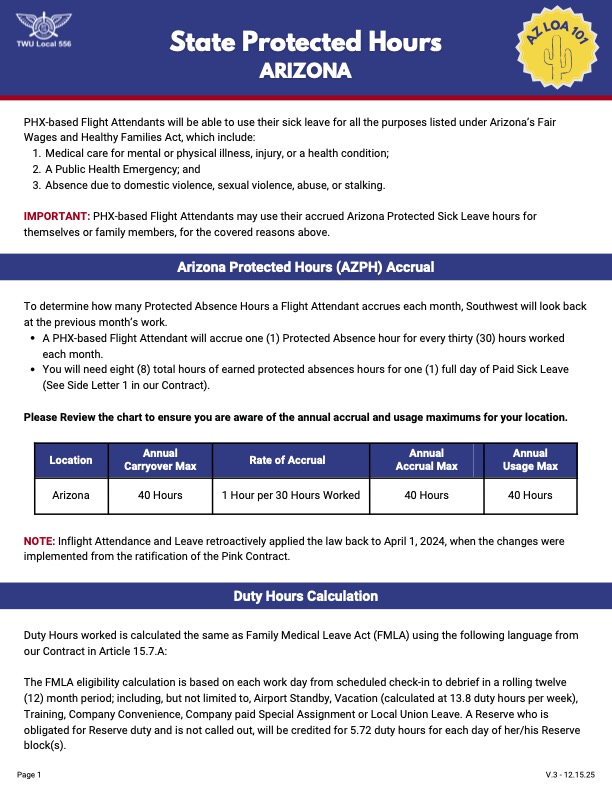
Arizona State Protected Hours (AZPH)
Phoenix-based Flight Attendants can protect sick absences from attendance points using Arizona Protected Hours (AZPH) earned under the Fair Wages and Healthy Families Act. You accrue one protected hour for every 30 hours worked, up to 40 hours annually, and can use AZPH for your own medical needs, public health emergencies, or domestic violence situations—for yourself or qualifying family members. This guide explains how duty hours are calculated, walks you through the Workday submission process, and clarifies that AZPH can be used on PIN blackout dates and during Emergency Sick Leave Procedures. Eight hours of accrued AZPH covers one full day of absence.
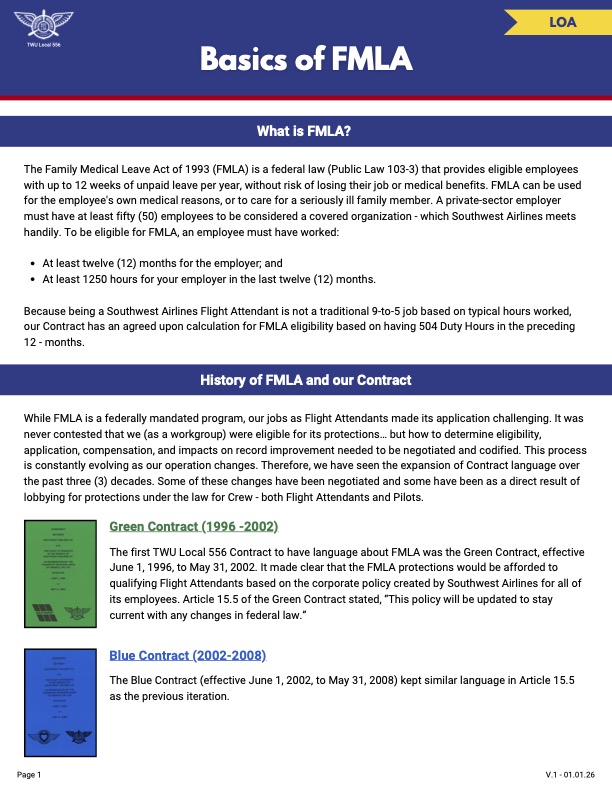
Basics of FMLA
The Family and Medical Leave Act provides eligible Flight Attendants with up to 72 days of job-protected leave per year for serious health conditions—your own or a family member’s. This guide traces the history of FMLA in our Contract from the 1996 Green Contract through the current Pink Contract, explains the difference between Intermittent (INT) and Continuous (CONT) FMLA, and details the critical 2026 change from calendar-year to rolling 12-month FMLA tracking. You’ll learn how to qualify with 504 duty hours, how to apply through Workday, and how INT FMLA protects your eligibility for quarterly record improvement. Whether you’re managing a chronic condition or facing an extended recovery, understanding FMLA is essential.
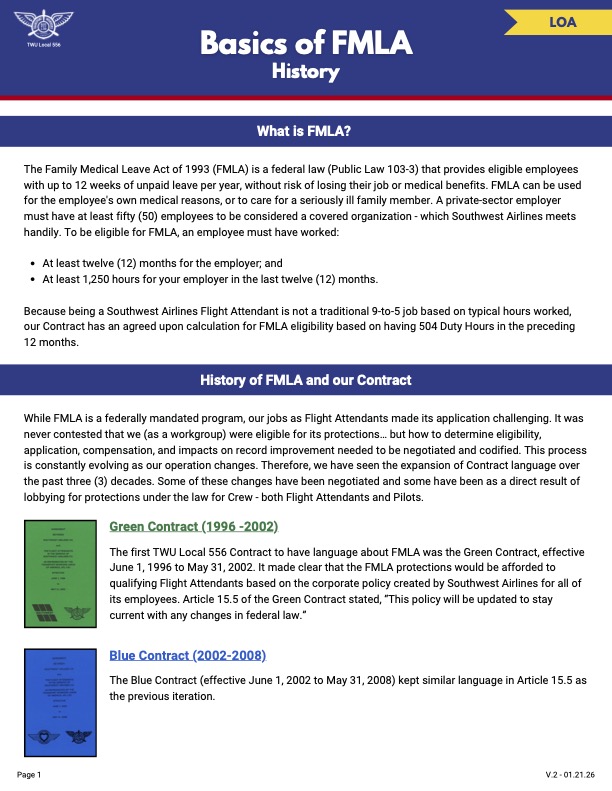
History of FMLA
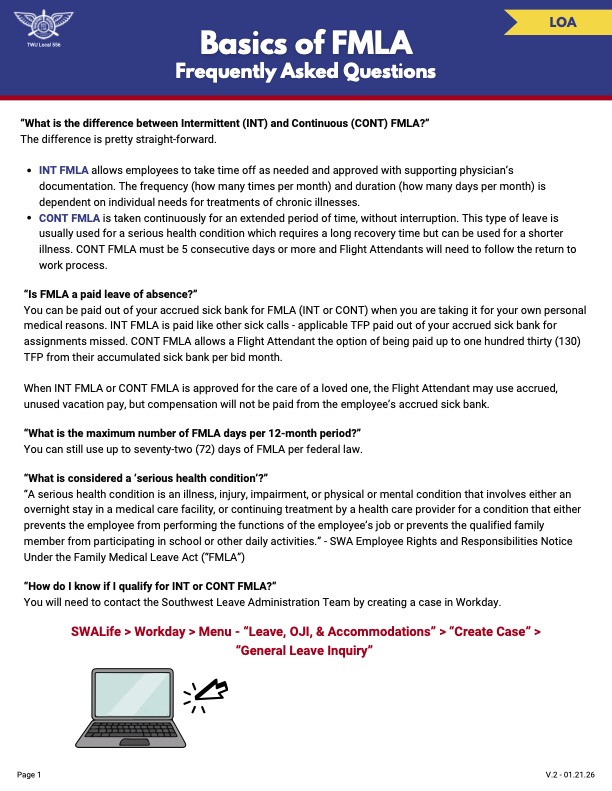
FMLA FAQs
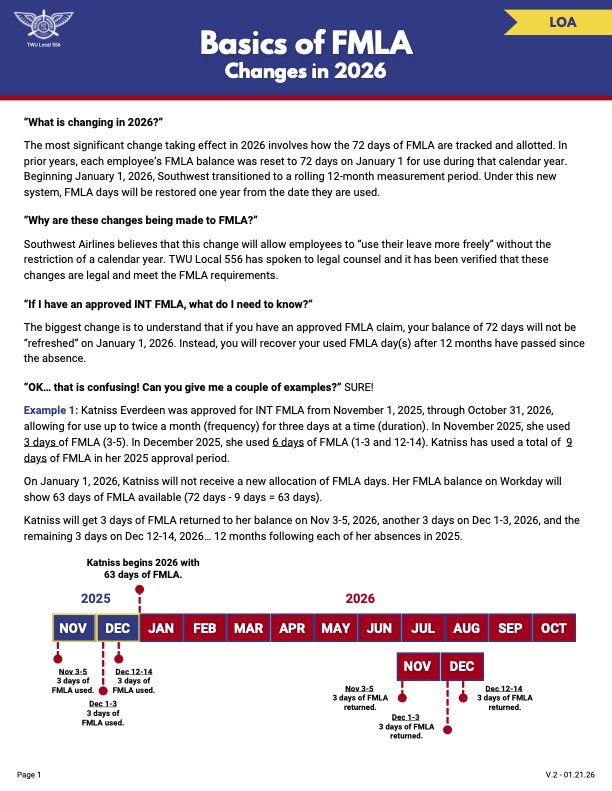
Changes in 2026
Oakland, Los Angeles & California State Protected Hours (OSCK/LSCK)
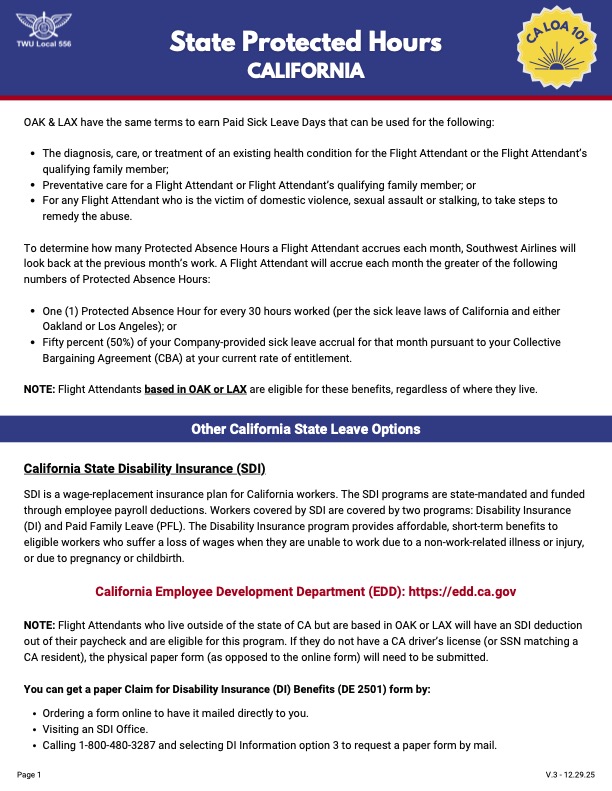
Flight Attendants based in Oakland (OAK) or Los Angeles (LAX) have access to Oakland and/or California Protected Hours for medical care, preventative treatment, or absences related to domestic violence or sexual assault. California also offers additional benefits including State Disability Insurance (SDI), Paid Family Leave (PFL) for bonding with a new child or caring for seriously ill family members, the Family School Partnership Act for school activities, and the right to designate a personal physician for on-the-job injuries. This guide covers accrual methods, submission deadlines, and important notes for Flight Attendants who live outside California but are based in OAK or LAX—you’re still eligible and have SDI deducted from your paycheck.
Colorado State Protected Hours (COPH) & Family Medical Leave Insurance (CFMLI)
Denver-based Flight Attendants benefit from two distinct Colorado programs. Colorado Protected Hours (COPH) provide up to 48 hours annually of attendance-point-protected sick leave for illness, injury, public health closures, or domestic violence situations. Additionally, the Colorado Family and Medical Leave Insurance (FAMLI) program—passed by voters in 2020 and now available to Flight Attendants—provides up to 12 weeks of paid leave per year (16 weeks for pregnancy/childbirth complications) for bonding with a new child, caring for family members, or addressing domestic violence. This guide explains how to use COPH through Workday and how to file CFMLI claims through the state’s FAMLI portal.
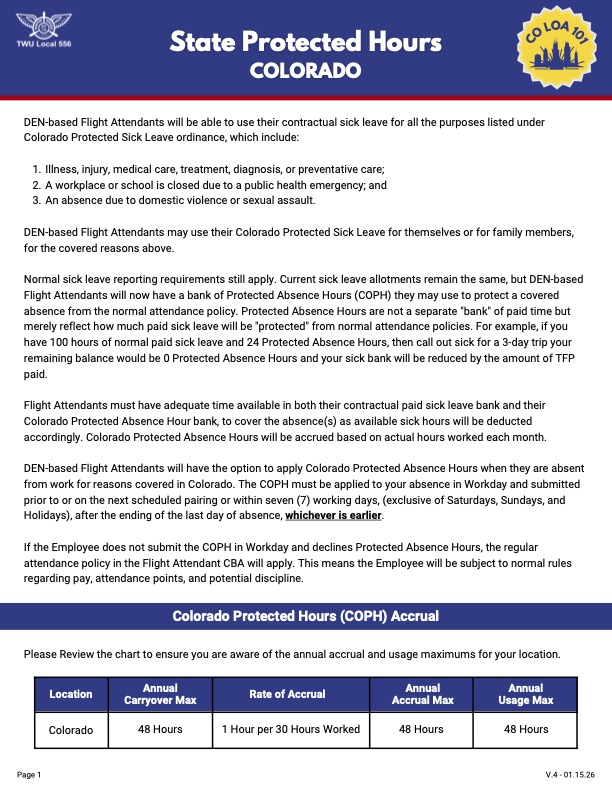
CO LOA 101
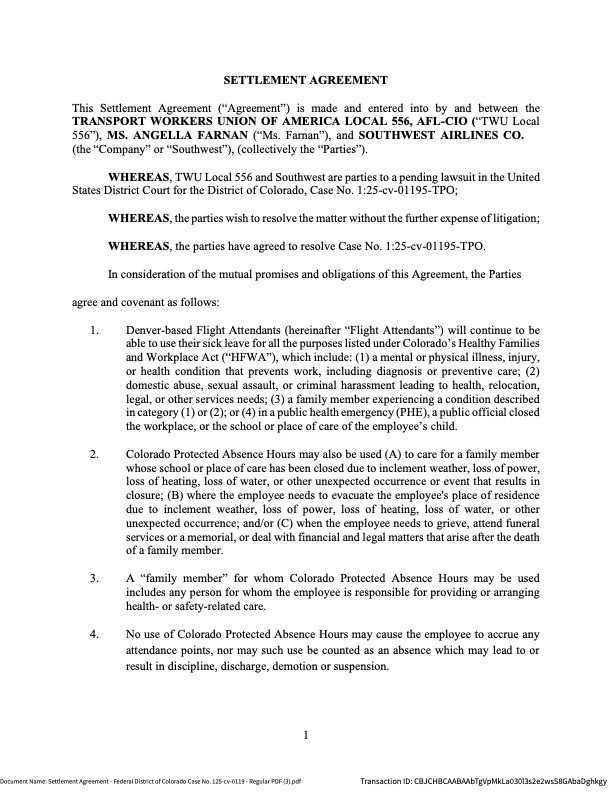
Settlement Agreement
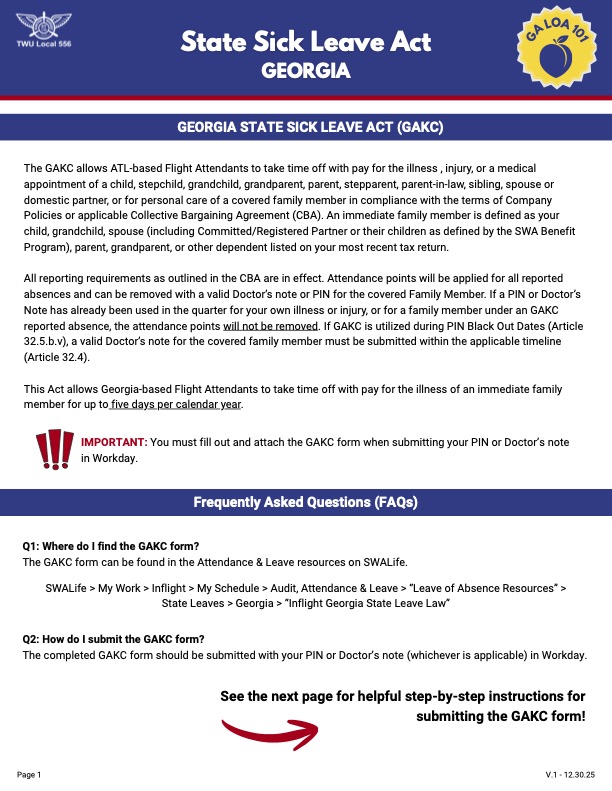
Georgia State Sick Leave Act (GAKC)
Atlanta-based Flight Attendants can use the Georgia State Sick Leave Act (GAKC) to take up to five paid days per calendar year to care for an ill immediate family member—including children, grandchildren, spouses, parents, grandparents, and dependents listed on your tax return. Unlike state protected hours programs, GAKC requires you to submit the GAKC form along with your PIN or Doctor’s note through Workday; attendance points are applied but can be removed with valid documentation. This guide provides the form location on SWALife and step-by-step Workday submission instructions.
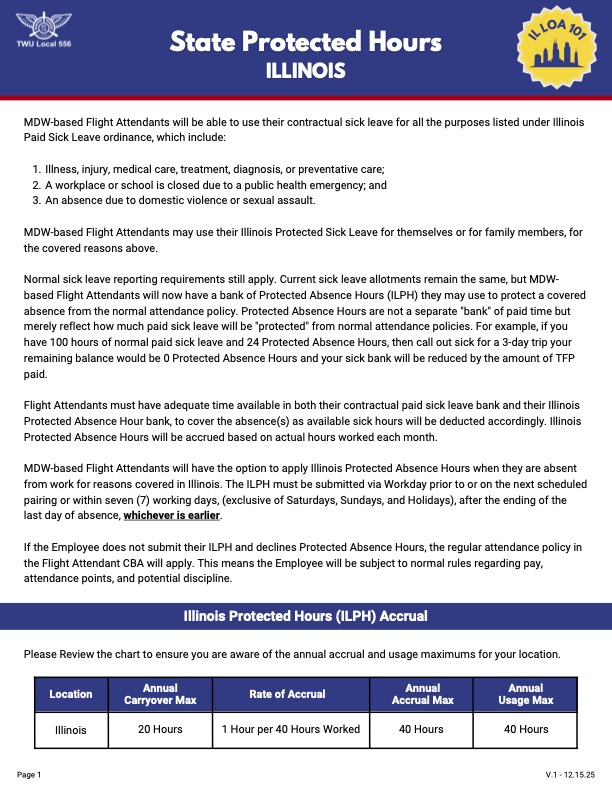
Illinois State Protected Hours (ILPH) & State Sick Leave Act (ILKC)
Chicago-based Flight Attendants have two leave options under Illinois law. Illinois Protected Hours (ILPH) accrue at one hour per 40 hours worked (up to 40 hours annually, with 20 hours carryover) and protect absences from attendance points for illness, public health emergencies, or domestic violence. If you’ve exhausted your ILPH but need to care for a family member, the Illinois State Sick Leave Act (ILKC) allows you to use your sick bank for a family member’s illness, injury, or medical appointment—though you’ll need to submit the ILKC form with a PIN or Doctor’s note to remove attendance points. This guide covers both programs and their distinct submission processes.
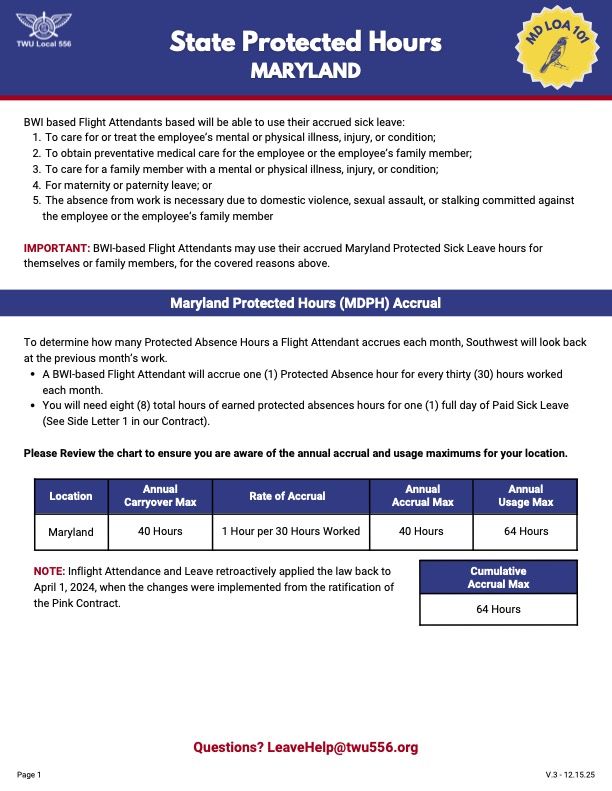
Maryland State Protected Hours (MDPH) & Family Flex Leave Act (MFFLA)
Baltimore-based Flight Attendants can use Maryland Protected Hours under the Healthy Working Families Act for their own medical needs, family care, maternity/paternity leave, or domestic violence situations. MDPH accrues at one hour per 30 hours worked with a 40-hour annual accrual cap and 64-hour usage maximum. Maryland also offers the Family Flex Leave Act (MFFLA), which allows you to use sick bank or vacation pay to care for an ill child, spouse, or parent. This guide explains both programs, including the important distinction that MDPH protects absences from points automatically while MFFLA requires a PIN or Doctor’s note submission to remove points.
Article 15: Leave of Absence
Your Contract guarantees job-protected leave for life’s major events—from welcoming a new child to caring for a sick family member to serving on jury duty. Birth mothers receive 6 weeks paid maternity leave (8 weeks for c-section) at 19.5 TFP per week, and can supplement from their sick bank up to 130 TFP monthly. All parents—birth, adoptive, or legal guardians—get 12 weeks of parental leave with the first 2 weeks paid, followed by up to a year of unpaid extended bonding leave if needed. Medical leave protects your job for up to 4 years with Company approval, and your health insurance continues based on your accrued sick leave plus 120 days. Bereavement provides 4 paid days for immediate family, while emergency family leave covers grave illness situations before a loved one passes. FMLA eligibility requires 504 duty hours in the preceding 12 months—calculated from check-in to debrief, including reserve credit at 5.72 hours per day. None of these protected leaves affect your attendance record improvement or perfect attendance status.
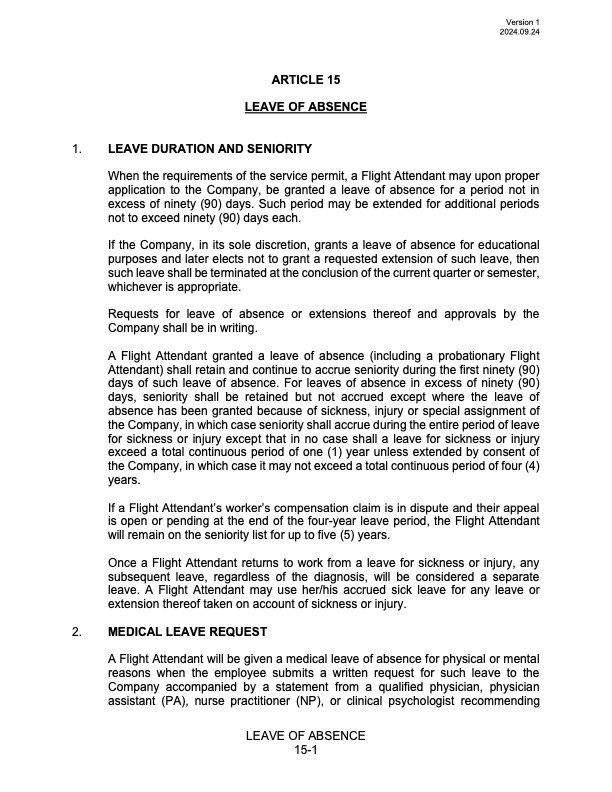
Article 15
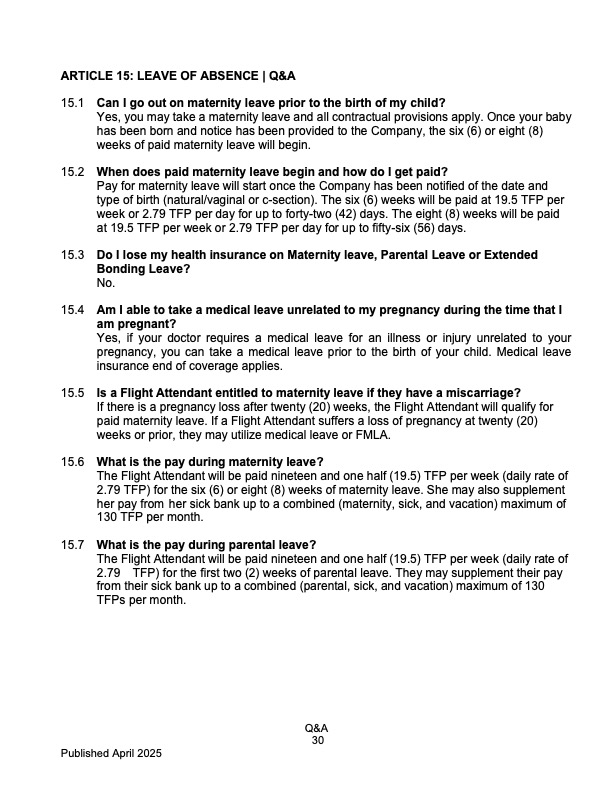
Article 15 – Q & A
Article 32: Attendance Policy
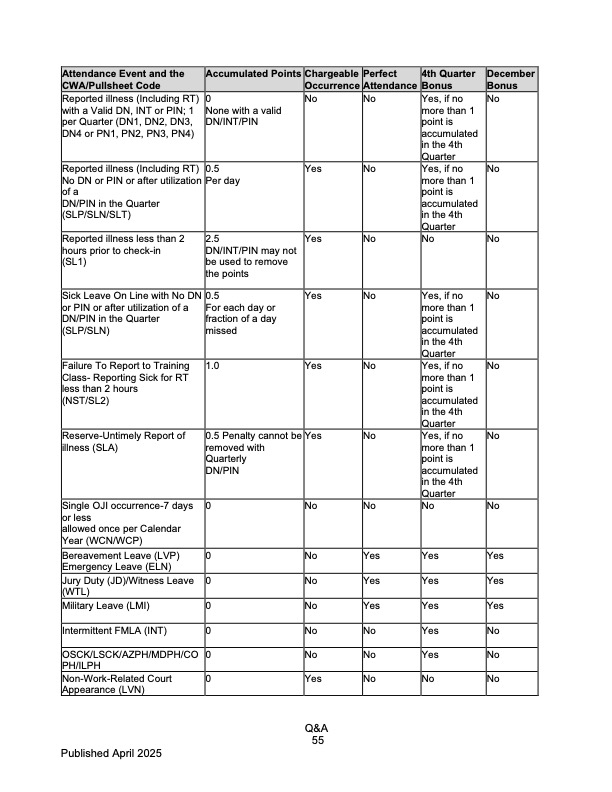
Your Contract’s attendance system runs on a quarterly point structure designed to protect you when you’re sick. Report sick as soon as your illness is known, and at least 2 hours before check-in to avoid the harsh 2.5-point penalty—timing matters. Each quarter you get one non-chargeable sick occurrence: use a doctor’s note (DN) or Personal Illness Note (PIN) to zero out points for that illness. PINs are self-written and cover up to 7 consecutive days, but they can’t be used on blackout dates like major holidays. Without a DN or PIN, you’ll accumulate 0.5 points per sick day up to 2.5 points per continuous illness. The discipline ladder runs from counseling at 5 points to termination at 12. But the Contract also rewards good attendance: earn 2 points off each quarter with no chargeable occurrences, bank up to 7 points as a cushion, and take advantage of the 4th Quarter bonus that can reset you to zero if you end the year at 4 points or less with minimal Q4 accumulation.
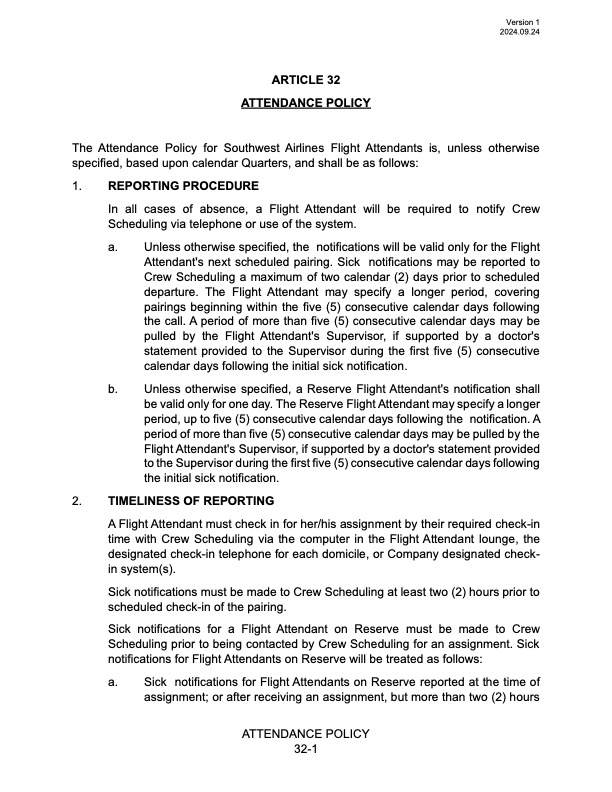
Article 32
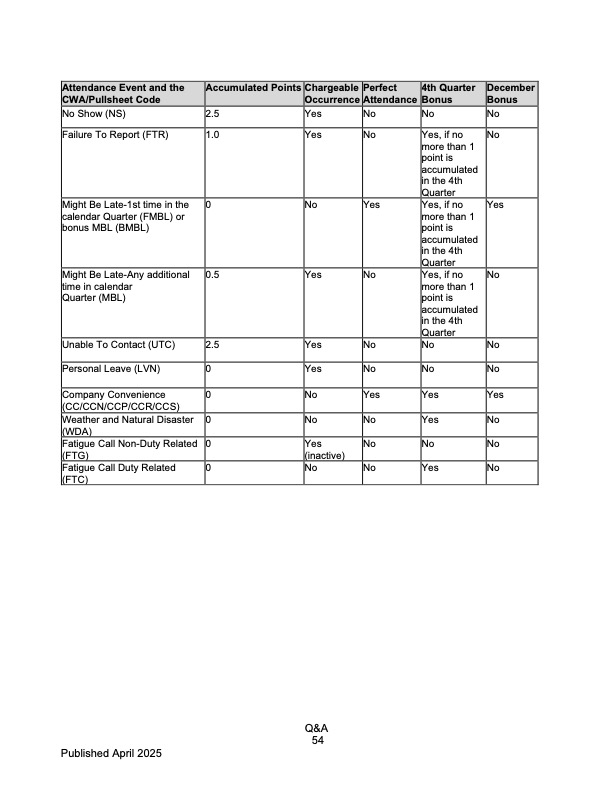
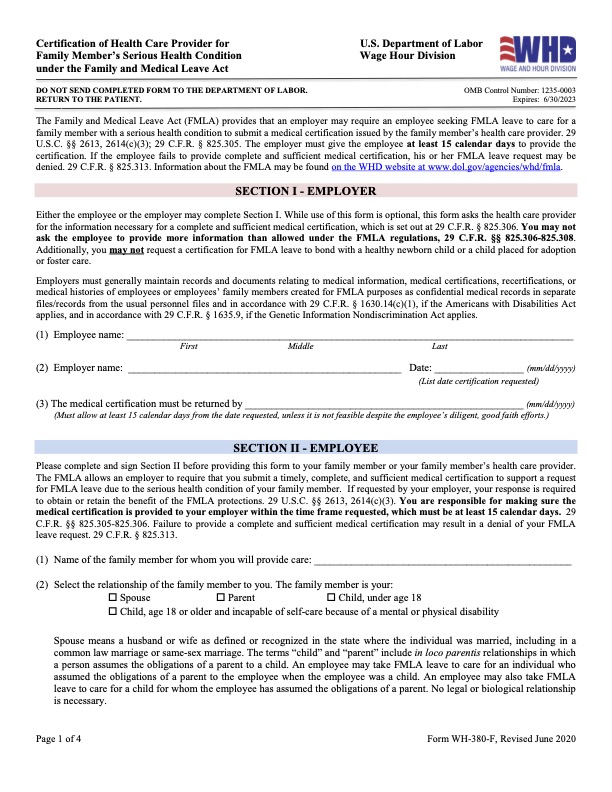
FMLA Medical Certification Forms
When requesting FMLA leave for a serious health condition, you may need to provide medical certification to support your request. The Department of Labor provides two standard forms for this purpose: Form WH-380-E for your own serious health condition, and Form WH-380-F for leave to care for a family member’s serious health condition. Your health care provider completes the medical sections of these forms. Southwest must give you at least 15 calendar days to return the completed certification. Download the appropriate form based on your leave situation.
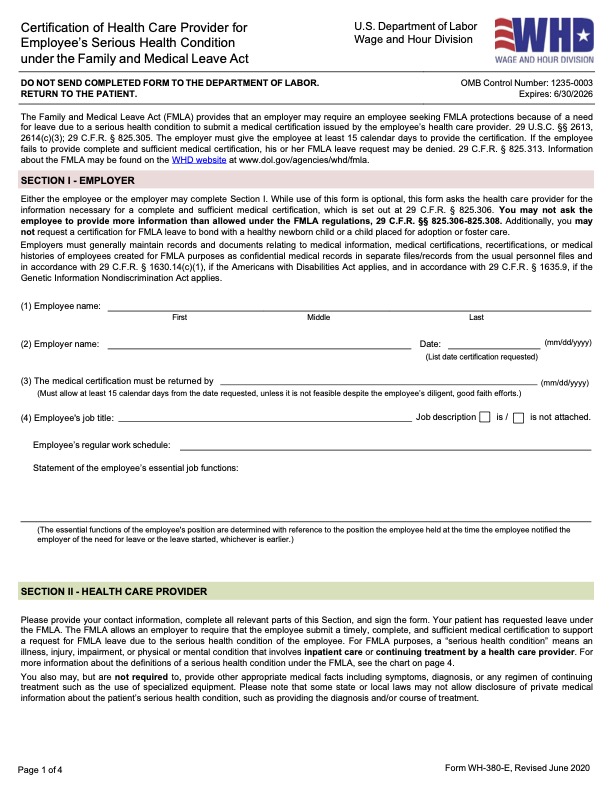
DOL Form – Own Health Condition